Nanoscientists Create Biological Switch from Spinach Molecule
September 5, 2006
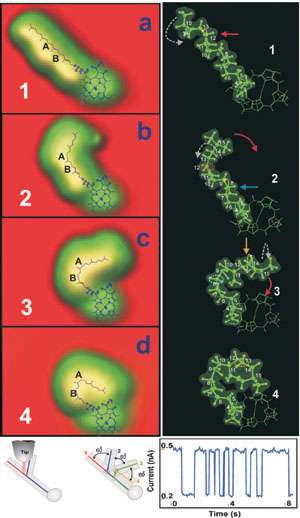
Scientists used a scanning tunneling microscope to manipulate chlorophyll-a into four positions. Art by: Saw-Wai Hla
Nanoscientists have transformed a molecule of chlorophyll-a from spinach into a complex biological switch that has possible future applications for green energy, technology and medicine.
The study offers the first detailed image of chloropyhll-a – the main ingredient in the photosynthesis process – and shows how scientists can use new technology to manipulate the configuration of the spinach molecule in four different arrangements, report Ohio University physicists Saw-Wai Hla and Violeta Iancu in today’s early edition of the journal Proceedings of the National Academy of Sciences.
The scientists used a scanning tunneling microscope to image chlorophyll-a and then injected it with a single electron to manipulate the molecule into four positions, ranging from straight to curved, at varying speeds. (View a movie here) Though the Ohio University team and others have created two-step molecule switches using scanning tunneling microscope manipulation in the past, the new experiment yields a more complex multi-step switch on the largest organic molecule to date.
The work has immediate implications for basic science research, as the configuration of molecules and proteins impacts biological functions. The study also suggests a novel route for creating nanoscale logic circuits or mechanical switches for future medical, computer technology or green energy applications, said Hla, an associate professor of physics.
“It’s important to understand something about the chlorophyll-a molecule for origin of life and solar energy conversion issues,” he said.
Source: Ohio University
-
Astrobiologists discover 'sweet spots' for the formation of complex organic molecules in the galaxy
Nov 02, 2011 |
5 / 5 (6) |
1
-
Research involving thyroid hormone lays foundation for more targeted drug development
Oct 21, 2011 |
4.5 / 5 (2) |
0
-
Tuberculosis bacterium's outer cell wall disarms the body's defense to remain infectious
Oct 03, 2011 |
5 / 5 (3) |
0
-
Faster diagnostics through cheap, ultra-portable blood testing
Sep 01, 2011 |
not rated yet |
0
-
One electron could be key to furture drugs that repair sunburn
Jul 25, 2011 |
4.9 / 5 (9) |
2
-
Engineers build first sub-10-nm carbon nanotube transistor
Feb 01, 2012 |
4.9 / 5 (30) |
30
-
Something old, something new: Evolution and the structural divergence of duplicate genes
Jan 31, 2012 |
4.6 / 5 (7) |
1
-
The hidden nanoworld of ice crystals: Revealing the dynamic behavior of quasi-liquid layers
Jan 30, 2012 |
5 / 5 (3) |
1
-
Stock market network reveals investor clustering
Jan 27, 2012 |
3.9 / 5 (23) |
8
-
Of microchemistry and molecules: Electronic microfluidic device synthesizes biocompatible probes
Jan 26, 2012 |
5 / 5 (1) |
0
-
Pertubance in a model
5 hours ago
-
Cancer drugs and Alzheimer's, Oh my!
13 hours ago
-
Squishing cells
13 hours ago
-
Any books/articles for evolutionary stable strategy models in humans?
Feb 09, 2012
-
Science behind the bore feeling?
Feb 09, 2012
-
Homo Sapien vs. Chimpanzee - Divergence Timeline
Feb 09, 2012
- More from Physics Forums - Biology
More news stories
What lies beneath: Mapping hidden nanostructures
The ability to diagnose and predict the properties of materials is vital, particularly in the expanding field of nanotechnology. Electron and atom-probe microscopy can categorize atoms in thin sheets of material, ...
2 hours ago |
5 / 5 (1) |
1
'Dark plasmons' transmit energy
Microscopic channels of gold nanoparticles have the ability to transmit electromagnetic energy that starts as light and propagates via "dark plasmons," according to researchers at Rice University.
19 hours ago |
5 / 5 (6) |
1
|
Nanotube therapy takes aim at breast cancer stem cells
Wake Forest Baptist Medical Center researchers have again proven that injecting multiwalled carbon nanotubes (MWCNTs) into tumors and heating them with a quick, 30-second laser treatment can kill them.
Nanotechnology / Bio & Medicine
Feb 09, 2012 |
5 / 5 (1) |
0
|
New kind of solar cell could capture significantly more energy than current cells
New solar cells could increase the maximum efficiency of solar panels by over 25%, according to scientists from the University of Cambridge.
Feb 08, 2012 |
4.5 / 5 (11) |
14
|
Nanoshell whispering galleries improve thin solar panels
Visitors to Statuary Hall in the U.S. Capitol Building may have experienced a curious acoustic feature that allows a person to whisper softly at one side of the cavernous, half-domed room and for another on ...
Nanotechnology / Nanomaterials
Feb 07, 2012 |
4.3 / 5 (6) |
6
|
New understanding of DNA repair could eventually lead to cancer therapy
A research group in the Faculty of Medicine & Dentistry at the University of Alberta is hoping its latest discovery could one day be used to develop new therapies that target certain types of cancers.
Zuckerberg's focus drives Facebook's ascent
When Mark Zuckerberg showed up to rent Judy Fusco's Los Altos, Calif., house in the fall of 2004, soon after he'd arrived in Silicon Valley, the landlord was immediately struck by his confidence.
Both maternal and paternal age linked to autism
Older maternal and paternal age are jointly associated with having a child with autism, according to a recently published study led by researchers at The University of Texas Health Science Center at Houston (UTHealth).
Night, weekend delivery OK for babies with birth defects
Weekday delivery is no better than night or weekend delivery for infants with birth defects, according to a new study presented today at The Pregnancy Meeting, the Society for Maternal-Fetal Medicine's annual conference. ...
Sonic Cradle lands spot in TED exhibition
A Simon Fraser University graduate student project that melds music, meditation and modern technology has landed a rare spot as an exhibit at TEDActive 2012 in Palm Springs, California this month.
Drug halts organ damage in inflammatory genetic disorder
A new study shows that Kineret (anakinra), a medication approved for the treatment of rheumatoid arthritis, is effective in stopping the progression of organ damage in people with neonatal-onset multisystem inflammatory disease ...