Cracking the real Da Vinci Code -- what happens in the artist's brain?
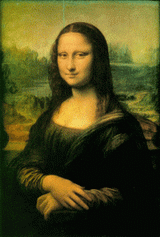
The brain of the artist is one of the most exciting workplaces, and now an art historian at the University of East Anglia has joined forces with a leading neuroscientist to unravel its complexities.
Creating a brand new academic discipline – neuroarthistory – Prof John Onians uses the results from new scanning techniques to answer questions such as:
-- What happens in the brain of the modern artist as he or she works?
-- What happened in the brain of an artistic genius like Leonardo Da Vinci?
-- How do the brains of amateur and professional artists differ?
-- Why do artists in certain times or places have certain visual tastes?
The new research will be presented at the BA Festival of Science in Norwich on Wednesday September 6.
Prof Onians, of UEA's School of World Art Studies, said: "Until now we had no way of knowing what went on inside the artist's brain – although Leonardo tried, using anatomy and observation. But now we are finally unlocking the door to this secret world.
"We can also use neuroarthistory much more widely, both to better understand the nature of familiar artistic phenomena such as style, and to crack so far intractable problems such as 'what is the origin of art?'"
There are many areas in which neuroarthistory puts the study of art on a more informed foundation. None is more striking than the first appearance of art in the Cave of Chauvet 32,000 years ago. No approach other than neuroarthistory can explain why this, the first art, is also the most naturalistic, capturing the mental and physical resources of bears and lions as if on a wildlife film.
Neuroarthistory can also explain why Florentine painters made more use of line and Venetian painters more of colour. The reason is that 'neural plasticity' ensured that passive exposure to different natural and manmade environments caused the formation of different visual preferences.
Similarly, the new discipline reveals that European artists such as Leonardo stood before vertical canvases while Chinese artists sat before flat sheets of silk or paper because 'mirror neurons' collectively affect artists' deportments.
"The most interesting aspect of neuroarthistory is the way it enables us to get inside the minds of people who either could not or did not write about their work," said Prof Onions. "We can understand much about the visual and motor preferences of people separated from us by thousands of miles or thousands of years."
Working alongside Prof Semir Zeki FRS of University College London, one of the leading neuroscientists in the field of the visual brain and the founder of neuroesthetics, Prof Onians will now apply his findings to a series of case studies, from prehistory to the present, in a book entitled Neuroarthistory. If the approach is successful this will be the foundation stone of a new discipline.
Source: University of East Anglia


