MIT team describes unique desert cloud forest
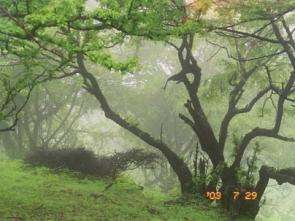
September 6th, 2006 A desert cloud forest in Oman. Photo courtesy / Elfatih Eltahir

A desert cloud forest in Oman. Photo courtesy / Elfatih Eltahir

Trees that live in an odd desert forest in Oman have found an unusual way to water themselves by extracting moisture from low-lying clouds, MIT scientists report.

In an area that is characterized mostly by desert, the trees have preserved an ecological niche because they exploit a wispy-thin source of water that only occurs seasonally, said Elfatih A.B. Eltahir, professor of civil and environmental engineering, and former MIT graduate student Anke Hildebrandt.

After studying the Oman site, they also expressed concern that the unusual forest could be driven into extinction if hungry camels continue eating too much of the foliage. As the greenery disappears it's possible the trees will lose the ability to pull water from the mist and recharge underground reservoirs.

A report on their research was published in a recent issue of Geophysical Research Letters. They are also advising the Omani government on handling the problem.

The forest is especially unique, said Eltahir and Hildebrandt, because it "is a water-limited seasonal cloud forest" that is kept alive by water droplets gathered from passing clouds -- ground fog. The water dribbles into the ground and sustains the trees later when the weather is dry. The MIT work suggests the trees actually get more of their water through contact with clouds than via rainfall.

In general, cloud forests are not really rare. But they occur most frequently in moist tropical regions where there is ample rainfall. So it is unusual, the researchers said, to find a cloud forest in a region known for chronic dryness.

The researchers studied the area in Oman to learn how the Dhofar Mountain ecosystem "functions naturally, and how it may respond to human activity" that could lead to desertification and the need for reforestation.

Eltahir and Hildebrandt, who is now at the UFZ Center for Environmental Research, in Leipzig, Germany, said the unusual forest is an interesting remnant "of a moist vegetation belt that once spread across the Arabian Peninsula" in the distant past. At that time the regional climate was generally wetter.

The forested area in the Sultanate of Oman is now semi-arid, and most of the ancient tree vegetation is gone. This small remnant has managed to survive in the Dhofar Mountains.

But it is under threat.

Although many Omanis have moved into cities and towns as the country has grown rich on oil, Eltahir explained, a family's prestige still comes from owning many camels, and people now tend to keep more camels than they need, which is part of the problem facing the forest.

"It is an unusual place," Eltahir said. "It's a very good example of a unique and fragile ecosystem" where constant pressure from over-grazing can have consequences beyond defoliation. In fact, the forest illustrates how small changes can lead to major impact on far bigger systems, Eltahir said.

The trees in wetter ecosystems would likely recover from small amounts of over-grazing, Eltahir said, but "in this location, due to the nature of the interaction of the canopy structure with the clouds, the trees may not recover."

The two said the forest probably would not regenerate naturally once it is gone. Without the trees that sweep the extra water from clouds, the forest cannot regrow. Grass, even if abundant, cannot collect enough moisture from fog to let a forest regrow.

Source: MIT


print this article email this article download pdf blog this article bookmark this article     Digg this Stumble it share on Facebook share on Reddit add to delicious save to Yahoo! bookmarks
4.6/5 after 27 votes


September 6th, 2006 all stories
Space & Earth / Earth Sciences

Comments: 0
Rank: 4.6/5 after 27 votes

  • Stumble this up

  • Digg this

  • Share it:
  • share on Facebook
  • share on MySpace
  • share on Slashdot
  • rss-newsfeed
  • share on Google
  • share on Reddit
  • add to delicious
  • save to Yahoo! bookmarks
  • share on Windows Live
  • Add to Mixx!
Rating: 4.6/5 after 27 votes

  • Related Stories

  • 'Lab on a chip' to measure water stress in plants
    created Jul 07, 2009 | popularity not rated yet | comments 0
  • Ferns took to the trees and thrived
    created Jul 02, 2009 | popularity not rated yet | comments 0
  • Major study links malaria mosquitoes to Amazon deforestation
    created Jun 26, 2009 | popularity not rated yet | comments 0
  • Rubber plantations could have 'devastating' impact in Asia
    created May 21, 2009 | popularity not rated yet | comments 0
  • Research finds mangroves being fed to death
    created May 19, 2009 | popularity not rated yet | comments 0

Tags


  • Transform a ball into a rock -- or make it invisible -- using transformation optics
    Transform a ball into a rock -- or make it invisible -- using transformation optics
    Physics / General Physics
    created 10 hours ago | popularity 3 / 5 (2) | comments 0
  • Could a quantum motor do work?
    Physics / General Physics
    created Jul 07, 2009 | popularity 4 / 5 (12) | comments 0
  • Physicists Demonstrate Quantum Memory with Matter Qubits
    Physicists Demonstrate Quantum Memory with Matter Qubits
    Physics / General Physics
    created Jul 03, 2009 | popularity 4.5 / 5 (20) | comments 1
  • 'Holey' Nanosheets for Wastewater Dye Removal
    Nanotechnology / Nanomaterials
    created Jul 01, 2009 | popularity 5 / 5 (5) | comments 1
  • Jellyfish Robot Swims Like its Biological Counterpart
    Jellyfish Robot Swims Like its Biological Counterpart
    Electronics / Robotics
    created Jun 26, 2009 | popularity 4.4 / 5 (9) | comments 1
  • Other News

    Living fossils hold record of 'supermassive' kick

    Living fossils hold record of 'supermassive' kick

    Space & Earth / Astronomy

    created 2 hours ago | popularity 4.5 / 5 (2) | comments 1

    The tight cluster of stars surrounding a supermassive black hole after it has been violently kicked out of a galaxy represents a new kind of astronomical object and a fossil record of the kick.


    Methane-eating microbes can use iron and manganese oxides to 'breathe'

    Methane-eating microbes can use iron and manganese oxides to 'breathe'

    Space & Earth / Earth Sciences

    created 5 hours ago | popularity 4.7 / 5 (3) | comments 0

    Iron and manganese compounds, in addition to sulfate, may play an important role in converting methane to carbon dioxide and eventually carbonates in the Earth's oceans, according to a team of researchers ...


    Tremors on southern San Andreas Fault may mean increased quake risk

    Tremors on southern San Andreas Fault may mean increased quake risk

    Space & Earth / Earth Sciences

    created 4 hours ago | popularity not rated yet | comments 0

    (PhysOrg.com) -- Increases in mysterious underground tremors observed in several active earthquake fault zones around the world could signal a build-up of stress at locked segments of the faults and presumably ...


    A Galaxy Collision in Action

    A Galaxy Collision in Action

    Space & Earth / Astronomy

    created 4 hours ago | popularity 4.8 / 5 (4) | comments 1

    This beautiful image gives a new look at Stephan's Quintet, a compact group of galaxies discovered about 130 years ago and located about 280 million light years from Earth. The curved, light blue ridge running ...


    NASA sails through countdown, weather outlook poor (AP)

    NASA sails through countdown, weather outlook poor

    Space & Earth / Space Exploration

    created 2 hours ago | popularity not rated yet | comments 0

    (AP) -- NASA is sailing through the countdown for Saturday's launch of space shuttle Endeavour, with weather the lone concern.