September 7, 2006 feature
Future space devices inspired by spider legs
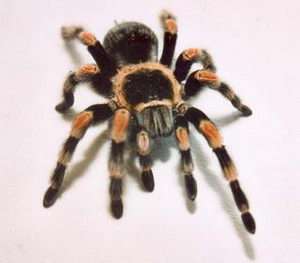
Are spiders ideal space travelers? Not quite, but according to a new study, their legs may be. Scientists Carlo Menon and Cristian Lira have designed and built lightweight, bendable joints based on the micro-hydraulic joint system of spider legs. The duo’s inflatable “Smart Stick” must overcome many of the harsh conditions of space, such as temperature range, pressure and atmospheric composition.
In a recent issue of Bioinspiration and Biomimetics, Menon and Lira explain how most animals use muscles to bend their joints, but spiders don’t possess such extensors. Instead, these boneless arachnids have legs that are attached to the prosoma, or the main body, which pumps out fluid into the legs by contracting and expanding. Although spiders don’t have veins or even true blood, a pressurized liquid called haemolymph fills the open spaces throughout a spider’s body.
"Our research approach is to find inspiration from nature to conceive new space engineering systems," Menon told PhysOrg.com. "We realized that the characteristics of spiders' hydraulic systems fit the need of great miniaturization and high force/mass ration required by space actuators."
The scientists’ Smart Stick, at 1 mm in diameter, is only slightly larger than a real spider’s leg. With one joint, the stick can bend about 1.8 degrees, and the scientists have developed a simple, modular system that enables the connection of several elastic joints for further bending. Each module consists of an inflatable elastic actuator that separates different segments, and a tube runs between each joint. To bend the Smart Stick, water in the tube is pressurized, causing the elastic actuators to fill with water and push the segments apart (see figure). Sensors measure the pressure and then provide feedback to the control unit, where more or less water is pressurized.
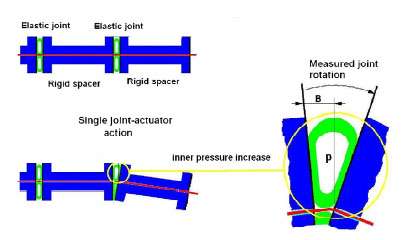
“Space applications require structures, mechanisms and systems that are able to fulfill challenging tasks, while keeping their volumes and masses to a minimum,” wrote the scientists, emphasizing the importance of gossamer structures in the space field. “By folding and deforming the mini-tube, mechanical connectors are avoided, making the system simple, reliable and light.”
Besides consisting of light materials, inflatable mechanisms must also confront high-energy particles, charged particles, and solar and space radiation when traveling beyond earth. In this premier run, Menon and Lira developed Smart Stick for Earth conditions, and predict that Smart Stick’s future will depend on using more flexible materials and incorporating a closed fluid loop in the system. A closed loop would increase the hydraulic pressure as well as overcome challenges such as leakage and outgassing required for space travel.
"Lightweight joints could potentially be integrated in several space mechanisms," Menon said. "For example, they could be implemented in miniaturized robotic systems of sample distributed units, in miniaturized grippers, or embedded in foldable/deployable systems."
Even if it takes a bit more time for Smart Stick to encounter space, the scientists already have ideas for terrestrial uses for the fluid actuator component of Smart Stick. Lira is also investigating a wearable, elastic textile called “variable structure fabric” that comfortably improves people’s posture, which is especially useful when working conditions call for long periods of standing or sitting.
"The actuators in 'Variable Structure Fabric (VSF)' involve a new conceptual design of miniaturized fluidic actuators, which are then inserted in cloth items," explains Lira's Web page (VSFproject.com). "Uses for it [include] upholstery, technical clothing, underwear, and vehicle interior linings (based on Smart Stick)."
Citation: Menon, C. and Lira C. “Active articulation for future space applications inspired by the hydraulic system of spiders.” Bioinspiration and Biomimetics. 1 (2006) 52-61.
By Lisa Zyga, Copyright 2006 PhysOrg.com


