ESA steps towards a great black hole census
September 7, 2006
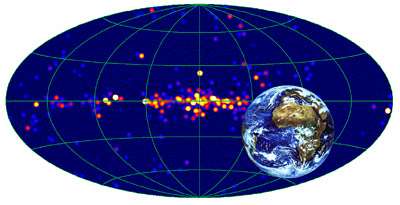
This all-sky image was obtained by ESA's Integral gamma-ray observatory during four years of operations and provides an important step towards estimating how many black holes there are in the Universe. The sources in this image were artificially blurred and the colour map was stretched to make both strong and weak sources readily visible. The concentration of sources along the mid plane of the image is due to neutron stars and stellar mass black holes in our Galaxy, while the majority of sources located far away from the Galactic plane are super-massive black holes in other galaxies. The Cosmic X-ray Background is composed from the emission of tens of millions of similar objects much further away from us. Superposed is an Earth image by ESA/EUMETSAT’s Meteosat satellite. Using the Earth as a shield to block the emission from the population of distant black holes astronomers precisely gauged the X-ray and gamma-ray background. An angular size of the Earth as seen from Integral during actual observations was smaller than shown in the image. Credits: ESA/IKI Integral team
Astronomers using ESA's orbiting gamma-ray observatory, Integral, have taken an important step towards estimating how many black holes there are in the Universe.
An international team, lead by Eugene Churazov and Rashid Sunyaev, Space Research Institute, Moscow, and involving scientists from all groups of the Integral consortium used the Earth as a giant shield to watch the number of tell-tale gamma rays from the distant Universe dwindle to zero, as our planet blocked their view.
"Point Integral anywhere in space and it will measure gamma rays," says Pietro Ubertini, INAF, Italy and Principal Investigator on Integral's gamma-ray imager. Most of those gamma rays do not come from nearby sources but from celestial objects so far away that they cannot yet be distinguished as individual sources. This distant gamma-ray emission creates a perpetual glow that bathes the Universe.
Most astronomers believe that the unseen objects are supermassive black holes, millions or billions of times heavier than the Sun and each sitting at the centre of a galaxy. As the black holes swallow matter, the swirling gases release X-rays and gamma rays. Accurately measuring the glow, known as the X-ray and gamma-ray background, is the first step towards calculating how many black holes are contributing to it and how far away in the Universe they are located.
The new Integral observations were made during January and February 2006 and provide highly accurate data on the gamma-ray background. The key to success was using the Earth as a shield.
Allowing the Earth to enter Integral's field of view goes against the standard set of nominal observations for the satellite, because the optical devices needed to determine the spacecraft's attitude would be blinded by the bright Earth. So, this operation required remarkable efforts from the ISOC/MOC teams operating the mission, who had to rely on alternative spacecraft control mechanisms. But the risk was worth it: by measuring the decrease of the gamma-ray flux once the Earth had blocked Integral's view and by making a model of the Earth's atmospheric emission, the astronomers precisely gauged the gamma-ray background.
Another bonus of the Integral observations is that the observatory's complementary instruments allowed the strength of both X-rays and gamma rays to be measured simultaneously. In the past, different satellites have had to measure the different energies of X-rays and gamma rays, leaving astronomers with the task of having to piece the results together like the pieces of a jigsaw puzzle.
It is not just the overall glow that Integral has seen. Before the satellite's launch, only a few dozen celestial objects were observed in gamma rays. Now Integral sees about 300 individual sources in our Galaxy and around 100 of the brightest supermassive black holes in other galaxies. These are the tip of the iceberg. Astronomers believe there are tens of millions of active black holes spread throughout space, all contributing to the gamma-ray background. From earlier observations in the softer X-ray band it is known that the soft background radiation is almost entirely populated by Active Galactic Nuclei (AGN). So it is highly likely that these objects are also responsible here at higher Integral energies, even if this is not proven yet.
The next step is for astronomers to programme computer models to calculate how the emission from this unseen population of black holes merges to give the observed glow. These computer models will predict the number and distance of the black holes, and provide insights into the way they behave at the centre of young, middle-aged and old galaxies. Meanwhile, the Integral team will continue to refine their measurements of the perplexing gamma-ray background.
Source: European Space Agency
-
Engineers build first sub-10-nm carbon nanotube transistor
Feb 01, 2012 |
4.9 / 5 (31) |
30
-
Something old, something new: Evolution and the structural divergence of duplicate genes
Jan 31, 2012 |
4.6 / 5 (7) |
1
-
The hidden nanoworld of ice crystals: Revealing the dynamic behavior of quasi-liquid layers
Jan 30, 2012 |
5 / 5 (3) |
1
-
Stock market network reveals investor clustering
Jan 27, 2012 |
3.9 / 5 (23) |
8
-
Of microchemistry and molecules: Electronic microfluidic device synthesizes biocompatible probes
Jan 26, 2012 |
5 / 5 (1) |
0
-
Neutron Star fragments?
2 hours ago
-
stationary or not?
6 hours ago
-
Scale of the Universe
Feb 10, 2012
-
Titan's lack of impact craters
Feb 09, 2012
-
Real pictures of black hole eating a star?
Feb 08, 2012
-
Hypothetical way to travel faster than light, but not technically exceed lightspeed
Feb 06, 2012
- More from Physics Forums - General Astronomy
More news stories
Europe stakes billion-dollar bet on new rocket
A pencil-slim rocket is scheduled to lift into space from South America on Monday, carrying a billion-dollar bet that Europe can grab a juicy slice of the market to place satellites in low orbit.
Space & Earth / Space Exploration
13 hours ago |
3.5 / 5 (2) |
0
Political leaders play key role in how worried Americans are by climate change: study
More than extreme weather events and the work of scientists, it is national political leaders who influence how much Americans worry about the threat of climate change, new research finds.
Feb 06, 2012 |
5 / 5 (6) |
72
NASA budget will axe Mars deal with Europe: scientists
US President Barack Obama's budget proposal to be submitted next week for 2013 will cut NASA's budget by 20 percent and eliminate a major partnership with Europe on Mars exploration, scientists said Thursday.
Space & Earth / Space Exploration
Feb 10, 2012 |
5 / 5 (3) |
47
Humans may have helped the decline of African rainforests 3000 years ago
(PhysOrg.com) -- Large areas of rainforests in Central Africa mysteriously disappeared over three thousand years ago, to be replaced by savannas. The prevailing theory has been that the cause was a change ...
Could Venus be shifting gear?
(PhysOrg.com) -- ESAs Venus Express spacecraft has discovered that our cloud-covered neighbour spins a little slower than previously measured. Peering through the dense atmosphere in the infrared, the ...
Space & Earth / Space Exploration
Feb 10, 2012 |
5 / 5 (8) |
10
|
Walney offshore wind farm is world's biggest (for now)
(PhysOrg.com) -- The Walney wind farm on the Irish Sea--characterized by high tides, waves and windy weather--officially opened this week. The farm is treated in the press as a very big deal as the Walney ...
GPS court ruling leaves US phone tracking unclear
A US Supreme Court decision requiring a warrant to place a GPS device on the car of a criminal suspect leaves unresolved the bigger issue of police tracking using mobile phones, legal experts say.
Europeans protest controversial Internet pact
Tens of thousands of people marched in protests in more than a dozen European cities Saturday against a controversial anti-online piracy pact that critics say could curtail Internet freedom.
Study finds that anti-diabetic medication can prevent the long-term effects of maternal obesity
In a study to be presented today at the Society for Maternal-Fetal Medicine's annual meeting, The Pregnancy Meeting, in Dallas, Texas, researchers will report findings that show that short therapy with the anti-diabetic medication ...
Netflix settlement trims 14 pct off 4Q earnings
(AP) -- Netflix pressed the rewind button on its fourth-quarter earnings after settling allegations that the video subscription service violated a consumer-privacy law.
Steroid injections prove effective in treatment of lumbar disc herniations
The use of epidural steroid injections may be a more efficient treatment option for lumbar disc herniations, according to research presented today at the American Orthopaedic Society for Sports Medicine's Specialty Day in ...