New computer model concept could solve big, real-world problems on a small, porous scale
September 7, 2006 New computer model concept could solve big, real-world problems on a small, porous scale

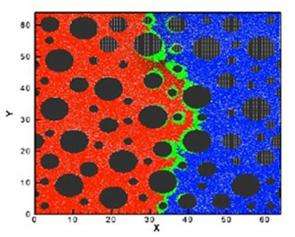
A computer simulation of various minerals and chemicals meeting and reacting. The black circles represent grains of the porous medium, such as sand, and the red and blue represent the fluid phase, with red being dissolved calcium and blue being dissolved carbonate. The green part represents areas where the mineral calcium carbonate has formed by reaction of the red and green dissolved chemicals. Pore-scale modeling such as this, when coupled with other simulation scales, helps researchers make more accurate predictions of the movement and fate of contaminants in groundwater. Pacific Northwest National Laboratory and its collaborators will work to develop a robust computer model that will join different models at multiple scales into a single hybrid model for enhanced predictability.

The Department of Energy’s Pacific Northwest National Laboratory today was awarded a Scientific Discovery through Advanced Computing, or SciDAC, grant to develop a computer model that can simulate biogeochemical processes on multiple scales. This computational advancement would enable researchers to make more accurate predictions of the movement and fate of contaminants in groundwater so that appropriate cleanup and human safety measures can be applied to the problem.

DOE today announced $60 million in grants for 30 SciDAC projects over the next three to five years.

Specific to the PNNL-led project, the SciDAC program provides the framework within which computational and earth scientists will work together to bring the most powerful computers and latest software developments to bear on the challenging groundwater problem.

Organizations collaborating with PNNL on the modeling project will be the University of California, San Diego; Idaho National Laboratory; and Oak Ridge National Laboratory.

Subsurface transport processes play a central role in issues that are of concern globally, as in DOE missions, such as cleanup of Cold War legacy contamination, development of energy resources, reduction of global climate impacts through subsurface sequestration of carbon dioxide, and safe storage of subsurface waste for the long-term.

Computer models that simulate groundwater’s behavior already exist, but with limited ability to share information between models at different scales. Researchers hope that a new, sophisticated model will be able to combine individual, small-scale simulations and this will create a larger picture where real-world problems can be analyzed and, hopefully, solved with a single model instead of developing them on a case-by-case basis.

Big problems, such as cleaning up contaminated groundwater at old plutonium production sites, are often complex on the surface, and even more complicated below the surface – that is, at the “pore” scale.

Consider a five-foot pathway of water that’s flowing underground. It isn’t a “clean” tunnel; rather, it’s a mixture of water, minerals, contaminants, and dirt, making it a stew that researchers must examine closely in order to determine how and where the water will flow.

If researchers simply examined the stew on the large scale, they might neglect small-scale (e.g., microscopic- or pore-scale) processes that ultimately control the large-scale behavior. But with a sophisticated computer model that marries various simulations representing different processes on a variety of scales, ranging from microbial growth in pores to migration of contaminants to rivers or wells, researchers get a clearer picture of what’s happening underground now and what’s likely to happen in the future.

A similar project that received a SciDAC grant will seek to enhance groundwater monitoring so that researchers can better understand the migration of radionuclides. The knowledge gained from detailed modeling could help with remediation efforts in locations where cleaning up the groundwater is necessary to avoid contamination of areas it contacts, such as rivers. PNNL will collaborate with Los Alamos National Laboratory on the project.

Source: Pacific Northwest National Laboratory


print this article email this article download pdf blog this article bookmark this article     Stumble it Digg this share on Facebook retweet share on Reddit add to delicious
Rate this story - 2.1 /5 (7 votes)


September 7, 2006 all stories

Comments: 0

2.1 /5 (7 votes)
  • Stumble this up

  • Digg this

  • share this

  • hide
  • Related Stories


  • hide
  • Relevant PhysicsForums posts

  • Rocks
    created Nov 11, 2009
  • Himalayan glaciers
    created Nov 11, 2009
  • upcoming GRL paper shows CO2 fraction is constant
    created Nov 11, 2009
  • Is there a point to buying organic?
    created Nov 11, 2009
  • More from Physics Forums - Earth

Other News

NASA on track for Monday space shuttle launch (AP)

NASA on track for Monday space shuttle launch

Space & Earth / Space Exploration

created 6 hours ago | popularity 3 / 5 (1) | comments 0

(AP) -- NASA has cleared space shuttle Atlantis for liftoff Monday on a trip to stock up the International Space Station with several years' worth of spare parts.


Wind power turbines in Dali, in China's southwestern Yunnan province

China tipped as global leader in green tech

Space & Earth / Environment

created 19 hours ago | popularity 3.3 / 5 (3) | comments 5

China can become the world's top exporter of "green technology" if it carries out crucial energy and ecological reforms, leading environmental campaigners said here Saturday.


French Research Institute for Exploitation of the Sea (IFREMER) team prepares to put in water the robot BOB

Underwater robot probes depths for Istanbul quake clues

Space & Earth / Earth Sciences

created 19 hours ago | popularity 4.8 / 5 (4) | comments 0

A state-of-the-art underwater robot called BOB may hold the key to protecting millions of people around Turkey's biggest city against a massive earthquake scientists say is all but inevitable.


LCROSS Impact Data Indicates Water on Moon

LCROSS Impact Finds Water on the Moon

Space & Earth / Space Exploration

created Nov 13, 2009 | popularity 4.9 / 5 (26) | comments 10

(PhysOrg.com) -- The argument that the moon is a dry, desolate place no longer holds water. Secrets the moon has been holding, for perhaps billions of years, are now being revealed to the delight of scientists ...


Controversial new climate change results

Controversial new climate change results

Space & Earth / Environment

created Nov 10, 2009 | popularity 4.1 / 5 (37) | comments 79

(PhysOrg.com) -- New data show that the balance between the airborne and the absorbed fraction of CO2 has stayed approximately constant since 1850, despite emissions of CO2 having risen from about 2 billion ...