Modern Humans, not Neandertals, may be evolutions's 'odd man out'
September 8, 2006
Modern Humans, not Neandertals, may be evolutions's 'odd man out'

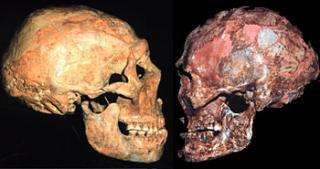
The most unusual characteristics throughout human anatomy occur in Modern Humans (right), argues Trinkaus, not in Neadertals (left).

Could it be that in the great evolutionary "family tree," it is we Modern Humans, not the brow-ridged, large-nosed Neandertals, who are the odd uncle out?

New research published in the August, 2006 journal Current Anthropology by Neandertal and early modern human expert, Erik Trinkaus, Ph.D., professor of anthropology at Washington University in St. Louis, suggests that rather than the standard straight line from chimps to early humans to us with Neandertals off on a side graph, it's equally valid, perhaps more valid based on the fossil record, that the line should extend from the common ancestor to the Neandertals, and Modern Humans should be the branch off that.

Trinkaus has spent years examining the fossil record and began to realize that maybe researchers have been looking at our ancient ancestors the wrong way.

Trinkaus identified fossil traits which seemed to be genetic markers - those not greatly influenced by environment, life ways and wear and tear. He was careful to examine traits that appear to be largely independent of each other to avoid redundancy.

"I wanted to see to what extent Neandertals are derived, that is distinct, from the ancestral form. I also wanted to see the extent to which modern humans are derived relative to the ancestral form," Trinkaus says. "What I came up with is that modern humans have about twice as many uniquely derived traits than do the Neandertals.

"In the broader sweep of human evolution," says Trinkaus, "the more unusual group is not Neandertals, whom we tend to look at as strange, weird and unusual, but it's us - Modern Humans."

The most unusual characteristics throughout human anatomy occur in Modern Humans, argues Trinkaus. "If we want to better understand human evolution, we should be asking why Modern Humans are so unusual, not why the Neandertals are divergent. Modern Humans, for example, are the only people who lack brow ridges. We are the only ones who have seriously shortened faces. We are the only ones with very reduced internal nasal cavities. We also have a number of detailed features of the limb skeleton that are unique."

Trinkaus admits that every paleontologist will define the traits a little differently. "If you really wanted to, you could make the case that Neandertals look stranger than we do. But if you are reasonably honest about it, I think it would be extraordinarily difficult to make Neandertals more derived than Modern Humans."

Source: Washington University in St. Louis

3.9 /5 (78 votes)  

Rank 3.9 /5 (78 votes)
Tags

Relevant PhysicsForums posts

More news stories

Entire genome of extinct human decoded from fossil

(PhysOrg.com) -- In 2010, Svante Pääbo and his colleagues presented a draft version of the genome from a small fragment of a human finger bone discovered in Denisova Cave in southern Siberia. The ...

Biology / Biotechnology

created Feb 07, 2012 | popularity 4.7 / 5 (58) | comments 44 | with audio podcast

Why are there so few fish in the Earth's oceans?

(PhysOrg.com) -- A Stony Brook University researcher has found that, contrary to popular belief, there are not plenty of fish in the sea.

Biology / Plants & Animals

created Feb 08, 2012 | popularity 4.3 / 5 (17) | comments 25 | with audio podcast

Miami battling invasion of giant African snails

No one knows how they got there. But an invasion of African giant snails has southern Florida in a panic over potential crop damage, disease and general yuckiness surrounding the slimy gastropods.

Biology / Ecology

created Feb 10, 2012 | popularity 4.5 / 5 (2) | comments 5

The power of estrogen -- male snakes attract other males

A new study has shown that boosting the estrogen levels of male garter snakes causes them to secrete the same pheromones that females use to attract suitors, and turned the males into just about the sexiest ...

Biology / Plants & Animals

created Feb 10, 2012 | popularity 4.8 / 5 (6) | comments 2 | with audio podcast

Deciding to go left or right: Researchers use device to determine that lower animals can navigate too

For decades, scientists have associated binary decision making — opting to go left or right — with higher-ranking animals, including humans. A team of Harvard researchers, however, is rewriting that ...

Biology / Plants & Animals

created Feb 09, 2012 | popularity 4 / 5 (1) | comments 4 | with audio podcast


Walney offshore wind farm is world's biggest (for now)

(PhysOrg.com) -- The Walney wind farm on the Irish Sea--characterized by high tides, waves and windy weather--officially opened this week. The farm is treated in the press as a very big deal as the Walney ...

GPS court ruling leaves US phone tracking unclear

A US Supreme Court decision requiring a warrant to place a GPS device on the car of a criminal suspect leaves unresolved the bigger issue of police tracking using mobile phones, legal experts say.

Europeans protest controversial Internet pact

Tens of thousands of people marched in protests in more than a dozen European cities Saturday against a controversial anti-online piracy pact that critics say could curtail Internet freedom.

Europe stakes billion-dollar bet on new rocket

A pencil-slim rocket is scheduled to lift into space from South America on Monday, carrying a billion-dollar bet that Europe can grab a juicy slice of the market to place satellites in low orbit.

Study finds that anti-diabetic medication can prevent the long-term effects of maternal obesity

In a study to be presented today at the Society for Maternal-Fetal Medicine's annual meeting, The Pregnancy Meeting, in Dallas, Texas, researchers will report findings that show that short therapy with the anti-diabetic medication ...

Netflix settlement trims 14 pct off 4Q earnings

(AP) -- Netflix pressed the rewind button on its fourth-quarter earnings after settling allegations that the video subscription service violated a consumer-privacy law.