Massive Planet Found by Astronomers Using Novel Network of Tiny Telescopes
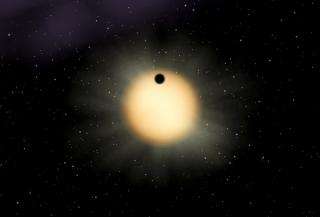
Our home solar system may be down by a planet with the recent demotion of Pluto, but the number of giant planets discovered in orbit around other stars continues to grow steadily. Now, an international team of astronomers has detected a planet larger than Jupiter that orbits a star 500 light-years from Earth in the constellation Draco.
Unlike the mythological names associated with the solar system's planets, the newly discovered planet is known by "TrES-2" and passes in front of the star "GSC 03549-02811" every two and a half days.
The new planet is especially noteworthy because it was identified by astronomers looking for transiting planets (that is, planets that pass in front of their home star) with a network of small automated telescopes. The humble telescopes used in the discovery consist of mostly amateur-astronomy components and off-the-shelf 4-inch camera lenses. This is the third transiting planet found using telescopes similar to those used by many amateur astronomers. "Hunting for planets with amateur equipment seemed crazy when we started the project," says David Charbonneau, an astronomer at the Harvard-Smithsonian Center for Astrophysics, "but with this discovery the approach has become mainstream."
By definition, a transiting planet passes directly between Earth and the star, causing a slight reduction in the light in a manner similar to that caused by the moon's passing between the sun and Earth during a solar eclipse. According to Francis O'Donovan, an Irish graduate student in astronomy at the California Institute of Technology, "When TrES-2 is in front of the star, it blocks off about one and a half percent of the star's light, an effect we can observe with our TrES telescopes.
"We know of about 200 planets around other stars," says O'Donovan, lead author of the paper announcing the discovery in an upcoming issue of the Astrophysical Journal, "but it is only for the nearby transiting planets that we can precisely measure the size and mass of the planet, and hence study its composition. That makes each new transiting planet a precious find. And because TrES-2 is the most massive of the nearby transiting planets, it is particularly valuable in telling us about the diversity of planets in neighboring Solar systems."
The planet TrES-2 is also noteworthy for being the first transiting planet in an area of the sky known as the "Kepler field," which has been singled out as the targeted field of view for the upcoming NASA Kepler mission. Using a satellite-based telescope, Kepler will stare at this patch of sky for four years, and should discover hundreds of giant planets and Earth-like planets. Finding a planet in the Kepler field with the current method allows astronomers to plan future observations with Kepler that include searching for moons around TrES-2. "TrES-2 will likely become the best-studied planet outside the Solar system once Kepler flies," says Charbonneau, who is a coauthor on the study.
The research team hails the discovery as the second transiting "hot Jupiter" found with the Trans-Atlantic Exoplanet Survey (TrES), an effort involving the "Sleuth" telescope at Caltech's Palomar Observatory in San Diego County, the Planet Search Survey Telescope (PSST) at Lowell Observatory near Flagstaff, Arizona, and the Stellar Astrophysics and Research on Exoplanets (Stare) telescope in the Canary Islands. The name of the planet, TrES-2, is derived from the name of the survey.
To look for transits, the small telescopes are automated to take wide-field timed exposures of the clear skies on as many nights as possible. A typical observing runs lasts two months, in which tens of thousands of stars are monitored. Once complete, the data are analyzed by computer software that searches for changes in a star's brightness that might prove to be the footprint of an orbiting planet. But identifying such "candidates" is only the beginning. "Honest-to-God planets are really hard to find," says David Latham, an astronomer at the Harvard-Smithsonian Center for Astrophysics. "Most of the candidates flagged by the software are just binary stars masquerading as planets. The art lies in the detective work to ferret out the planets amongst all the impostors."
In order to confirm they had found a planet, O'Donovan and his colleagues switched from the 10-centimeter TrES telescopes to one of the 10-meter telescopes at the W. M. Keck Observatory on the summit of Mauna Kea, Hawaii. Using this giant telescope, they confirmed that they had found a new planet. O'Donovan says, "Each of us had spent countless hours working on TrES at that point, and we had suffered many disappointments. All our hard work was made worthwhile when we saw the results from our first night's observations, and realized we had found our second transiting planet."
TrES-2 was first spotted by the Sleuth telescope, which was set up by David Charbonneau while at Caltech. The PSST, which is operated by Georgi Mandushev and Edward Dunham (coauthors from Lowell Observatory), also observed transits of TrES-2, confirming the initial detections.
The other authors of the paper are Guillermo Torres of Harvard-Smithsonian; Alessandro Sozzetti of Harvard-Smithsonian and the INAF-Osservatorio Astronomico di Torino; Timothy Brown of the Las Cumbres Observatory Global Telescope; John Trauger of the Jet Propulsion Laboratory; Juan Belmonte, Markus Rabus, Jose Almenara, and Hans Deeg of the Instituto de Astrofisica de Canarias; Roi Alonso of the Laboratoire d'Astrophysique de Marseille and the Institute de Astrofisica de Canarias; Gilbert Esquerdo of Harvard-Smithsonian and the Planetary Science Institute in Tucson; Emilio Falco of Harvard-Smithsonian; Lynne Hillenbrand of Caltech; Anna Roussanova of MIT; Robert Stefanik of Harvard-Smithsonian; and Joshua Winn of MIT.
Source: Harvard-Smithsonian Center for Astrophysics


