The fight back by Britain's otters sees a decline in American mink
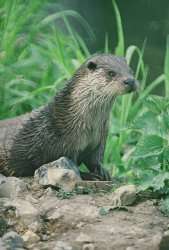
September 11, 2006 An otter.Credit: Pat Morris MTUK

An otter.Credit: Pat Morris MTUK

A study by Oxford’s Wildlife Conservation Research Unit (WildCRU) suggests that native otters are driving American mink from Britain’s riverbanks. Researchers found a significant relationship between the decline in mink signs and the increase in those of otters, suggesting that returning otters may be driving the reduction of mink.

For the last thirty years mink, the descendants of escapees from fur farms, have been causing havoc among the native population – killing fish, birds and mammals. The hope now is that that decline has been reversed.

Water voles have been disappearing rapidly for decades as a result of habitat loss and mink predation, so the increase in the otter population is welcome news for those concerned about safeguarding the water vole. The highly endangered water vole is now at risk of national extinction and the study concludes: ‘Mink control, at least locally, is likely to be necessary to ensure the survival of water vole populations in many areas.’

The study is part of a long-term research programme examining the recovery of the otter population since their decline in the 1960s and 1970s. Large numbers died of poisoning from dieldrin, the since banned sheep dip found in fish eaten by otters. The devastation in the otter population left the way open for mink to flourish, but it seems the fight back has begun as the numbers of otter has increased. It appears that otters have driven mink out of rivers in western and northern England but in the south and east, mink are still a problem.

The study appears in the report The State of Britain’s Mammals 2006 published by the Mammals Trust UK.

Professor David Macdonald, from WildCRU, said: ‘ An increasing number of specialists and amateurs have worked very hard at conserving Britain’s mammals and our report is a synthesis of their achievements. Knowledge is really deepening, but so too is the realisation that solving many conservation problems is technically difficult – scientific evidence is the bedrock of sensible policy.’

Source: University of Oxford


print this article email this article download pdf blog this article bookmark this article     Stumble it Digg this share on Facebook retweet share on Reddit add to delicious
Rate this story - 3.5 /5 (2 votes)


September 11, 2006 all stories

Comments: 0

3.5 /5 (2 votes)
  • Stumble this up

  • Digg this

  • share this

  • hide
  • Related Stories

  • Mink control vital to save water voles
    created Jan 09, 2009 | popularity not rated yet | comments 0
  • Extent of Mercury Pollution More Widespread
    created Sep 19, 2006 | popularity not rated yet | comments 0
  • Research study on the European mink, Mustela lutreola
    created Nov 02, 2009 | popularity not rated yet | comments 0
  • Prion infectivity found in white and brown fat tissues of mice
    created Dec 05, 2008 | popularity not rated yet | comments 0
  • Two for One: New Design Enables More Cost-Effective Quantum Key Distribution
    created May 29, 2008 | popularity not rated yet | comments 0


Other News

New discovery allows scientists for the first time to experimentally annotate genomes

New discovery allows scientists for the first time to experimentally annotate genomes

Biology / Biotechnology

created 1hour ago | popularity 5 / 5 (1) | comments 0

Over the last 20 years, the sequencing of the human genome, along with related organisms, has represented one of the largest scientific endeavors in the history of mankind. The information collected from genome ...


Scientists successfully reprogram blood cells

Biology / Cell & Microbiology

created 2 hours ago | popularity 5 / 5 (1) | comments 0

Researchers have transplanted genetically modified hematopoietic stem cells into mice so that their developing red blood cells produce a critical lysosomal enzyme -preventing or reducing organ and central nervous system damage ...


Wasp

Well-traveled wasps provide hope for vanishing species

Biology / Plants & Animals

created 1hour ago | popularity not rated yet | comments 0

They may only be 1.5mm in size, but the tiny wasps that pollinate fig trees can travel over 160km in less than 48 hours, according to research from scientists at the University of Leeds. The fig wasps are transporting ...


Study shows that some malignant tumors can be shut down after all

Biology / Cell & Microbiology

created 5 hours ago | popularity 5 / 5 (2) | comments 1

Oncologists have had their hands tied because more than half of all human cancers have mutations that disable a protein called p53. As a critical anti-cancer watchdog, p53 masterminds several cancer-fighting operations within ...


Drought resistance explained

Drought resistance explained

Biology / Cell & Microbiology

created 5 hours ago | popularity 5 / 5 (1) | comments 0

Much as adrenaline coursing through our veins drives our body's reactions to stress, the plant hormone abscisic acid (ABA) is behind plants' responses to stressful situations such as drought, but how it does ...