Scientists and engineers simulate jet colliding with World Trade Center
Researchers at Purdue University have created a simulation that uses scientific principles to study in detail what likely happened when a commercial airliner crashed into the World Trade Center's North Tower on Sept. 11, 2001.
The simulation could be used to better understand which elements in the building's structural core were affected, how they responded to the initial shock of the aircraft collision, and how the tower later collapsed from the ensuing fire fed by an estimated 10,000 gallons of jet fuel, said Mete Sozen, the Kettelhut Distinguished Professor of Structural Engineering in Purdue's School of Civil Engineering.
It took about 80 hours using a high-performance computer containing 16 processors to produce the first simulation, which depicts how the plane tore through several stories of the structure within a half-second, said Christoph M. Hoffmann, a professor of computer science and co-director of the Computing Research Institute at Purdue.
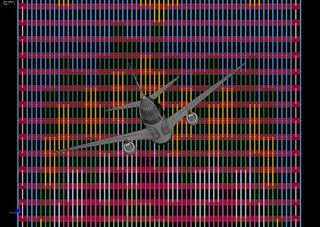
"This required a tremendous amount of detailed work," Hoffmann said. "We have finished the first part of the simulation showing what happened to the structure during the initial impact. In the coming months, we will explore how the structure reacted to the extreme heat from the blaze that led to the building's collapse, and we will refine the visual presentations of the simulation."
The researchers are analyzing how many columns were destroyed initially in the building's core, a spine of 47 heavy steel I-beams extending through the center of the structure, Sozen said.
"Current findings from the simulation have identified the destruction of 11 columns on the 94th floor, 10 columns on the 95th floor and nine columns on the 96th floor," he said. "This is a major insight. When you lose close to 25 percent of your columns at a given level, the building is significantly weakened and vulnerable to collapse."
The simulation research, funded by the National Science Foundation, was carried out by a team that includes Hoffmann; Sozen; Ayhan Irfanoglu, an assistant professor of civil engineering; Voicu Popescu, an assistant professor of computer science; computer science doctoral student Paul Rosen; and civil engineering doctoral students Oscar Ardila and Ingo Brachmann.
The simulation research is associated with an NSF "information technology research project" called Model Reduction for Dynamical Systems, which is led by Purdue and includes researchers from Rice University, Florida State University and the Catholic University of Louvain. The project is headed by Ahmed Sameh, Purdue's Samuel D. Conte Professor of Computer Science.
"One challenge will be taking the scientific simulation and putting it into a commercial visualization software so that the package is viewer friendly," said Popescu, who is leading that portion of the work.
Mathematical models are used to represent the Boeing 767 and the building.
"The simulation is enabling us to 'look' inside the building to see what really happened structurally," Sozen said. "This is not the first simulation, but I would say it's the most scientifically realistic one. We have spent a great deal of time on details of the mechanical properties of the columns and of the airplane, and we have benefited from the results of previous efforts at simulation."
In a broader sense, results of the computational component of the work will help scientists and engineers better understand situations and phenomena that are not ordinarily accessible using other methods. Such models can lead to insights in many areas of research and industry for applications ranging from designing safer buildings to developing new pharmaceuticals, said Sozen and Hoffmann.
High-performance computing is essential for the research, Hoffmann said. The computer scientists and engineers have been using the "nano-regatta" computer, an IBM system approximately equivalent to the combined power of 128 personal computers. The computer is operated by Information Technology at Purdue as part of the Network for Computational Nanotechnology, based at Purdue's Discovery Park and supported by the NSF.
Other computations were carried out using computers operated by the Northwest Indiana Computational Grid, a consortium supported by the U.S. Department of Energy involving Purdue, the University of Notre Dame, Purdue University Calumet and the Argonne National Laboratory, as well as computers at Purdue's Robert L. and Terry L. Bowen Civil Engineering Laboratory for Large Scale Research.
A team consisting of many of the same Purdue researchers in 2002 created a similar simulation of the Sept. 11 attack on the Pentagon.
Experience gained during the Pentagon-related research and laboratory experiments have helped the Purdue civil engineers and computer scientists develop the new model, Sozen said.
"As a result of the Pentagon research, we have a better understanding of what happens when a tremendous mass of fluid such as fuel hits a solid object at high velocity," Sozen said. "We believe most of the structural damage from such aircraft collisions is caused by the mass of the fluid on the craft, which includes the fuel.
"Damage resulting solely from the metal fuselage, engines and other aircraft parts is not as great as that resulting from the mass of fluids on board. You could think of the aircraft as a sausage skin. Its mass is tiny compared to the plane's fluid contents."
The simulation represents the plane and its mass as a mesh of hundreds of thousands of "finite elements," or small squares containing specific physical characteristics. Like the previous Pentagon simulation, the software tool uses principles of physics to simulate how a plane's huge mass of fuel and cargo impacts a building.
"It is a virtual reality," Sozen said. "The building is reduced to a mathematical representation, the airplane is reduced to a mathematical representation, and then we see what happens on impact."
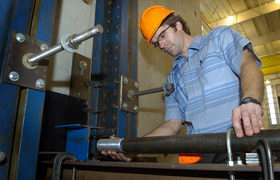
Santiago Pujol, an assistant professor of civil engineering, worked with the researchers to develop experimental data to test the accuracy of the simulation by using an "impact simulator" to shoot 8-ounce beverage cans at high velocity at steel and concrete targets at Purdue's Bowen Laboratory. These data enabled the researchers to fine tune and validate the theoretical model for the simulation.
"We created a mathematical model of the beverage can and its fluid contents the same way we modeled the airplane, and then we tested our assumptions used to formulate the model by comparing the output from the model with that from the experiment," Sozen said.
Information about the simulation and the details about the NSF modeling project are available online.
Source: Purdue University, by Emil Venere, Elizabeth K. Gardner


