A 'Genetic Study' of the galaxy
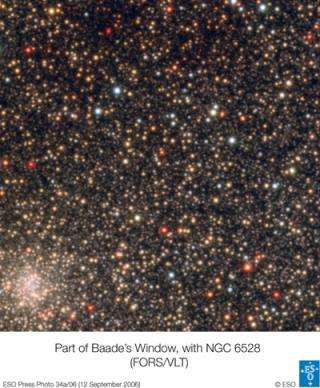
September 12th, 2006 The Field around Baade's Window (FORS/VLT)

Part of one of the four regions of the sky in the direction of the Galactic Bulge in which the astronomers measured the iron and oxygen abundances in stars. This particular field is in the vicinity of the so-called 'Baade's Window', a region with relatively low amounts of interstellar "dust" that could block the sight, allowing astronomers to peer into the central parts of the Milky Way galactic centre and beyond. The globular cluster NGC 6528 is visible in the lower left corner. The image is a colour composite, based on images obtained in the B-, V-, and I-filters with the FORS instrument on the ESO VLT. The images were extracted from the ESO Science Archive and processed by Henri Boffin (ESO). North is to the right and East on top.

Looking in detail at the composition of stars with ESO's VLT, astronomers are providing a fresh look at the history of our home galaxy, the Milky Way. They reveal that the central part of our Galaxy formed not only very quickly but also independently of the rest.

"For the first time, we have clearly established a 'genetic difference' between stars in the disc and the bulge of our Galaxy," said Manuela Zoccali, lead author of the paper presenting the results in the journal Astronomy and Astrophysics. "We infer from this that the bulge must have formed more rapidly than the disc, probably in less than a billion years and when the Universe was still very young."

The Milky Way is a spiral galaxy, having pinwheel-shaped arms of gas, dust, and stars lying in a flattened disc, and extending directly out from a spherical nucleus of stars in the central region. The spherical nucleus is called a bulge, because it bulges out from the disc. While the disc of our Galaxy is made up of stars of all ages, the bulge contains old stars dating from the time the galaxy formed, more than 10 billion years ago. Thus, studying the bulge allows astronomers to know more about how our Galaxy formed.

To do this, an international team of astronomers analysed in detail the chemical composition of 50 giant stars in four different areas of the sky towards the Galactic bulge. They made use of the FLAMES/UVES spectrograph on ESO's Very Large Telescope to obtain high-resolution spectra.

The chemical composition of stars carries the signature of the enrichment processes undergone by the interstellar matter up to the moment of their formation. It depends on the previous history of star formation and can thus be used to infer whether there is a 'genetic link' between different stellar groups. In particular, comparison between the abundance of oxygen and iron in stars is very illustrative. Oxygen is predominantly produced in the explosion of massive, short-lived stars (so-called Type II supernovae), while iron instead originates mostly in Type Ia supernovae, which can take much longer to develop. Comparing oxygen with iron abundances therefore gives insight on the star birth rate in the Milky Way's past.

Type Ia supernovae are a sub-class of supernovae that were historically classified as not showing the signature of hydrogen in their spectra. They are currently interpreted as the disruption of small, compact stars, called white dwarfs, that acquire matter from a companion star. A white dwarf represents the penultimate stage of a solar-type star. The nuclear reactor in its core has run out of fuel a long time ago and is now inactive. However, at some point the mounting weight of the accumulating material will have increased the pressure inside the white dwarf so much that the nuclear ashes in there will ignite and start burning into even heavier elements. This process very quickly becomes uncontrolled and the entire star is blown to pieces in a dramatic event. An extremely hot fireball is seen that often outshines the host galaxy.

"The larger size and iron-content coverage of our sample allows us to draw much more robust conclusions than were possible until now," said Aurelie Lecureur, from the Paris-Meudon Observatory (France) and co-author of the paper.

The astronomers clearly established that, for a given iron content, stars in the bulge possess more oxygen than their disc counterparts. This highlights a systematic, hereditary difference between bulge and disc stars.

"In other words, bulge stars did not originate in the disc and then migrate inward to build up the bulge but rather formed independently of the disc," said Zoccali. "Moreover, the chemical enrichment of the bulge, and hence its formation timescale, has been faster than that of the disc."

Comparisons with theoretical models indicate that the Galactic bulge must have formed in less than a billion years, most likely through a series of starbursts when the Universe was still very young.

Source: European Southern Observatory


print this article email this article download pdf blog this article bookmark this article     Digg this Stumble it share on Facebook share on Reddit add to delicious save to Yahoo! bookmarks
4.4/5 after 19 votes


September 12th, 2006 all stories
Space & Earth / Astronomy

Comments: 0
Rank: 4.4/5 after 19 votes

  • Stumble this up

  • Digg this

  • Share it:
  • share on Facebook
  • share on MySpace
  • share on Slashdot
  • rss-newsfeed
  • share on Google
  • share on Reddit
  • add to delicious
  • save to Yahoo! bookmarks
  • share on Windows Live
  • Add to Mixx!
Rating: 4.4/5 after 19 votes

  • Related Stories

  • A 'Genetic Study' of the Galaxy
    created Sep 11, 2008 | popularity not rated yet | comments 0
  • The purple rose of Virgo
    created Mar 27, 2007 | popularity not rated yet | comments 0
  • Cosmic Stocktake Reveals What's Left of Big Bang
    created Aug 18, 2006 | popularity not rated yet | comments 0
  • Midsummer's Dream Galaxies
    created Aug 10, 2005 | popularity not rated yet | comments 0
  • Red giant star Betelgeuse is mysteriously shrinking
    created Jun 10, 2009 | popularity not rated yet | comments 0

Tags


  • Physicists Demonstrate Quantum Memory with Matter Qubits
    Physicists Demonstrate Quantum Memory with Matter Qubits
    Physics / General Physics
    created Jul 03, 2009 | popularity 4.4 / 5 (17) | comments 1
  • 'Holey' Nanosheets for Wastewater Dye Removal
    Nanotechnology / Nanomaterials
    created Jul 01, 2009 | popularity 5 / 5 (5) | comments 1
  • Jellyfish Robot Swims Like its Biological Counterpart
    Jellyfish Robot Swims Like its Biological Counterpart
    Electronics / Robotics
    created Jun 26, 2009 | popularity 4.4 / 5 (8) | comments 1
  • Could Maxwell's Demon Exist in Nanoscale Systems?
    Could Maxwell's Demon Exist in Nanoscale Systems?
    Physics / General Physics
    created Jun 24, 2009 | popularity 4.4 / 5 (18) | comments 29
  • Living Safely with Robots, Beyond Asimov's Laws
    Living Safely with Robots, Beyond Asimov's Laws
    Electronics / Robotics
    created Jun 22, 2009 | popularity 4.6 / 5 (54) | comments 40
  • Other News

    China environmental phenomena monitored from space

    Space & Earth / Earth Sciences

    created 2 hours ago | popularity not rated yet | comments 0

    China is in a very seismically active area and has had many catastrophic earthquakes during its history. A joint European-Chinese team is using satellite radar data to monitor ground deformation across major continental faults ...


    California to require sun-blocking car windows

    Space & Earth / Environment

    created 4 hours ago | popularity 2 / 5 (4) | comments 6

    New cars sold in California must include windshields that block or absorb the sun's rays beginning in 2012, the state's Air Resources Board recently ruled.


    Steam billows from the cooling towers at a nuclear power generating station in Byron

    Tropical zone expanding due to climate change: study

    Space & Earth / Earth Sciences

    created 7 hours ago | popularity 3.6 / 5 (7) | comments 3

    Climate change is rapidly expanding the size of the world's tropical zone, threatening to bring disease and drought to heavily populated areas, an Australian study has found.


    Scientists: Silent tremors may foretell next Big One

    Space & Earth / Earth Sciences

    created 4 hours ago | popularity 5 / 5 (1) | comments 0

    The seismometer is snugged in its hole and tamped over with dirt. Now it's time for the stomp test.


    The least sea ice in 800 years

    The least sea ice in 800 years

    Space & Earth / Earth Sciences

    created Jul 01, 2009 | popularity 4.1 / 5 (65) | comments 61

    New research, which reconstructs the extent of ice in the sea between Greenland and Svalbard from the 13th century to the present indicates that there has never been so little sea ice as there is now. The ...