MIT's molecular sieve advances protein research
September 12, 2006
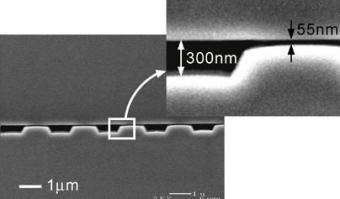
This scanning electron microscopy (SEM) image shows MIT's new nanoscale molecular sieve, which consists of thousands of alternating deep (300 nanometers or billionths of a meter) and shallow (55 nanometers) regions. The deep and shallow regions act together to form energy barriers that separate proteins by size. Pores of different sizes can be engineered for different filters to capture specific proteins. Image courtesy / Han lab
New MIT technology promises to speed up the accurate sorting of proteins, work that may ultimately aid in the detection and treatment of disease.
Separating proteins from complex biological fluids such as blood is becoming increasingly important for understanding diseases and developing new treatments. The molecular sieve developed by MIT engineers is more precise than conventional methods and has the potential to be much faster.
The team's results appear in recent issues of Physical Review Letters, the Virtual Journal of Biological Physical Research and the Virtual Journal of Nanoscale Science and Technology.
The key to the molecular sieve, which is made using microfabrication technology, is the uniform size of the nanopores through which proteins are separated from biological fluids. Millions of pores can be spread across a microchip the size of a thumbnail.
The sieve makes it possible to screen proteins by specific size and shape.
In contrast, the current technique used for separating proteins, gel electrophoresis, is time-consuming and less predictable. Pore sizes in the gels vary, and the process itself is not well understood by scientists.
"No one has been able to measure the gel pore sizes accurately," said Jongyoon Han, the Karl Van Tassel Associate Professor of Electrical Engineering and Biological Engineering at MIT. "With our nanopore system, we control the pore size precisely, so we can control the sieving process of the protein molecules."
That, in turn, means proteins can be separated more efficiently, which should help scientists learn more about these crucial molecules, said Han, who also has appointments in MIT's Research Laboratory of Electronics, Computational and Systems Biology Initiative, Center for Materials Science and Engineering and Microsystems Technology Laboratories.
Han and his team, led by Jianping Fu, a graduate student in the Department of Mechanical Engineering, have devised a sieve that is embedded into a silicon chip. A biological sample containing proteins is put through the sieve for separation.
The sieving process is based on a theoretical model known as the Ogston sieving mechanism. In the model, proteins move through deep and shallow regions that act together to form energy barriers. These barriers separate proteins by size. The smaller proteins go through more quickly, followed by increasingly larger proteins, with the largest passing through last.
Once the proteins are separated, scientists can isolate and capture the proteins of interest. These include the "biomarker" proteins that are present when the body has a disease. By studying changes in these biomarkers, researchers can identify disease early on, even before symptoms show up, and potentially develop new treatments.
To date, the Ogston sieving model has been used to explain gel electrophoresis, even though no one has been able to unequivocally confirm this model in gel-based experiments. The MIT researchers were, however, able to confirm Ogston sieving in the nanopore sieves.
"This is the first time anyone was able to experimentally confirm this theoretical idea behind molecular sieving, which has been used for more than 50 years," Han said. "We can precisely control the pore size, so we can do better engineering. We can change the pore shape and engineer a better separation system." The sieve structure is based on work Han did earlier at Cornell University with large strands of DNA.
The performance of the researchers' current one-dimensional sieves matches the state-of-the-art speed of one-dimensional gels, but Han said the sieve's performance can be improved greatly.
"This device can replace gels and give us an ideal physical platform to investigate Ogston sieving," Fu said. The new sieves also potentially could be used to replace 2D gels in the process of discovering disease biomarkers, as well as to learn more about disease.
Source: MIT
-
HIV prevention research named scientific breakthrough of the year by Science
Dec 22, 2011 |
5 / 5 (3) |
3
-
Polar quest: Will Antarctic worms warm to changing climate?
Dec 20, 2011 |
3.7 / 5 (3) |
1
-
Study finds more effective way to dry ethanol, reduce costs
Sep 14, 2011 |
not rated yet |
2
-
Study finds Avastin and Lucentis are equally effective in treating AMD
Apr 28, 2011 |
not rated yet |
0
-
For first time, scientists show an HIV vaccine impacts the genetic makeup of the virus
Mar 01, 2011 |
4 / 5 (1) |
1
-
Engineers build first sub-10-nm carbon nanotube transistor
Feb 01, 2012 |
4.9 / 5 (31) |
30
-
Something old, something new: Evolution and the structural divergence of duplicate genes
Jan 31, 2012 |
4.6 / 5 (7) |
1
-
The hidden nanoworld of ice crystals: Revealing the dynamic behavior of quasi-liquid layers
Jan 30, 2012 |
5 / 5 (3) |
1
-
Stock market network reveals investor clustering
Jan 27, 2012 |
3.9 / 5 (23) |
8
-
Of microchemistry and molecules: Electronic microfluidic device synthesizes biocompatible probes
Jan 26, 2012 |
5 / 5 (1) |
0
-
Universe as a cellular automaton
1 hour ago
-
Question about Newton's laws
1 hour ago
-
Gravity Question (I think) with mass and speed
4 hours ago
-
Can you manipulate any formula in Physics?
4 hours ago
-
I have a quiz -_-
6 hours ago
-
Understanding Antennas based on GPS
6 hours ago
- More from Physics Forums - General Physics
More news stories
Explained: Sigma
It's a question that arises with virtually every major new finding in science or medicine: What makes a result reliable enough to be taken seriously? The answer has to do with statistical significance -- but ...
Feb 09, 2012 |
5 / 5 (18) |
65
Quantum physicist explains $100K offer for proof scaled-up quantum computing is impossible
(PhysOrg.com) -- MIT researcher Scott Aaronson has certainly riled the physics community with his offer this past Friday, of $100,000 to anyone who can prove that scaled-up quantum computing is impossible. ...
Diamond light, brighter than the sun
Its the size of five football pitches and generates light 10 billion times brighter than the sun. As the Diamond Light Source celebrates its tenth anniversary this year, Penny Bailey visits one of the ...
Feb 07, 2012 |
4.3 / 5 (7) |
15
|
Physicists 'record' magnetic breakthrough
An international team of scientists has demonstrated a revolutionary new way of magnetic recording which will allow information to be processed hundreds of times faster than by current hard drive technology.
Feb 07, 2012 |
4.5 / 5 (41) |
14
|
Hints of the Higgs - papers are submitted
Back in December 2011, the ATLAS and CMS experiments at CERN presented some exciting results that provided tantalising hints of the Higgs boson.
Feb 08, 2012 |
4.1 / 5 (7) |
10
Walney offshore wind farm is world's biggest (for now)
(PhysOrg.com) -- The Walney wind farm on the Irish Sea--characterized by high tides, waves and windy weather--officially opened this week. The farm is treated in the press as a very big deal as the Walney ...
Europeans protest controversial Internet pact
Tens of thousands of people marched in protests in more than a dozen European cities Saturday against a controversial anti-online piracy pact that critics say could curtail Internet freedom.
GPS court ruling leaves US phone tracking unclear
A US Supreme Court decision requiring a warrant to place a GPS device on the car of a criminal suspect leaves unresolved the bigger issue of police tracking using mobile phones, legal experts say.
Europe stakes billion-dollar bet on new rocket
A pencil-slim rocket is scheduled to lift into space from South America on Monday, carrying a billion-dollar bet that Europe can grab a juicy slice of the market to place satellites in low orbit.
Study finds that anti-diabetic medication can prevent the long-term effects of maternal obesity
In a study to be presented today at the Society for Maternal-Fetal Medicine's annual meeting, The Pregnancy Meeting, in Dallas, Texas, researchers will report findings that show that short therapy with the anti-diabetic medication ...
Netflix settlement trims 14 pct off 4Q earnings
(AP) -- Netflix pressed the rewind button on its fourth-quarter earnings after settling allegations that the video subscription service violated a consumer-privacy law.