Ingredient in Prozac Increases Risk of Extinction for Freshwater Mussels
September 12, 2006 Ingredient in Prozac Increases Risk of Extinction for Freshwater Mussels

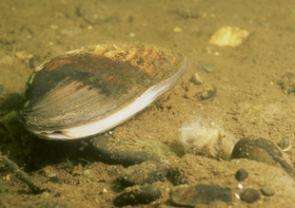
Traces amounts of Prozac (fluoxetine) in rivers and streams endanger fresh water mussels, according to research presented at the 232nd American Chemical Society National Meeting in San Francisco. When exposed to the popular antidepressant drug, female fresh water mussels prematurely release larvae, greatly reducing their chances of survival. About 70 percent of the fresh water mussel species native to North America are extinct, endangered or declining. (Photo courtesy of the U.S. Fish & Wildlife Service)

You'd think in a river filled with anti-depressants, freshwater mussels would be, well, happy as clams. Far from it. In fact, a new laboratory study suggests that exposure to Prozac can disrupt the reproductive cycle of these mollusks, potentially increasing their risk of extinction.

The study, one of the first to examine the ecotoxicological effects of Prozac (fluoxetine) on native freshwater mussels, found that the drug caused females to prematurely release their larvae, essentially dooming them. The findings were presented today at the 232nd national meeting of the American Chemical Society.

"The results from this study were quite alarming," said co-investigator Rebecca Heltsley, a National Research Council Post-Doctoral Fellow at the National Institute of Standards and Technology, Hollings Marine Laboratory in Charleston, S.C. "When larvae are released too early, they are not viable, which only contributes to the problems faced by struggling populations of native freshwater mussels."

About 70 percent of the nearly 300 species of freshwater mussels native to North America are extinct, endangered or declining, according to Heltsley. In the past 100 years, no other widespread North American animal group has experienced such notable collapse, she added.

In some cases, native mussels have been crowded out by invasive species such as the zebra mussel, Heltsley said. In others, native mussels have been devastated by increased sediment loads in rivers, habitat alteration and loss, or killed off by pollutants.

"The presence of Prozac and similar drugs in U.S. rivers and streams has likely compounded the problem," Heltsley said. "It's a big concern because freshwater mussels are such an imperiled group."

Prozac, one of the nation's most prescribed anti-depressant medications, helps relieve depression by increasing the brain's supply of a neurotransmitter called serotonin. But like many prescription drugs, some remnants of Prozac ultimately are mixed into wastewater that reaches rivers and streams, Heltsley said. Recently, University of Georgia researchers who found traces of Prozac in fish and frogs concluded the drug slowed the development of these animals.

In their study, Heltsley, along with lead investigator Gregory Cope of North Carolina State University and other colleagues, placed female freshwater mussels carrying larvae into tanks containing laboratory water with varying concentrations of fluoxetine, the active ingredient in Prozac. The Prozac concentrations, which ranged from 0.3 to 3,000 micrograms per liter, mimicked those previously found in surface waters of lakes and streams. They also exposed a similar set of mussels directly to serotonin. Within 48 hours, the mussels in both groups had released their larvae prematurely.

"Protecting freshwater mussels and other aquatic life that are susceptible to the unintended consequences of exposure to pharmaceuticals in our rivers and streams will take a concentrated effort," Heltsley said. "These efforts could include the development of more efficient wastewater treatment facilities that can filter out these products before they reach our waterways."

Freshwater mussels have a key role in the ecology of rivers and streams, Heltsley emphasized. They filter large volumes of water for food each day, thereby helping filter contaminants and excessive nutrients from water and serving as an early warning of water quality problems. They also are an important source of food for muskrats, otters, fish and other animals.

Heltsley and her colleagues are evaluating surface water and sediment samples from a natural water system and will compare the results of this work with the results of their laboratory based study.

Source: American Chemical Society (ACS)


Rate this story - 4.9 /5 (8 votes)


September 12, 2006 all stories

Comments: 0

4.9 /5 (8 votes)

  • hide
  • Related Stories

  • Environmental Change Impacts Oklahoma Rivers
    created Jan 25, 2010 | popularity not rated yet | comments 0
  • Researchers Reveal That Environmentally Devastating Zebra Mussels Can Be Controlled
    created Dec 14, 2009 | popularity not rated yet | comments 0
  • Asian carp raises fear and loathing on Great Lakes
    created Dec 10, 2009 | popularity not rated yet | comments 0
  • 15,000 reasons to worry about invasive species
    created Nov 09, 2009 | popularity not rated yet | comments 0
  • Scientists are first to 'unlock' the mystery of creating cultured pearls from the queen conch
    created Nov 04, 2009 | popularity not rated yet | comments 0


  • hide
  • Relevant PhysicsForums posts

  • Carbon Dioxide emissions question
    created Feb 08, 2010
  • Photosynthesis vs. carbonization
    created Feb 07, 2010
  • Sheep's footprints
    created Feb 05, 2010
  • How did Victorians estimate the ages of fossils?
    created Feb 03, 2010
  • More from Physics Forums - Earth

Other News

Space shuttle Endeavour pulls in at space station (AP)

Space shuttle Endeavour pulls in at space station

Space & Earth / Space Exploration

created 1hour ago | popularity not rated yet | comments 0

(AP) -- Shuttle Endeavour arrived to a warm welcome at the International Space Station early Wednesday, delivering a new room and observation deck that will come close to completing construction 200 miles ...


Rho Ophiuchus cloud

Professor: We have a 'moral obligation' to seed universe with life

Space & Earth / Astronomy

created 22 hours ago | popularity 3.1 / 5 (27) | comments 54 | with audio podcast report

(PhysOrg.com) -- Eventually, the day will come when life on Earth ends. Whether that’s tomorrow or five billion years from now, whether by nuclear war, climate change, or the Sun burning up its fuel, the last ...


Climate 'Tipping Points' May Arrive Without Warning, Says Top Forecaster

Space & Earth / Environment

created 11 hours ago | popularity 3 / 5 (8) | comments 8 | with audio podcast

(PhysOrg.com) -- A new University of California, Davis, study by a top ecological forecaster says it is harder than experts thought to predict when sudden shifts in Earth's natural systems will occur -- a worrisome finding ...


38 percent of world's surface in danger of desertification

38 percent of world's surface in danger of desertification

Space & Earth / Environment

created 8 hours ago | popularity 2.3 / 5 (3) | comments 5

A team of Spanish researchers has measured the degradation of the planet's soil using the Life Cycle Assessment (LCA), a scientific methodology that analyses the environmental impact of human activities, and ...


A new 3-D map of the interstellar gas within 300 parsecs from the sun

A new 3D map of the interstellar gas within 300 parsecs from the Sun

Space & Earth / Astronomy

created 14 hours ago | popularity 5 / 5 (5) | comments 0 | with audio podcast

(PhysOrg.com) -- Astronomy & Astrophysics is publishing new 3D maps of the interstellar gas in the local area around our Sun. A French-American team of astronomers presents new absorption measurements toward ...