High-tech equipment may help reduce wildlife-vehicle collisions
September 12, 2006
Wildlife-Detection System in Yellowstone

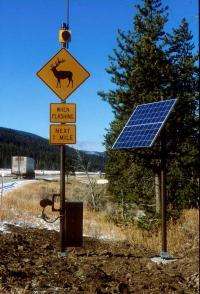
As part of a six-year study, the Western Transportation Institute at Montana State University helped test and develop this animal-detection system on U.S. Highway 191 in Yellowstone National Park. The system reliably detects elk on, or near, the roadway ahead and warns drivers. Credit: Photo by Marcel Huijser, WTI-MSU

As part of a six-year study, researchers at the Western Transportation Institute at Montana State University have helped test and develop an animal-detection system that may give motorists the upper hand in avoiding crashes with wildlife across the nation.

The system, by Sensor Technologies & Systems of Scottsdale, Ariz., reliably detected elk on U.S. Highway 191 in Yellowstone National Park. How effective the system is in reducing animal-vehicle collisions will be evaluated over the next two years.

The testing and development of the system was just one part of a 271-page report summarizing all the available information on animal-detection systems in the world: data from more than 30 study sites and 15 different animal-detection technologies in place across United States and Europe. One Swiss study showed collisions with large animals were reduced 82 percent in locations with animal-detection systems.

Animal detection systems use passive or active infrared signals, lasers, microwaves, or seismic sensors to activate warning signs that urge drivers to slow down, be more alert, or both, when large animals are on, or near, the road ahead.

"This is a very promising technology that can make U.S. roadways safer. Our results urge us to fine tune this technology so that it can be used across the country," said Marcel Huijser, the study's lead investigator at the WTI.

WTI researchers also calculated the average total costs associated with an animal-vehicle collision for three species: $7,890 for deer, $17,100 for elk, and $28,100 for moose. Further calculations showed that animal detection systems could be cost effective; they may pay for themselves at locations that have at least five deer, three elk or two moose collisions per mile per year on average.

Nationally, roughly 200 people are killed, more than 15,000 injured and 300,000 vehicles damaged annually from collisions with wildlife and domestic animals, according to federal safety data.

In Montana alone, five people were killed and 123 injured in 2005 out of 1,866 recorded wildlife-vehicle collisions, according to the Montana Highway Patrol.

The Oregon Department of Transportation was the lead funding agency for the study, but reducing animal-vehicle collisions has a broad national interest and the departments of transportation from California, Indiana, Iowa, Kansas, Maryland, Montana, Nevada, New Hampshire, New York, North Dakota, Pennsylvania, Wisconsin, Wyoming, Alaska, as well the Federal Highway Administration all participated.

"Animal detection systems are a relatively new application of these technologies. This study gives us some data on how effective they are," said Barnie Jones of the Oregon Department of Transportation, the lead state in managing the research project.

"Despite these technologies being exposed to extreme cold, snow and rain, the project helped develop a system that detects elk reliably," Jones said. "States such as Arizona, California, Colorado, New Mexico and Nevada are all planning on adding animal detection systems to their roadways."

The study also generated ideas on how to make animal-detection systems smaller and more reliable. Another follow-up project will aim to set standards for reliability by comparing different systems at the same location under similar circumstances in Lewistown, Mont.

Source: Montana State University


Rank 4 /5 (2 votes)
Tags

Relevant PhysicsForums posts
  • Calling function with no input argument
    created14 hours ago
  • Force free body diagram problem on gym equipment
    created15 hours ago
  • Empirical data regarding shower heads and water
    created23 hours ago
  • feed hold button on CNC lathe
    createdFeb 09, 2012
  • RFAC in Fortran
    createdFeb 09, 2012
  • dynamics 2/32
    createdFeb 08, 2012
  • More from Physics Forums - General Engineering

More news stories

Anonymous knocks CIA website offline (Update)

The website of the Central Intelligence Agency was inaccessible on Friday after the hacker group Anonymous claimed to have knocked it offline.

Technology / Internet

created 9 hours ago | popularity 5 / 5 (9) | comments 14

Google users warned of threat to smartphone wallets

Users of Google smartphone wallets were being warned on Friday that there is a way to crack pass codes intended to thwart thieves from going on illicit shopping sprees.

Technology / Internet

created 7 hours ago | popularity 5 / 5 (2) | comments 0

New error-correcting codes guarantee the fastest possible rate of data transmission

Error-correcting codes are one of the triumphs of the digital age. They’re a way of encoding information so that it can be transmitted across a communication channel — such as an optical fiber o ...

Technology / Computer Sciences

created 17 hours ago | popularity 4.9 / 5 (8) | comments 6 | with audio podcast

New power source discovered

(PhysOrg.com) -- Researchers at the Massachusetts Institute of Technology (MIT) and RMIT University have made a breakthrough in energy storage and power generation.

Technology / Energy & Green Tech

created 16 hours ago | popularity 4.8 / 5 (27) | comments 8 | with audio podcast

Small modular reactor design could be a 'SUPERSTAR'

(PhysOrg.com) -- Though most of today's nuclear reactors are cooled by water, we've long known that there are alternatives; in fact, the world's first nuclear-powered electricity in 1951 came from a reactor ...

Technology / Energy & Green Tech

created 17 hours ago | popularity 4.3 / 5 (12) | comments 22 | with audio podcast


Humans may have helped the decline of African rainforests 3000 years ago

(PhysOrg.com) -- Large areas of rainforests in Central Africa mysteriously disappeared over three thousand years ago, to be replaced by savannas. The prevailing theory has been that the cause was a change ...

The power of estrogen -- male snakes attract other males

A new study has shown that boosting the estrogen levels of male garter snakes causes them to secrete the same pheromones that females use to attract suitors, and turned the males into just about the sexiest ...

Complex wiring of the nervous system may rely on a just a handful of genes and proteins

Researchers at the Salk Institute have discovered a startling feature of early brain development that helps to explain how complex neuron wiring patterns are programmed using just a handful of critical genes. ...

Could Venus be shifting gear?

(PhysOrg.com) -- ESA’s Venus Express spacecraft has discovered that our cloud-covered neighbour spins a little slower than previously measured. Peering through the dense atmosphere in the infrared, the ...

Putting the squeeze on planets outside our solar system

(PhysOrg.com) -- Using high-powered lasers, scientists at Lawrence Livermore National Laboratory and collaborators discovered that molten magnesium silicate undergoes a phase change in the liquid state, abruptly ...

Advanced power-grid model finds low-cost, low-carbon future in West

(PhysOrg.com) -- The least expensive way for the Western U.S. to reduce greenhouse gas emissions enough to help prevent the worst consequences of global warming is to replace coal with renewable and other ...