Samsung Introduces the Next Generation of Nonvolatile Memory - PRAM
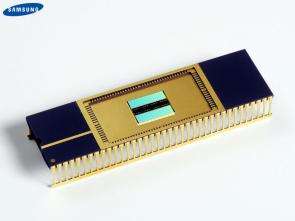
Samsung Electronics announced that it has completed the first working prototype of what is expected to be the main memory device to replace high density NOR flash within the next decade - a Phase-change Random Access Memory (PRAM). The company unveiled the 512M-Megabit (Mb) device at its sixth annual press conference in Seoul yesterday.
More scalable than any other memory architecture being researched, PRAM features the fast processing speed of RAM for its operating functions combined with the non-volatile features of flash memory for storage, giving it the nickname : perfect RAM.
A key advantage in PRAM is its extremely fast performance. Because PRAM can rewrite data without having to first erase data previously accumulated, it is effectively 30-times faster than conventional flash memory. Incredibly durable, PRAM is also expected to have at least 10-times the life span of flash memory.
PRAM will be a highly competitive choice over NOR flash, available beginning sometime in 2008. Samsung designed the cell size of its PRAM to be only half the size of NOR flash. Moreover, it requires 20 percent fewer process steps to produce than those used in the manufacturing of NOR flash memory.
Samsung's new PRAM was developed by adopting the use of vertical diodes with the three-dimensional transistor structure that it now uses to produce DRAM. The new PRAM has the smallest 0.0467um2 cell size of any working memory that is free of inter-cell noise, allowing virtually unlimited scalability.
Adoption of PRAM is expected to be especially popular in the future designs of multi-function handsets and for other mobile applications, where faster speeds translate into immediately noticeable boosts in performance. High-density versions will be produced first, starting with 512 Mb.
Source: Samsung Electronics


