A projector the size of a sugar cube
September 12, 2006 A projector the size of a sugar cube

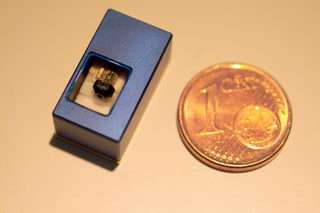
This projector gets by with a single mirror instead of a million. As a result, it is small and easily manageable. © Fraunhofer IOF

No larger than a sugar cube, the video projector is ready to hand at all times. Instead of the conventional microarrays, it contains just a single mirror which can be rotated around two axes. This makes it smaller, lighter and handier than traditional.

Cameras, MP3 players and memory chips are growing smaller by the day. The next challenge is to shrink the projector, a device used day in day out in lecture halls and for video presentations.

However, all attempts at miniaturization have so far come up against certain physical boundaries: the core piece of the classic projector is a micromirror array comprising a million mirrors. These can be tilted in one plane and are evenly illuminated. By turning towards or away from the light source, they produce light or dark pixels that together form the projected image. But not only do the arrays preclude miniaturization, their unaffordable prices also make it difficult for projectors to enter the consumer goods market.

Researchers at the Fraunhofer Institute for Photonic Microsystems IPMS in Dresden and the Fraunhofer Institute for Applied Optics and Precision Engineering IOF in Jena have now come up with an alternative to the previous micromirror arrays. The result is a projector the size of a sugar cube. “We use just one single mirror,” reveals Andreas Bräuer, director of the Microoptic Systems division at IOF. “This mirror can be tilted around two axes.”

The next obstacle in the miniaturization process is the light source. The customary high-pressure lamp will have to give way to small diode lasers if the projector is to shrink to the size of a sugar cube. While red and blue diode lasers are already small enough, green lasers are still too bulky.

Today’s technology allows RGB projectors with a side length of ten by seven by three centimeters to be produced. Although this is still distinctly larger than a sugar cube, it is only a quarter the size of a standard projector. Researchers around the globe are attempting to scale down the green light source. Together with the blue and red diode lasers, it will ideally form the new red-green-blue source. “If green diode lasers are successfully reduced to the size of red ones, then RGB projectors the size of sugar cubes will become a reality,” states Bräuer.

Such would prove useful in many areas. The automotive industry, for example, requires small, cost-effective laser arrays to act as distance sensors that measure the gap between the car and the nearest object when parking. Sensors of this type are also used in robotics and installation technology. Yet another area of usage for the mini-lasers are digital projectors, which can be integrated in mobile devices such as laptops or PDAs.

Source: Fraunhofer-Gesellschaft


Rate this story - 3.1 /5 (163 votes)


September 12, 2006 all stories

Comments: 0

3.1 /5 (163 votes)

  • hide
  • Related Stories

  • Smart bubbly, corny USB sticks lead fair's gadget parade
    created Mar 04, 2009 | popularity not rated yet | comments 0
  • Vest-pocket beamer
    created Dec 08, 2004 | popularity not rated yet | comments 0
  • Useful, useless and unusual at US gadget show
    created Jan 11, 2010 | popularity not rated yet | comments 0
  • Laser projector, set-top box win gadget awards
    created Jan 10, 2010 | popularity not rated yet | comments 0
  • BlackBerry presents PowerPoint for 'road warriors'
    created Jan 08, 2010 | popularity not rated yet | comments 0


  • hide
  • Relevant PhysicsForums posts

Other News

Student Builds Spider Robot From Spare Parts

Student Builds Spider Robot From Spare Parts (w/ Video)

Electronics / Robotics

created 10 hours ago | popularity 4.6 / 5 (10) | comments 3

Picture a spider-like robot that teaches itself to walk, can adapt when damaged and watches its maker as he moves around the room. That might sound terrifying.


US technology titans IBM and Intel have rolled out powerful new computer chips designed for business networks

Intel, IBM roll out new computer network chips

Electronics / Hardware

created 22 hours ago | popularity 5 / 5 (4) | comments 1

US technology titans IBM and Intel have rolled out powerful new computer chips designed for businesses continually demanding more from networks and data centers.


Seagate Ships 10,000 RPM 600 GB 2.5-inch Hard Drive

Electronics / Hardware

created 8 hours ago | popularity 3 / 5 (2) | comments 0

Seagate today announced worldwide shipments of its Savvio 10K.4 hard disk drive (HDD), the world's highest-capacity and most reliable 2.5-inch enterprise-class drive.


Millimeter-scale, energy-harvesting sensor system developed

Millimeter-scale, energy-harvesting sensor system developed

Electronics / Hardware

created Feb 08, 2010 | popularity 4.8 / 5 (12) | comments 5 | with audio podcast

(PhysOrg.com) -- A 9-cubic millimeter solar-powered sensor system developed at the University of Michigan is the smallest that can harvest energy from its surroundings to operate nearly perpetually.


Robonaut 2: NASA, GM Create Cutting Edge Robotic Technology

Robonaut 2: NASA, GM Create Cutting Edge Robotic Technology

Electronics / Robotics

created Feb 04, 2010 | popularity 4.5 / 5 (13) | comments 8 | with audio podcast

(PhysOrg.com) -- Robonaut is evolving. NASA and General Motors are working together to accelerate development of the next generation of robots and related technologies for use in the automotive and aerospace ...