Trenches create memory space
September 12, 2006 Trenches create memory space

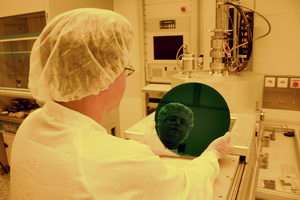
The 300-mm wafers are coated with an etch-resistant film in the cleanroom. Currently being tested: Masks made of aluminum nitride instead of silicon dioxide. © Fraunhofer IKTS

The requirements are tightening up. Computers are having to become more and more efficient. A new technology boosts memory capacity: etching the silicon wafer creates deep trenches that increase its capacity to store data.

Computers are required to become more and more efficient. Inevitably, this involves greater demands on memory devices as well: they should be as small, strong, fast, and economical as possible – and always stay cool, if you please!

Only memory modules – known in technical terminology as DRAM – which outstrip their rivals in these areas, have any chance of a future career in PCs, laptops, mobile communications, the entertainment industry and the gigantic server parks of Internet service providers. The memory business generates a worldwide sales volume of 25 billion dollars a year.

The pressure to innovate is relentless, and only manufacturers with the best technologies and the most efficient production methods can survive. The world’s second-largest supplier in the hotly contested DRAM market is the Dresden-based chip manufacturer Qimonda. The new company, a wholly-owned Infineon subsidiary, currently produces memory components based on 90-nanometer technology, and is striving to be able to etch structures only 65 nanometers wide on the silicon wafers in the not-too-distant future.

Qimonda is supported by engineers at the Fraunhofer Institute for Ceramic Technologies and Systems IKTS in Dresden. The team of researchers led by Tobias Mayer-Uhma, Falko Schlenkrich and Ingolf Endler has developed a new etch-resistant film that will make it possible to produce deeper and narrower “trenches”, for it is this that makes the vital difference in memory chip production.

After a series of complex processing steps such as photolithography, etching and polishing, an etch-resistant silicon dioxide film, known as the “hard mask”, is applied. This film contains the structures into which the trenches are later etched using an etching gas. Subsequently filling up such a trench with dielectric material produces a capacitor. The deeper the trenches are etched, the more wall surface is available and the greater is the capacitance.

“We provide the technology for manufacturing and etching these masks,” explains Mayer-Uhma. In order to etch increasingly deep trenches, the Fraunhofer researchers are developing and testing more reactive gas mixtures along with correspondingly more robust mask materials. Masks made of aluminum nitride – which is five times more resistant to etching gas than silicon dioxide – are currently being tested at the team’s own modified vapor deposition facility.

Source: Fraunhofer-Gesellschaft


print this article email this article download pdf blog this article bookmark this article     Stumble it Digg this share on Facebook retweet share on Reddit add to delicious
Rate this story - 2.8 /5 (6 votes)


September 12, 2006 all stories

Comments: 0

2.8 /5 (6 votes)
  • Stumble this up

  • Digg this

  • share this

  • hide
  • Related Stories

  • Early scents really do get 'etched' in the brain
    created Nov 05, 2009 | popularity not rated yet | comments 0
  • Operating quantum memory at room temperature
    created Aug 25, 2008 | popularity not rated yet | comments 0
  • Pinpoint microwave resolution could lead to wireless power transfer
    created Apr 25, 2008 | popularity not rated yet | comments 0
  • Proposed 'Nanomechanical' Computer is Both Old-School and Cutting-Edge
    created Aug 03, 2007 | popularity not rated yet | comments 0
  • Toshiba Develops New NAND Flash Technology
    created Jun 12, 2007 | popularity not rated yet | comments 0


  • hide
  • Relevant PhysicsForums posts

Other News

Google digital book ambitions hinge on settlement (AP)

Google makes concessions on digital book deal (Update)

Technology / Internet

created 17 hours ago | popularity 5 / 5 (1) | comments 2

(AP) -- Google Inc. will loosen its control over millions of copyright-protected books that will be added to its digital library if a federal judge approves a revised legal settlement addressing the earlier ...


Aircraft that can see for themselves

Aircraft that can see for themselves (w/ Video)

Technology / Engineering

created 17 hours ago | popularity 4.6 / 5 (9) | comments 0

(PhysOrg.com) -- Australian researchers have made two important advances in the development of unmanned aircraft capable of seeing for themselves as they fly fast and low over dangerous terrain.


Road trains may be coming soon to Europe

Road trains may be coming soon to Europe (w/ Video)

Technology / Engineering

created Nov 13, 2009 | popularity 4.8 / 5 (11) | comments 17

(PhysOrg.com) -- Road trains linking vehicles together in a traveling convoy are planned for Europe. With only the lead vehicle being actively driven, the road trains would allow commuters to sleep, read a ...


A system of space solar power system (SSPS)

Japan eyes solar station in space as new energy source

Technology / Energy

created Nov 08, 2009 | popularity 4.8 / 5 (21) | comments 28

It may sound like a sci-fi vision, but Japan's space agency is dead serious: by 2030 it wants to collect solar power in space and zap it down to Earth, using laser beams or microwaves.


The collection and storage and retention of the household data makes it vulnerable to security breaches

New 'smart' electrical meters raise privacy issues

Technology / Energy

created Nov 06, 2009 | popularity 4.3 / 5 (11) | comments 12

The new "smart meters" utilities are installing in homes around the world to reduce energy use raise fresh privacy issues because of the wealth of information about consumer habits they reveal, experts said ...