Islands spark accelerated evolution
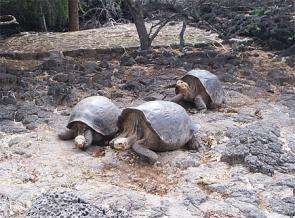
The notion of islands as natural test beds of evolution is nearly as old as the theory itself. The restricted scale, isolation, and sharp boundaries of islands create unique selective pressures, often to dramatic effect. Following what’s known as the “island rule,” small animals evolve into outsize versions of their continental counterparts while large animals shrink.
Giant tortoises and iguanas still inhabit the Galápagos and a few other remote islands today, but only fossils remain of the dwarf hippopotami, elephants, and deer that once lived on islands in Indonesia, the Mediterranean, and the Pacific Ocean. The fossil record suggests that these size changes occur rapidly after species become isolated on islands, but this long standing assumption has never been empirically examined in a systematic manner. Now, in a new study published in PLoS Biology, Virginie Millien confirms that island species undergo accelerated evolutionary changes over relatively short time frames, between decades and several thousand years.
Millien collected data from text, figures, and tables in an extensive survey of the published literature. From these datasets, she calculated a total of 826 evolutionary rates for 170 populations representing 88 species. Rates of evolutionary change, she found, decreased over time for both island and mainland species, with a slower rate of decrease for island species. The differences in evolutionary rates between island and mainland pairs also decreased over time, becoming statistically insignificant for intervals over 45,000 years. Overall, island species evolved faster than mainland species—a phenomenon that was most pronounced for intervals between 21 years through 20,000 years.
The finding that mammals evolve faster on islands, Millien argues, comports with the island evolution theory prediction that mammals respond to their new island homes with rapid morphological and size adaptations. The brisk pace of these changes may explain why the fossil record harbors few examples of intermediate forms between the mainland ancestor and island descendant. Millien’s results are also consistent with the hypothesis that evolution rates for island species slow down after the initial period of accelerated change, approaching rates on the mainland.
If island species can evolve quickly, Millien argues, it stands to reason that mainland species retain a similar capacity. As habitat destruction continues to pose the number one threat to biodiversity, many mainland habitats are beginning to resemble islands, with isolated pockets of wildlife separated by degraded or developed lands.
Thus, island species may serve as a model for understanding how mainland species will adapt to the rapidly changing environmental conditions brought on by habitat destruction and global warming. It appears that some mainland species are already responding like island species: a 1989 study followed the island rule in linking fragmented habitat to body size changes in 25 European mammals over the past 200 years. How long animals can continue to evolve in the face of these changes, however, remains to be seen.
Citation: Millien V (2006) Morphological evolution is accelerated among island mammals. PLoS Biol 4(10): e321. DOI: 10.1371/journal.pbio.0040321. dx.doi.org/10.1371/journal.pbio.0040321
Source: Public Library Of Science


