Compact Muon Solenoid magnet reaches full field
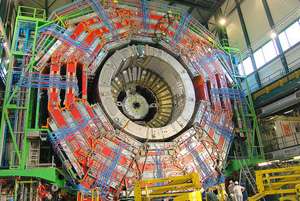
Scientists of the U.S. Department of Energy/Office of Science's Fermi National Accelerator Laboratory and collaborators of the US/CMS project have joined colleagues from around the world in announcing that the world's largest superconducting solenoid magnet has reached full field strength in tests at CERN, the European Particle Physics Laboratory.
Weighing in at more than 13,000 tons, the Compact Muon Solenoid experiment's magnet is built around a 20-foot-diameter, nearly 43-foot-long superconducting solenoid - a wire coil with multiple loops, which generates a magnetic field when electricity passes through it. The CMS solenoid generates a magnetic field of 4 Tesla, some 100,000 times stronger than the Earth's magnetic field, and stores 2.5 gigajoules of energy, enough to melt nearly 20 tons of gold. Superconductivity is achieved by chilling the coil to a temperature near absolute zero, where virtually all electrical resistance vanishes. Extremely high electrical current can then be used to generate a powerful magnetic field.
CMS is one of the experiments preparing to take data at CERN's Large Hadron Collider (LHC) particle accelerator, scheduled to begin operations in November 2007. Physicists from the US, CERN and around the world will address some of nature's most fundamental questions, such as why particles have mass, and what makes up the so-far-unexplored 96 percent of the universe. Through Fermilab, the DOE's Office of Science has contributed $23 million to the CMS magnet construction.
"We see this excellent early test result as just the beginning of a great scientific return on our investment," said Robin Staffin, DOE's Associate Director, Office of High Energy Physics. "We see a strong and continuing U.S. role at the leading edge of particle physics research during an exciting new era of scientific discovery."
Some 2000 scientists from 155 institutes in 36 countries - including approximately 600 members of US/CMS, the US contingent of the CMS collaboration - are working together to build the CMS particle detector, which is currently undergoing tests prior to installation in an experimental hall about 328 feet underground. The tests are being carried out with a full slice of the CMS detector, including all its subsystems.
"After recording 30 million tracks from cosmic ray particles," said CMS spokesman Michel Della Negra of CERN, "all systems are working very well, and we're looking forward to first collisions in the LHC next year."
The CMS magnet has two unique characteristics: its strong magnetic field and the uniformity of its field over a large volume.
"This magnet is the central device around which the entire experiment is built," said Fermilab's Dan Green, Research Project Manager for US/CMS. "This test is a great success, and the entire process has gone very smoothly."
The University of Wisconsin at Madison, a US/CMS member, designed the magnet's steel return yoke for the detector endcap. Fermilab supplied the superconductor cable, along with aluminum matrix and stabilizing aluminum for the superconductor wire coil. The aluminum is needed to protect the coil against quenches by transporting heat away from the conductor. In addition, Fermilab engineered a strengthening of the cryostat supporting the hadron calorimeter, which tracks particle collisions and was also supplied by the US; and designed the magnetic field mapper, which offers detailed and accurate measurement of the field in three dimensions. The measurements are needed to confirm the design, and provide input to the tracking to accurately determine particle momenta. Green said the field mapper would be starting up soon.
CMS magnet construction was approved in 1996, and began in earnest in 1998. By 2002, fabrication of the superconducting wire was complete. Winding the cable to produce the solenoid coil began in 2000 and took five years to achieve. By the end of 2005, the solenoid was ready for testing, and in February this year, it was cooled down to its operating temperature of around -269 degrees Celsius. Following the insertion of particle detectors, testing started at the end of July.
The magnet is a common project in which all of CMS's 155 institutes have taken part, with major contributions made by the Department of Energy's Fermilab and the University of Wisconsin in US/CMS; the French Atomic Energy Commission in Saclay (CEA); CERN, the Swiss Federal Polytechnic Institute in Zurich (ETHZ); the Italian National Institute of Nuclear Physics (INFN) in Genoa, and the Russian Institute for Theoretical and Experimental Physics (ITEP) in Moscow.
Source: Fermilab


