Titan Weather: Cloudy Every 15 Years
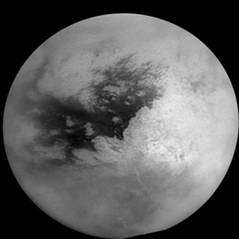
About two years ago, before the Huygens probe arrived at Titan, Henry Roe, a graduate student I was working with at Berkeley, discovered clouds on Titan. He was the first person to get images of what he thought were clouds on the south pole.
We sent his results off for publication, which is what a good graduate student is supposed to do, and the editor sent it out for review. But the reviewer said, "Nope, those aren't clouds. That's a mistake in the data processing. It's just an artifact." So I had the student assemble the raw data as well as the processed data, and the clouds were still there in the raw data.
So we were predicting clouds on the southern rim of Titan. When Henry first saw them, they had just appeared there. They hadn't been there before. So the Cassini orbiter flew under Titan and took pictures of the south pole looking up - and there were the clouds. It's really spectacular. It was a real vindication for Henry Roe. And it shows the advantage of actually being there to see them, of being able to get underneath Titan and look up at them, rather than looking at them edge-on.
In the images that were taken over a five-hour period in July, you can see that the clouds have changed. If you fly in and out of Dallas in the summer, you'll often see thunderstorm lines up along the plains. They change, too, over a period of about an hour or so.
So the clouds on Titan changed on about the same time scale as a thunderstorm system on Earth. You look at them and they could be clouds on Earth. They're white, fluffy, billowing. But they're not water. There's no water anywhere near here. These are methane, liquid methane clouds. And the temperature there is about minus 200 Centigrade. And there are clouds and they're moving.
On Earth, clouds tend to form mostly in the tropics, where the sun is the brightest and the thermal contrast between the dark cycle and the light cycle, night and day, is the strongest. That causes upwelling, which drives clouds to form near the equator.
On Titan, we don't see clouds at the equator. We see clouds at the pole. Titan is different from Earth in that the place on Titan which has the strongest contrast between dark and light is the poles. At Titan's equator, the sun goes up and sets, but the atmosphere is so thick that at nighttime the temperature is the same as the daytime.
The thermal response of the atmosphere is much, much longer than the Titan day, which is 16 Earth days. But it's shorter than the Titan year, which is 30 Earth years.
In fact, in the equatorial mid-latitude regions of Titan, the temperature hasn't changed in 20 years. It's exactly the same to half a degree. So it's very easy to predict. If you were a weatherman working on Titan, in the mid-latitude, your report would be, "Temperature today and tomorrow will be exactly like it was yesterday. And we can predict that for the next 20 years it will be exactly the same."
The only place on Titan where you can have a light-dark contrast, which is what drives this kind of storm activity, is in the polar regions, not at the equator. In that sense, it's different from the Earth in its meteorology.
These clouds are now gone. We don't see them any more. They were only there during the height of Titan's southern summer, when the southern pole was getting 24 hours of sunlight. That's when the clouds came. Now that fall has come to Titan, the clouds have gone away. They were apparently only there for a couple of years. And our prediction is that in another 15 years, clouds will form at the north pole, as that becomes sunlit summer. So, I'm going too try to stick around to see that.
My buddy Henry Roe, who's now a post-doc, also detected clouds in Titan's mid-latitudes. He's seeing these thin clouds, sort of like Cirrus clouds, at 40 degrees south, all the time. There are two possible explanations. One is that, like on Earth, there's a certain convergence there, and that's creating clouds. It's an atmospheric effect. If that's true, as we watch it, with seasons the clouds will move north and in 10 years they'll be up at 30 degrees north.
The other possibility is that there is a cryovolcano at 40 degrees south, a source of methane, a volcano ejecting methane. Remember the reason we once thought Titan had an ocean was that something had to be resupplying the atmosphere with methane. Well, there's no ocean. So you might be wondering, How is Titan resupplying the atmosphere then? Good question. It's not coming from an ocean; what could it be coming from? Henry suggested that these clouds could be caused by a cryovolcano. And if you calculate how much methane this volcano would have to put out to make these clouds, it turns out to be just the right amount to keep the atmosphere in methane.
So there are dueling views. Some people think these clouds are caused by atmospheric circulation, some people think it's a cryovolcano. We don't know. We'll just have to wait and see.
Copyright 2005 by Space Daily, Distributed United Press International


