Astronomers discover strange new planet
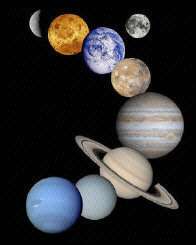
September 14, 2006 NASA montage of planets

U.S. astronomers have discovered a planet unlike any other known in the universe. Smithsonian scientists say the new planet was discovered using a network of small automated telescopes known as HATl. The planet -- designated HAT-P-1 -- orbits one member of a pair of distant stars 450 light-years away in the constellation Lacerta.

"We could be looking at an entirely new class of planets," said Gaspar Bakos, a Hubble fellow at the Harvard-Smithsonian Center for Astrophysics in Cambridge, Mass.

With a radius about 1.38 times that of Jupiter, HAT-P-1 is the largest known planet. But, in spite of its huge size, its mass is only half that of Jupiter.

"This planet is about one-quarter the density of water," Bakos said. "In other words, it's lighter than a giant ball of cork! Just like Saturn, it would float in a bathtub if you could find a tub big enough to hold it."

Astronomer Robert Boyes, co-discoverer of the planet, said, "This new discovery suggests something could be missing in our theories of how planets form."

Bakos is lead author of a paper submitted to the Astrophysical Journal describing the discovery.

Copyright 2006 by United Press International


print this article email this article download pdf blog this article bookmark this article     Stumble it Digg this share on Facebook retweet share on Reddit add to delicious
Rate this story - 4.1 /5 (116 votes)


September 14, 2006 all stories

Comments: 0

4.1 /5 (116 votes)
  • Stumble this up

  • Digg this

  • share this

  • hide
  • Related Stories


  • hide
  • Relevant PhysicsForums posts

  • Question about 2-body gravity
    created 20 hours ago
  • life on Mars
    created 23 hours ago
  • Semi-major axis from cartesian co-ordinates
    created Nov 23, 2009
  • Primary Mirror grinding
    created Nov 23, 2009
  • More from Physics Forums - General Astronomy

Other News

America's increasing food waste is laying waste to the environment

Space & Earth / Environment

created 31 minutes ago | popularity not rated yet | comments 0

Food waste contributes to excess consumption of freshwater and fossil fuels which, along with methane and carbon dioxide emissions from decomposing food, impacts global climate change. In a new paper published in the open-access, ...


Shuttle Atlantis leaves space station, headed home (AP)

Shuttle Atlantis leaves space station, headed home

Space & Earth / Space Exploration

created 42 minutes ago | popularity not rated yet | comments 0

(AP) -- Atlantis and its seven astronauts have left the International Space Station.


First black holes may have incubated in giant, starlike cocoons, says CU-Boulder study

First black holes may have incubated in giant, starlike cocoons

Space & Earth / Astronomy

created 16 hours ago | popularity 4.4 / 5 (10) | comments 15

(PhysOrg.com) -- The first large black holes in the universe likely formed and grew deep inside gigantic, starlike cocoons that smothered their powerful x-ray radiation and prevented surrounding gases from ...


Cassini Captures Ghostly Dance of Saturn's Northern Lights

Cassini Captures Ghostly Dance of Saturn's Northern Lights (w/ Video)

Space & Earth / Space Exploration

created 13 hours ago | popularity 5 / 5 (5) | comments 0

(PhysOrg.com) -- In the first video showing the auroras above the northern latitudes of Saturn, Cassini has spotted the tallest known "northern lights" in the solar system, flickering in shape and brightness ...


ET: Check your voicemail

ET: Check your voicemail

Space & Earth / Space Exploration

created 13 hours ago | popularity 3.4 / 5 (5) | comments 5

(PhysOrg.com) -- Alien beings on faraway planets may not have noticed, but it’s been 35 years since human beings made the first deliberate effort to send them a message.