Study: Romantic male mice enjoy singing
November 1, 2005
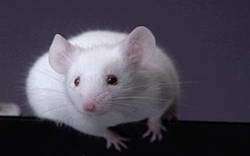
Washington University scientists have confirmed a long-standing suspicion: romantic male mice enjoy singing complex songs to potential mates.
Neuroscientists at the St. Louis university found male mice burst out in song when they encounter sex pheromones from female mice, The Guardian reported.
The songs aren't audible to humans because they are sung at an extremely high frequency.
Researchers Tim Holy and Zhongsheng Guo said they made their discovery while testing how male mice responded to sex pheromones. The scientists said within seconds of encountering female mouse urine, the males began emitting ultrasonic songs.
The scientists recorded the sounds and then made them audible to the human ear by slowing the audio track and lowering the pitch, while retaining the tempo.
Such courtship melodies are common among birds, insects, and frogs, but such behavior in mammals has previously been thought limited to humans, whales and bats.
The study appears in the open access journal, Public Library of Science, Biology.
Copyright 2005 by United Press International
-
Mammal secrets
9 hours ago |
not rated yet |
0
-
Copper + love chemical = big sulfur stink
Feb 06, 2012 |
4.3 / 5 (6) |
1
-
Sex-specific behaviors traced to hormone-controlled genes in the brain
Feb 02, 2012 |
5 / 5 (5) |
4
-
A mighty revealing mouse
Feb 01, 2012 |
5 / 5 (1) |
0
-
Tiny crooners: Male house mice sing songs to impress the girls
Jan 26, 2012 |
4.7 / 5 (3) |
0
-
Engineers build first sub-10-nm carbon nanotube transistor
Feb 01, 2012 |
4.9 / 5 (30) |
30
-
Something old, something new: Evolution and the structural divergence of duplicate genes
Jan 31, 2012 |
4.6 / 5 (7) |
1
-
The hidden nanoworld of ice crystals: Revealing the dynamic behavior of quasi-liquid layers
Jan 30, 2012 |
5 / 5 (3) |
1
-
Stock market network reveals investor clustering
Jan 27, 2012 |
3.9 / 5 (23) |
8
-
Of microchemistry and molecules: Electronic microfluidic device synthesizes biocompatible probes
Jan 26, 2012 |
5 / 5 (1) |
0
More news stories
Prague gets hold of modern genetics founder Mendel's papers
Germany has handed to the Czech Republic a manuscript of Johann Gregor Mendel, founder of modern genetics, on his plant hybridization experiments, the Czech foreign minister said Thursday.
2 hours ago |
not rated yet |
0
US workers are 'giving away the store,' costing firms billions
Nearly 70 percent of the nation's service employees give away free goods and services from hamburgers to cable TV costing companies billions of dollars a year, according to a groundbreaking study.
Other Sciences / Economics & Business
5 hours ago |
not rated yet |
6
Storm warning: Financial tsunami heading this way
In today's global village, national coffers are more interconnected than ever before. And as the current economic crisis has proven, a downturn in one country can travel in a wave across the globe, like a financial tsunami. ...
Other Sciences / Economics & Business
6 hours ago |
1 / 5 (1) |
5
'Flipped classroom' teaching model gains an online community
Researchers at Harvard University have launched the Peer Instruction (PI) Network, a new global social network for users of interactive teaching methods.
Other Sciences / Social Sciences
6 hours ago |
5 / 5 (2) |
0
Kids show cultural gender bias
(PhysOrg.com) -- Talk about gender confusion! A recent study by University of Alberta researchers Elena Nicoladis and Cassandra Foursha-Stevenson in the Journal of Cross-Cultural Psychology into whether speaki ...
Other Sciences / Social Sciences
11 hours ago |
2 / 5 (1) |
2
'Dark plasmons' transmit energy
Microscopic channels of gold nanoparticles have the ability to transmit electromagnetic energy that starts as light and propagates via "dark plasmons," according to researchers at Rice University.
Anyone can learn to be more inventive, cognitive researcher says
There will always be a wild and unpredictable quality to creativity and invention, says Anthony McCaffrey, a cognitive psychology researcher at the University of Massachusetts Amherst, because an "Aha moment" is rare and ...
New method makes culture of complex tissue possible in any lab
Scientists at the University of California, San Diego have developed a new method for making scaffolds for culturing tissue in three-dimensional arrangements that mimic those in the body. This advance, published online in ...
Ultraviolet protection molecule in plants yields its secrets
Lying around in the sun all day is hazardous not just for humans but also for plants, which have no means of escape. Ultraviolet (UV) radiation from the sun can damage proteins and DNA inside cells, leading ...
Cell biologists describes mechanism by which some people may be more susceptible to colon cancer
An international research team led by cell biologists at the University of California, Riverside has uncovered a new insight into colon cancer, the third leading cause of cancer-related deaths in the United ...
Hydrogen from acidic water: Researchers develop potential low cost alternative to platinum for splitting water
A technique for creating a new molecule that structurally and chemically replicates the active part of the widely used industrial catalyst molybdenite has been developed by researchers with the Lawrence Berkeley ...