Researchers unveil reliable new approach to cancer drug delivery
Prostate, breast and other cancer patients may be offered a new, stauncher targeted drug delivery system to treat their diseases in the next decade.
Using atomic force microscopy and computer simulations, researchers from Lawrence Livermore National Laboratory and the UC Davis Cancer Center have unveiled a new and reliable technique to characterize the binding interaction of multivalent molecules designed for targeted drug delivery in cancer treatment.
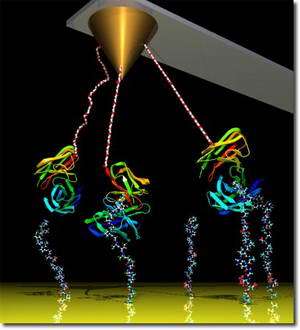
Image: Stretching and breaking multiple parallel antibody-antigen bonds with Atomic Force Microscopy (AFM). The model shows an AFM tip with three tethered single-chain antibody fragments that mimic the architecture of a cancer drug. Two of the antibody fragments bind the target cancer marker MUC1 on the surface. Researchers measure the interactions’ strength by pulling on the MUC1-antibody bonds with the cantilever. This technique can help to design more efficient immunotherapeutics for cancer treatment. Ed Lau/LLNL
The Livermore team used atomic force microscopy (AFM) to measure the binding forces between several single-chain antibody fragments and Mucin1 peptide. Mucin1 is commonly found in large quantities in a variety of epithelial cells in the human body, and one of its specific forms is a characteristic marker for prostate, breast, colon, lung, gastric and pancreatic cancers. Binding between Mucin1 and antibodies recognizing the marker is critical to targeted drug delivery for cancer patients.
“We found a very good way of quantifying the drug binding affinity, which determines the drug’s efficiency,” said Aleksandr Noy, a researcher in LLNL’s Chemical Biology and Nuclear Sciences Division (CBDN), who along with CBDN postdoctoral student Todd Sulchek is the lead author of a paper that appears in the Proceedings of the National Academy of Sciences online edition for the week of Oct. 31-Nov. 4. “Not only does this technique aid doctors in delivering targeted drugs in cancer treatment, but it also may benefit the Laboratory’s efforts evaluating antibodies and designing better binding molecules for biosensors that play such a critical role in national security.”
Noy said the technique could be applied to other types of cancer including colon, lung, gastric and pancreatic.
The UC Davis collaborators are one of the leading groups in the radioimmunotherapeutics development field. The group has had promising outcomes from testing this new generation of enhanced radioimmunotherapeutics.
The team’s results open significant new opportunities for researchers in areas ranging from drug design to biophysics.
“We developed a technique that could help to optimize binding affinity, so for this particular application we have looked at super-binders targeting cancer cells,” Noy said. “If the program wants to create a super-binder for a pathogen assay, the technology and the results will be directly applicable.”
In addition to Noy and Sulchek, Livermore scientists Raymond Friddle, Kevin Langry, Edmond Lau, Timothy Ratto and Michael Colvin (who now works at UC Merced) collaborated with UC Davis Cancer Center researchers Huguette Albrecht and Sally DeNardo.
Source: Lawrence Livermore National Laboratory


