Mathematicians get a handle on centuries old shape
November 1st, 2005 Mathematicians get a handle on centuries old shape

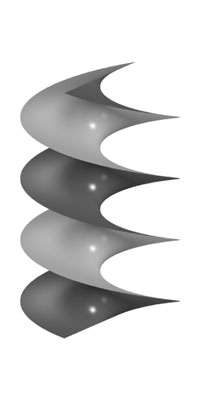
It has been almost 230 years since French general and mathematician Jean Meusnier's study of soap films - the same kind used by children today to blow bubbles -- led to one of the fundamental mathematical examples in geometric optimization. Meusnier showed that one of nature's simplest geometric figures - an ordinary two-dimensional plane -- could be twisted infinitely into a helicoid, a shape that has the delicate balance everywhere of a soap film.

Meusnier offered mathematical proof that the helicoid - which resembles a parking garage ramp -- was a "minimal" surface, meaning that each part of the surface had the same shape as a curved soap film. In new findings published online today by the Proceedings of the National Academy of Sciences, a team of mathematicians from Rice, Stanford and Indiana universities offers the first proof since Meusnier's for a new type of minimal surface that meets the same criteria of being an infinitely twisted version of a fundamentally simple shape.

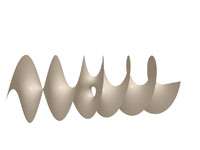
Mathematicians Matthias Weber of Indiana, David Hoffman of Stanford and Michael Wolf of Rice call the new surface a "genus one helicoid." From far away, the surface looks much like Meusnier's helicoid. However, when untwisted, the new shape differs from the flat plane of Meusnier's untwisted helicoid in a key way: It has a curved handle, much like the handle one might find on the flat lid of a kitchen pot.

"A soap film spanning a bent coathanger -- regardless of how many twists you add to the hanger -- will use the least amount of material necessary to do that work of spanning," said Wolf, professor and chair of the Rice's Department of Mathematics . "This was a natural optimization problem for 18 th and 19 th century geometers and physicists to study, and it shed light on many problems where one is interested in the best or most efficient shape to serve a purpose.
Mathematicians get a handle on centuries old shape
"What mathematicians are finding in the past 25 years is that these surfaces are far more abundant than most people ever dreamed," Wolf said. "Until recently, most people would have guessed that any attempt to sew a handle onto a helicoidal soap film would have destroyed the soap film, even theoretically."

Hoffman and colleagues first identified the shape of the genus one helicoids in 1992, but the latest paper offers the first full theoretical proof that the new shape never doubles back to intersect itself.

Given the high-powered computational tools available in the 21 st Century, one might expect that Weber, Hoffman and Wolf's proof would contain computer code or computational tools unavailable to an 18 th Century scholar like Meusnier. In reality, the two documents are more similar than not, Wolf said.

"Computers have certainly influenced some aspects of mathematical research," Wolf said. "Mathematicians can use computers to experiment with some of the phenomena they study in very sophisticated ways. In this case, my collaborators had strong numerical evidence that what we were trying to prove was true and that our basic approach reflected what was true in nature.

"However, mathematicians still require the same sort of airtight, absolutely convincing argument that they always have," Wolf said. "Providing that was the challenge here, even after we were quite sure that this surface existed."

The proof itself runs more than 100 pages and contains no computational evidence, only prose and logic.

Wolf said that while it is impossible to predict how the research will be applied to specific scientific problems, history has shown time and again that mathematical discoveries are almost invariably transmitted and transformed into useful solutions for society.

"I don't know of a practical use of a helicoid with a handle, but now I know that soap films are more flexible than they were once thought to be," Wolf said. "That adds to our understanding of shapes and optimization, and though there is an excitingly broad range of possibilities, no one can ever really know where it will lead."

Source: Rice University


print this article email this article download pdf blog this article bookmark this article     Digg this Stumble it share on Facebook share on Reddit add to delicious save to Yahoo! bookmarks
4.9/5 after 8 votes


November 1st, 2005 all stories
Other Sciences /

Comments: 0
Rank: 4.9/5 after 8 votes

  • Stumble this up

  • Digg this

  • Share it:
  • share on Facebook
  • share on MySpace
  • share on Slashdot
  • rss-newsfeed
  • share on Google
  • share on Reddit
  • add to delicious
  • save to Yahoo! bookmarks
  • share on Windows Live
  • Add to Mixx!
Rating: 4.9/5 after 8 votes

  • Related Stories

  • Mathematicians solve old problem that may have new applications
    created Dec 25, 2005 | popularity not rated yet | comments 0
  • Grey wolf withdrawn from US endangered list
    created May 04, 2009 | popularity not rated yet | comments 0
  • Scientists examine effect of wolves' absence and see an ecosystem 'unraveling'
    created Jan 29, 2009 | popularity not rated yet | comments 0
  • Hubble captures outstanding views of mammoth stars
    created Nov 25, 2008 | popularity not rated yet | comments 0
  • 'Missing link' galaxies discovered
    created Nov 25, 2008 | popularity not rated yet | comments 0

Tags


  • Physicists Demonstrate Quantum Memory with Matter Qubits
    Physicists Demonstrate Quantum Memory with Matter Qubits
    Physics / General Physics
    created Jul 03, 2009 | popularity 4.4 / 5 (17) | comments 1
  • 'Holey' Nanosheets for Wastewater Dye Removal
    Nanotechnology / Nanomaterials
    created Jul 01, 2009 | popularity 5 / 5 (5) | comments 1
  • Jellyfish Robot Swims Like its Biological Counterpart
    Jellyfish Robot Swims Like its Biological Counterpart
    Electronics / Robotics
    created Jun 26, 2009 | popularity 4.4 / 5 (8) | comments 1
  • Could Maxwell's Demon Exist in Nanoscale Systems?
    Could Maxwell's Demon Exist in Nanoscale Systems?
    Physics / General Physics
    created Jun 24, 2009 | popularity 4.4 / 5 (18) | comments 29
  • Living Safely with Robots, Beyond Asimov's Laws
    Living Safely with Robots, Beyond Asimov's Laws
    Electronics / Robotics
    created Jun 22, 2009 | popularity 4.6 / 5 (52) | comments 40
  • Other News

    Creation Museum president Ken A. Ham

    Paleontologists brought to tears, laughter by Creation Museum

    Other Sciences / Other

    created Jun 30, 2009 | popularity 4.3 / 5 (41) | comments 120

    For a group of paleontologists, a tour of the Creation Museum seemed like a great tongue-in-cheek way to cap off a serious conference.


    Mummified dinosaur skin yields up new secrets

    Mummified dinosaur skin yields up new secrets

    Other Sciences / Archaeology & Fossils

    created Jul 01, 2009 | popularity 4.7 / 5 (15) | comments 10

    (PhysOrg.com) -- Scientists from The University of Manchester have identified preserved organic molecules in the skin of a dinosaur that died around 66-million years ago.


    Liberal? Conservative? Stanford study says mental nudge can make voters flip-flop

    Liberal? Conservative? Stanford study says mental nudge can make voters flip-flop

    Other Sciences / Social Sciences

    created Jul 02, 2009 | popularity 3.8 / 5 (5) | comments 4

    (PhysOrg.com) -- No doubt you’ve worked hard for your success. But chances are you’ve also had some help and lucky breaks along the way.


    Probing Question: How do Ponzi Schemes work?

    Other Sciences / Economics

    created Jul 02, 2009 | popularity 5 / 5 (1) | comments 2

    Imagine the shock, the horror, and the sheer panic that would come with learning that the financial plan you’d sunk your life savings into was a sham, the financial experts you trusted were crooks, and all your money was ...


    Tourists enjoy a "Pineapple Tour" in Costa Rica

    Costa Rica tops happiness, 'green living' poll

    Other Sciences / Social Sciences

    created Jul 04, 2009 | popularity 2 / 5 (2) | comments 0

    Costa Rica is the happiest place on earth, and one of the most environmentally friendly, according to a new survey by a British non-governmental group.