NASA Sends Dextre to Fix the Hubble
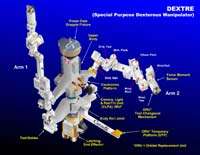
NASA has decided to try to save the orbiting Hubble Space Telescope by sending a Canadian-made robot Dextre to fix it, agency officials say. Dextre - formally the Special Purpose Dextrous Manipulator - is a complex robot designed to perform intricate maintenance and servicing tasks on the outside of the International Space Station (ISS). It has demonstrated to engineers that it's fully capable of replacing Hubble's failing hardware.
Earlier this week NASA reported that one of four science instruments aboard NASA's Hubble's Space Telescope suspended operations, and engineers are now looking into possible recovery options.
NASA has decided to service the Hubble Space Telescope using a robotic repairman to change batteries and gyroscopes. Everybody says, 'We want to save the Hubble' -- well, let's go save the Hubble," said NASA Administrator Sean O'Keefe.
Researchers at the NASA Goddard Space Flight Center in Maryland are instructed to begin serious work to put the robotic mission into space in 2007. It will cost at least $1 billion and possibly $1.6 billion to save the telescope.
About Dextre
Dextre is a sophisticated dual armed robot, which is part of Canada's contribution to the International Space Station (ISS). Along with Canadarm2, whose technical name is the Space Station Remote Manipulator System, and a moveable work platform called the Mobile Base System, these three elements form a robotic system called the Mobile Servicing System (MSS). The three components have been designed to work together or independently.
Dextre is an essential tool for maintaining and servicing the space station. With its dual-arm design providing added flexibility, Dextre will remove and replace smaller components on the Station’s exterior, where precise handling is required. It will be equipped with lights, video equipment, a tool platform and four tool holders.
Dextre can perform dexterous tasks by sensing various forces and moments on the payload. In response, it can automatically compensate its movements to ensure the payload is manipulated smoothly.
With its two arms, Dextre will load and unload objects, use robotic tools, attach and detach covers and install various units of the Space Station. It also has four cameras that will provide the crew inside the Station with additional views of the work areas.


