New evidence links stellar remains to oldest-recorded supernova
September 18, 2006 New evidence links stellar remains to oldest-recorded supernova

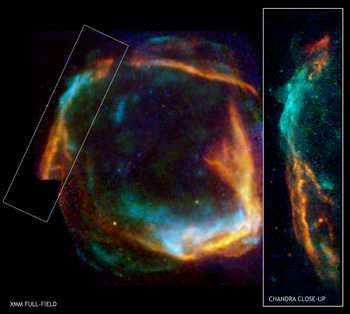
The combined image from the Chandra and XMM-Newton X-ray observatories of RCW 86 shows the expanding ring of debris that was created after a massive star in the Milky Way collapsed onto itself and exploded. Both the Chandra and XMM images show low energy X-rays in red, medium energies in green and high energies in blue. The Chandra observations focused on the northeast (left-hand) side of RCW 86, and show that X-ray radiation is produced both by high-energy electrons accelerated in a magnetic field (blue) as well as heat from the blast itself (red). Properties of the shell in the Chandra image, along with the remnant´s size and a basic understanding of how supernovas expand, were used to help determine the age of RCW 86. The new data revealed that RCW 86 was created by a star that exploded about 2,000 years ago. This age matches observations of a new bright star by Chinese astronomers in 185 A.D. (and possibly Romans as well) and may be the oldest known recordings of a supernova. Supernova explosions in galaxies like ours are rare, and none have been recorded in hundreds of years. Credit: Chandra: NASA/CXC/Univ. of Utrecht/J.Vink et al. XMM-Newton: ESA/Univ. of Utrecht/J.Vink et al.

Recent observations have uncovered evidence that helps to confirm the identification of the remains of one of the earliest stellar explosions recorded by humans.

The new study shows that the supernova remnant RCW 86 is much younger than previously thought. As such, the formation of the remnant appears to coincide with a supernova observed by Chinese astronomers in 185 A.D. The study used data from NASA's Chandra X-ray Observatory and the European Space Agency's XMM-Newton Observatory.

"There have been previous suggestions that RCW 86 is the remains of the supernova from 185 A.D.," said Jacco Vink of University of Utrecht, the Netherlands, and lead author of the study. "These new X-ray data greatly strengthen the case."

When a massive star runs out of fuel, it collapses on itself, creating a supernova that can outshine an entire galaxy. The intense explosion hurls the outer layers of the star into space and produces powerful shock waves. The remains of the star and the material it encounters are heated to millions of degrees and can emit intense X-ray radiation for thousands of years.

In their stellar forensic work, Vink and colleagues studied the debris in RCW 86 to estimate when its progenitor star originally exploded. They calculated how quickly the shocked, or energized, shell is moving in RCW 86, by studying one part of the remnant. They combined this expansion velocity with the size of the remnant and a basic understanding of how supernovas expand to estimate the age of RCW 86.

"Our new calculations tell us the remnant is about 2,000 years old," said Aya Bamba, a coauthor from the Institute of Physical and Chemical Research (RIKEN), Japan. "Previously astronomers had estimated an age of 10,000 years."

The younger age for RCW 86 may explain an astronomical event observed almost 2000 years ago. In 185 AD, Chinese astronomers (and possibly the Romans) recorded the appearance of a new bright star. The Chinese noted that it sparkled like a star and did not appear to move in the sky, arguing against it being a comet. Also, the observers noticed that the star took about eight months to fade, consistent with modern observations of supernovas.

RCW 86 had previously been suggested as the remnant from the 185 AD event, based on the historical records of the object's position. However, uncertainties about the age provided significant doubt about the association.

"Before this work I had doubts myself about the link, but our study indicates that the age of RCW 86 matches that of the oldest known supernova explosion in recorded history," said Vink. "Astronomers are used to referencing results from 5 or 10 years ago, so it's remarkable that we can build upon work from nearly 2000 years ago."

The smaller age estimate for the remnant follows directly from a higher expansion velocity. By examining the energy distribution of the X-rays, a technique known as spectroscopy, the team found most of the X-ray emission was caused by high-energy electrons moving through a magnetic field. This is a well-known process that normally gives rise to low-energy radio emission. However, only very high shock velocities can accelerate the electrons to such high energies that X-ray radiation is emitted.

"The energies reached in this supernova remnant are extremely high," said Andrei Bykov, another team member from the Ioffe Institute, St. Peterburg, Russia. "In fact, the particle energies are greater than what can be achieved by the most modern particle accelerators."

The difference in age estimates for RCW 86 is due to differences in expansion velocities measured for the supernova remnant. The authors speculate that these variations arise because RCW 86 is expanding into an irregular bubble blown by a wind from the progenitor star before it exploded. In some directions, the shock wave has encountered a dense region outside the bubble and slowed down, whereas in other regions the shock remains inside the bubble and is still moving rapidly. These regions give the most accurate estimate of the age.

Source: Chandra X-ray Center


print this article email this article download pdf blog this article bookmark this article     Stumble it Digg this share on Facebook retweet share on Reddit add to delicious
Rate this story - 4.8 /5 (17 votes)


September 18, 2006 all stories

Comments: 0

4.8 /5 (17 votes)
  • Stumble this up

  • Digg this

  • share this

  • hide
  • Related Stories

  • Chandra Finds Star With a Mystery Partner
    created Jul 11, 2007 | popularity not rated yet | comments 0
  • Supernova leaves behind mysterious object
    created Jul 07, 2006 | popularity not rated yet | comments 0
  • A Super-Efficient Particle Accelerator
    created Jul 01, 2009 | popularity not rated yet | comments 0
  • Milky Way's super-efficient particle accelerators caught in the act
    created Jun 25, 2009 | popularity not rated yet | comments 0
  • A Look into the Hellish Cradles of Suns and Solar Systems
    created Aug 19, 2009 | popularity not rated yet | comments 0


  • hide
  • Relevant PhysicsForums posts

  • Black hole confusion
    created 22 hours ago
  • Moon tied to Earth
    created Nov 13, 2009
  • Water on the Moon!
    created Nov 13, 2009
  • Is it possible for a single super-massive black hole...
    created Nov 13, 2009
  • Why are tides stronger at ...
    created Nov 13, 2009
  • Leonids in 2009?
    created Nov 13, 2009
  • More from Physics Forums - General Astronomy

Other News

NASA on track for Monday space shuttle launch (AP)

NASA on track for Monday space shuttle launch

Space & Earth / Space Exploration

created 6 hours ago | popularity 3 / 5 (1) | comments 0

(AP) -- NASA has cleared space shuttle Atlantis for liftoff Monday on a trip to stock up the International Space Station with several years' worth of spare parts.


Wind power turbines in Dali, in China's southwestern Yunnan province

China tipped as global leader in green tech

Space & Earth / Environment

created 18 hours ago | popularity 3.3 / 5 (3) | comments 5

China can become the world's top exporter of "green technology" if it carries out crucial energy and ecological reforms, leading environmental campaigners said here Saturday.


French Research Institute for Exploitation of the Sea (IFREMER) team prepares to put in water the robot BOB

Underwater robot probes depths for Istanbul quake clues

Space & Earth / Earth Sciences

created 18 hours ago | popularity 4.8 / 5 (4) | comments 0

A state-of-the-art underwater robot called BOB may hold the key to protecting millions of people around Turkey's biggest city against a massive earthquake scientists say is all but inevitable.


LCROSS Impact Data Indicates Water on Moon

LCROSS Impact Finds Water on the Moon

Space & Earth / Space Exploration

created Nov 13, 2009 | popularity 4.9 / 5 (26) | comments 10

(PhysOrg.com) -- The argument that the moon is a dry, desolate place no longer holds water. Secrets the moon has been holding, for perhaps billions of years, are now being revealed to the delight of scientists ...


Controversial new climate change results

Controversial new climate change results

Space & Earth / Environment

created Nov 10, 2009 | popularity 4.1 / 5 (37) | comments 79

(PhysOrg.com) -- New data show that the balance between the airborne and the absorbed fraction of CO2 has stayed approximately constant since 1850, despite emissions of CO2 having risen from about 2 billion ...