Scientists snap first images of brown dwarf in planetary system
September 18, 2006 Scientists snap first images of brown dwarf in planetary system

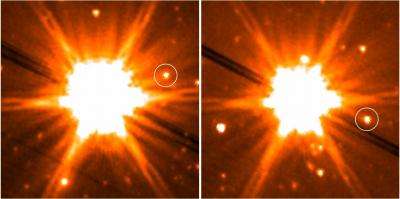
Using infrared photographs obtained with NASA's Spitzer Space Telescope, astronomers have discovered two very cold brown dwarfs orbiting the stars HD 3651 (left) and HN Peg (right). These brown dwarfs have masses of only 20 and 50 times the mass of Jupiter and have orbits that are more than 10 times larger than Pluto's orbit. HD 3651 and HN Peg are in the Sun's neighborhood of the Galaxy, with distances of only 36 and 60 light years from the Sun. Credit: NASA / JPL-Caltech / K. Luhman (Penn State University)

Scientists using NASA's Spitzer Space Telescope have discovered and directly imaged a small brown dwarf star, 50 times the mass of Jupiter, orbiting with a planet around a Sun-like star. Such an arrangement has never before been seen but might be common, the scientists say, leading to solar systems with distorted planetary orbits.

Kevin Luhman of Penn State University is the lead author on a report describing this discovery, which will be published in The Astrophysical Journal. The discovery concerns a class of the coldest brown dwarfs, called T dwarfs.

"Over the last ten years, astronomers have been extremely successful in finding planets close to their host stars using indirect detection methods," said Luhman, an assistant professor in the Penn State Department of Astronomy and Astrophysics. "Because of its infrared capabilities, Spitzer is well suited for directly detecting cool T dwarfs, and perhaps even large planets, in the outer parts of planetary systems."

Luhman's team also discovered a second brown dwarf that is smaller yet, about 20 times the mass of Jupiter, orbiting another star. This smaller object could be the youngest T dwarf known, offering scientists a snapshot of early brown-dwarf development. The two T dwarfs are the first to be imaged by Spitzer. Shortly after these companions were found, Spitzer also discovered a T dwarf that is floating through space by itelf rather than orbiting a star. The team that discovered that T dwarf is led by Daniel Stern at NASA's Jet Propulsion Laboratory.
Scientists snap first images of brown dwarf in planetary system

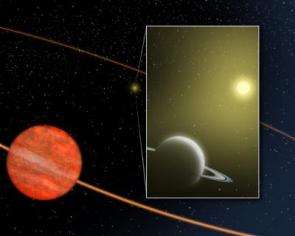
This is an artist's concept of the star HD 3651 as it is orbited by a close-in Saturn-mass planetary companion and the distant brown dwarf companion discovered by Spitzer infrared photographs. The Saturn-mass planet was discovered through Doppler observations in 2003. Its orbit is very small, the size of Mercury's, and is highly elliptical. The gravity of the distant brown dwarf companion may be reponsible for the distorted shape of the inner planet's orbit. Credit: NASA / JPL-Caltech / T. Pyle (SSC)

Brown dwarfs are small stars that are not massive enough to burn hydrogen, like our Sun does. Their cores are not hot enough to trigger such nuclear fusion. As a result, their surface temperature is only a few thousands of degrees when young, cooling considerably to about the temperature of a planet as they age. Consequently, they are dim and hard to identify and, as a result, the first unambiguous identification came only about ten years ago.

The more massive of the two newly discovered T dwarfs is called HD 3651 B, located in the constellation Pisces. This object is in a solar system containing a star slightly less massive than our Sun that is orbited by a planet slightly smaller than Saturn.

The planet's orbit around the Sun-like star is highly elliptical, which had suggested that the gravity of some unseen object farther away from the star was pulling the planet outward. Sure enough, it was a T dwarf. Many extrasolar planets have been discovered with highly elliptical orbits. The Spitzer discovery is the first evidence to support the theory that small companions such as T dwarfs can hide in such solar systems and can cause the orbits of planets to be extreme.

"The orbit of the planet in this system is similar to Mercury's, but the T dwarf has an orbit over ten times larger than Pluto's," said Brian Patten of the Harvard-Smithsonian Center for Astrophysics (CfA), a co-author. "Although HD 3651 B would be just beyond naked-eye visibility to an intrepid astronomer living on this system's planet, the T dwarf makes its presence known through gravity."

The other T dwarf is called HN Peg B in the constellation Pegasus. Whereas most brown dwarfs are billions of years old, HN Peg B is relatively young, only about 300 million years old. The scientists determined its age by carefully studying the companion star, which was formed at the same time from the same gas cloud. The system also contains a previously discovered disk of dust and rocks.

"Detectable debris disks and T dwarf companions are fairly rare, so the presence of both around the same star makes this a particularly exciting star system," said Giovanni Fazio of CfA, a co-author.

Source: Penn State


print this article email this article download pdf blog this article bookmark this article     Stumble it Digg this share on Facebook retweet share on Reddit add to delicious
Rate this story - 4.2 /5 (26 votes)


September 18, 2006 all stories

Comments: 0

4.2 /5 (26 votes)
  • Stumble this up

  • Digg this

  • share this

  • hide
  • Related Stories


  • hide
  • Relevant PhysicsForums posts

  • Gravity on Mars
    created 7 hours ago
  • Question about the orbit between Mars and Earth
    created 15 hours ago
  • SIMBAD/NED help
    created 19 hours ago
  • Black hole confusion
    created Nov 14, 2009
  • Moon tied to Earth
    created Nov 13, 2009
  • Water on the Moon!
    created Nov 13, 2009
  • More from Physics Forums - General Astronomy

Other News

Ghostly 'Spokes' Puff Out From Saturn's Ring's

Ghostly 'Spokes' Puff Out From Saturn's Ring's (w/ Video)

Space & Earth / Space Exploration

created 2 hours ago | popularity 5 / 5 (1) | comments 0

(PhysOrg.com) -- Massive, bright clouds of tiny ice particles hover above the darkened rings of Saturn in an image captured by the Cassini spacecraft on Sept. 22, 2009, around the time of Saturn's equinox. ...


NASA 'Drops' Next Generation Robotic Lander During Autonomous Tests

NASA 'Drops' Next Generation Robotic Lander During Autonomous Tests

Space & Earth / Space Exploration

created 3 hours ago | popularity 4.5 / 5 (2) | comments 0

(PhysOrg.com) -- NASA has successfully completed a series of autonomous "drop" tests of a robotic lander test article - in a record 10 months - to demonstrate the ability to perform a controlled landing on ...


Space shuttle Atlantis lifts off on supply mission (AP)

Space shuttle Atlantis lifts off on supply mission

Space & Earth / Space Exploration

created 2 hours ago | popularity not rated yet | comments 0

(AP) -- With 100 Internet-savvy NASA fans cheering on the shuttle and churning out constant Twitter updates, Atlantis sailed smoothly into orbit Monday with six astronauts and a full load of spare parts for ...


Close-up movie shows hidden details in the birth of super-suns

Close-up movie shows hidden details in the birth of super-suns (w/ Video)

Space & Earth / Astronomy

created 6 hours ago | popularity 4.7 / 5 (3) | comments 0

(PhysOrg.com) -- The constellation of Orion is a hotbed of massive star formation, most prominently in the Great Nebula that sits in Orion's sword. The glowing gas of the Nebula is powered by a group of young ...


Ancient high-altitude trees grow faster as temperatures rise

Space & Earth / Earth Sciences

created 4 hours ago | popularity 5 / 5 (2) | comments 0

PIC=32536:left]Increasing temperatures at high altitudes are fueling the post-1950 growth spurt seen in bristlecone pines, the world's oldest trees, according to new research.