Materials scientists tame tricky carbon nanotubes
September 18, 2006
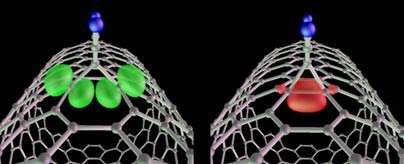
MIT researchers have discovered that certain molecules can attach themselves to metallic carbon nanotubes without interfering with the nanotubes' exceptional ability to conduct electricity. At left, the high conductance state has two molecular orbitals, shown in green. Some molecules even let the nanotube switch between highly conductive, left, and poorly conductive (right, with one red molecular orbital), creating the potential for new applications. Image courtesy / Marzari Lab
Based on a new theory, MIT scientists may be able to manipulate carbon nanotubes -- one of the strongest known materials and one of the trickiest to work with -- without destroying their extraordinary electrical properties.
The work is reported in the Sept. 15 issue of Physical Review Letters.
Carbon nanotubes -- cylindrical carbon molecules 50,000 times thinner than a human hair -- have properties that make them potentially useful in nanotechnology, electronics, optics and reinforcing composite materials. With an internal bonding structure rivaling that of another well-known form of carbon, diamonds, carbon nanotubes are extraordinarily strong and can be highly efficient electrical conductors.
The problem is working with them. There is no reliable way to arrange the tubes into a circuit, partly because growing them can result in a randomly oriented mess resembling a bowl of spaghetti.
Researchers have attached to the side walls of the tiny tubes chemical molecules that work as "handles" that allow the tubes to be assembled and manipulated. But these molecular bonds also change the tubes' structure and destroy their conductivity.
Now Young-Su Lee, an MIT graduate student in materials science and engineering, and Nicola Marzari, an associate professor in the same department, have identified a class of chemical molecules that preserve the metallic properties of carbon nanotubes and their near-perfect ability to conduct electricity with little resistance.
Using these molecules as handles, Marzari and Lee said, could overcome fabrication problems and lend the nanotubes new properties for a host of potential applications as detectors, sensors or components in novel optoelectronics.
Playing with atoms
Marzari and Lee use the fundamental laws of quantum mechanics to simulate material properties that are difficult or impossible to measure, such as molten lava in the Earth's core or atomic motion in a fast chemical reaction. Then they run these simulations on interconnected PCs and use the results to optimize and engineer novel materials such as electrodes for fuel cells and polymers that contract and expand like human muscles.
With the help of a powerful algorithm created by Lee and published last year in Physical Review Letters, the theorists focused on solving some of the problems of working with carbon nanotubes.
Like fuzzy balls and Velcro, the hexagon of carbon that makes up a nanotube has a predilection for clinging to other hexagons. One of the many challenges of working with the infinitesimally small tubes is that they tend to stick to each other.
Attaching a molecule to the sidewall of the tube serves a double purpose: It stops nanotubes from sticking so they can be processed and manipulated more easily, and it allows researchers to control and change the tubes' electronic properties. Still, most such molecules also destroy the tubes' conductance because they make the tube structurally more similar to a diamond, which is an insulator, rather than to graphite, a semi-metal.
Lee and Marzari used Lee's algorithm to identify a class of "molecular handles" (carbenes and nitrenes) that stop this from happening and preserve the tubes' original conductivity. "We now have a way to attach molecules that allows us to manipulate the nanotubes without losing their conductance," Marzari said.
Carbenes and nitrenes work by breaking a molecular bond on the nanotube's wall while creating their own new bond to the tube. This process -- one bond formed, one bond lost -- restores the perfect number of bonds each carbon atom had in the original tube and "conductance is recovered," Marzari said.
Some molecular handles can even transform between a bond-broken and a bond-intact state, allowing the nanotubes to act like switches that can be turned on or off in the presence of certain substances or with a laser beam. "This direct control of conductance may lead to novel strategies for the manipulation and assembly of nanotubes in metallic interconnects, or to sensing or imaging devices that respond in real-time to optical or chemical stimuli," Marzari said.
The next step is for experiments to confirm that the approach works.
Source: MIT
-
Nanotube therapy takes aim at breast cancer stem cells
9 hours ago |
5 / 5 (1) |
0
-
'Shish kebab' structure provides improved form of 'buckypaper'
Feb 08, 2012 |
1 / 5 (1) |
0
-
A bronze matryoshka doll: The metal in the metal in the metal
Feb 07, 2012 |
5 / 5 (7) |
1
-
The right recipe: Engineering research improves laser detectors, batteries
Feb 06, 2012 |
5 / 5 (7) |
0
-
Engineers build first sub-10-nm carbon nanotube transistor
Feb 01, 2012 |
4.9 / 5 (30) |
30
-
Engineers build first sub-10-nm carbon nanotube transistor
Feb 01, 2012 |
4.9 / 5 (31) |
30
-
Something old, something new: Evolution and the structural divergence of duplicate genes
Jan 31, 2012 |
4.6 / 5 (7) |
1
-
The hidden nanoworld of ice crystals: Revealing the dynamic behavior of quasi-liquid layers
Jan 30, 2012 |
5 / 5 (3) |
1
-
Stock market network reveals investor clustering
Jan 27, 2012 |
3.9 / 5 (23) |
8
-
Of microchemistry and molecules: Electronic microfluidic device synthesizes biocompatible probes
Jan 26, 2012 |
5 / 5 (1) |
0
-
Question about Gravity?
1 hour ago
-
Wearing black in a desert
2 hours ago
-
Did space exist before mass?
2 hours ago
-
How can E&M Waves be polarized?
2 hours ago
-
Does light travel for ever?
3 hours ago
-
Infinity by Particles
4 hours ago
- More from Physics Forums - General Physics
More news stories
What lies beneath: Mapping hidden nanostructures
The ability to diagnose and predict the properties of materials is vital, particularly in the expanding field of nanotechnology. Electron and atom-probe microscopy can categorize atoms in thin sheets of material, ...
12 hours ago |
5 / 5 (1) |
1
New kind of solar cell could capture significantly more energy than current cells
New solar cells could increase the maximum efficiency of solar panels by over 25%, according to scientists from the University of Cambridge.
Feb 08, 2012 |
4.5 / 5 (12) |
14
|
Nanoshell whispering galleries improve thin solar panels
Visitors to Statuary Hall in the U.S. Capitol Building may have experienced a curious acoustic feature that allows a person to whisper softly at one side of the cavernous, half-domed room and for another on ...
Nanotechnology / Nanomaterials
Feb 07, 2012 |
4.3 / 5 (6) |
6
|
'Dark plasmons' transmit energy
Microscopic channels of gold nanoparticles have the ability to transmit electromagnetic energy that starts as light and propagates via "dark plasmons," according to researchers at Rice University.
Feb 09, 2012 |
5 / 5 (6) |
1
|
Revealing how a battery material works
Since its discovery 15 years ago, lithium iron phosphate (LiFePO4) has become one of the most promising materials for rechargeable batteries because of its stability, durability, safety and ability to deliver ...
Nanotechnology / Nanomaterials
Feb 08, 2012 |
5 / 5 (5) |
0
|
Google users warned of threat to smartphone wallets
Users of Google smartphone wallets were being warned on Friday that there is a way to crack pass codes intended to thwart thieves from going on illicit shopping sprees.
Anonymous knocks CIA website offline (Update)
The website of the Central Intelligence Agency was inaccessible on Friday after the hacker group Anonymous claimed to have knocked it offline.
Complex wiring of the nervous system may rely on a just a handful of genes and proteins
Researchers at the Salk Institute have discovered a startling feature of early brain development that helps to explain how complex neuron wiring patterns are programmed using just a handful of critical genes. ...
New error-correcting codes guarantee the fastest possible rate of data transmission
Error-correcting codes are one of the triumphs of the digital age. Theyre a way of encoding information so that it can be transmitted across a communication channel such as an optical fiber o ...
The power of estrogen -- male snakes attract other males
A new study has shown that boosting the estrogen levels of male garter snakes causes them to secrete the same pheromones that females use to attract suitors, and turned the males into just about the sexiest ...
Humans may have helped the decline of African rainforests 3000 years ago
(PhysOrg.com) -- Large areas of rainforests in Central Africa mysteriously disappeared over three thousand years ago, to be replaced by savannas. The prevailing theory has been that the cause was a change ...