Bitter Taste Identifies Poisons in Foods
September 18, 2006
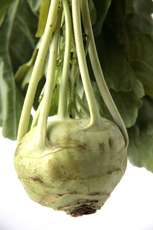
Kohlrabi contains glucosinolates, compounds that inhhibit iodine uptake by the thyroid. Individuals with the sensitive form of the hTAS2R38 taste receptor gene rate kohlrabi as being more bitter than people with the less sensitive form of the gene. Credit: Rick Davis
Scientists at the Monell Chemical Senses Center report that bitter taste perception of vegetables is influenced by an interaction between variants of taste genes and the presence of naturally-occurring toxins in the vegetable. The study appears in the September 19 issue of Current Biology.
Scientists have long assumed that bitter taste evolved as a defense mechanism to detect potentially harmful toxins in plants. The Current Biology paper provides the first direct evidence in support of this hypothesis by establishing that variants of the bitter taste receptor TAS2R38 can detect glucosinolates, a class of compounds with potentially harmful physiological actions, in natural foods.
“The findings show that our taste receptors are capable of detecting toxins in the natural setting of the fruit and vegetable plant matrix,” said senior author Paul Breslin, a Monell sensory scientist.
Glucosinolates act as anti-thyroid compounds. The thyroid converts iodine into thyroid hormones, which are essential for protein synthesis and regulation of the body’s metabolism. Glucosinolates inhibit iodine uptake by the thyroid, increasing risk for goiter and altering levels of thyroid hormones. The ability to detect and avoid naturally-occurring glucosinolates would confer a selective advantage to the over 1 billion people who presently have low iodine status and are at risk for thyroid insufficiency.
In the study, 35 healthy adults were genotyped for the hTAS2R38 bitter taste receptor gene; the three genotypes were PAV/PAV (sensitive to the bitter-tasting chemical PTC, AVI/AVI (insensitive), and PAV/AVI (intermediate).
Subjects then rated bitterness of various vegetables; some contained glucosinolates while others did not. Examples of the 17 glucosinolate-containing vegetables include watercress, broccoli, bok choy, kale, kohlrabi, and turnip; the 11 non-glucosinolate foods included radicchio, endive, eggplant and spinach. Subjects with the sensitive PAV/PAV form of the receptor rated the glucosinolate-containing vegetables as 60% more bitter than did subjects with the insensitive (AVI/AVI) form. The other vegetables were rated equally bitter by the two groups, demonstrating that variations in the hTAS2R38 gene affect bitter perception specifically of foods containing glucosinolate toxins.
Together, the findings provide a complete picture describing individual differences in responses to actual foods at multiple levels: evolutionary, genetic, receptor, and perceptual. “The sense of taste enables us to detect bitter toxins within foods, and genetically-based differences in our bitter taste receptors affect how we each perceive foods containing a particular set of toxins,” summarizes Breslin.
Breslin notes, “The contents of the veggies are a double-edged sword, depending upon the physiological context of the individual eating them. Most people in industrialized cultures can and should enjoy these foods. In addition to providing essential nutrients and vitamins, many are reported to have anti-cancer properties.”
Lead author Mari Sandell comments on additional nutritional and practical implications of the study, “Taste has a great impact on food acceptability and choice. A comprehensive understanding how food components contribute to taste is necessary to develop modern tools for both nutritional counseling and food development.”
Source: Monell Chemical Senses Center
-
Engineers build first sub-10-nm carbon nanotube transistor
Feb 01, 2012 |
4.9 / 5 (31) |
30
-
Something old, something new: Evolution and the structural divergence of duplicate genes
Jan 31, 2012 |
4.6 / 5 (7) |
1
-
The hidden nanoworld of ice crystals: Revealing the dynamic behavior of quasi-liquid layers
Jan 30, 2012 |
5 / 5 (3) |
1
-
Stock market network reveals investor clustering
Jan 27, 2012 |
3.9 / 5 (23) |
8
-
Of microchemistry and molecules: Electronic microfluidic device synthesizes biocompatible probes
Jan 26, 2012 |
5 / 5 (1) |
0
More news stories
Hydrogen from acidic water: Researchers develop potential low cost alternative to platinum for splitting water
A technique for creating a new molecule that structurally and chemically replicates the active part of the widely used industrial catalyst molybdenite has been developed by researchers with the Lawrence Berkeley ...
Feb 09, 2012 |
4.8 / 5 (15) |
21
|
Fool's gold may prove an unlikely alternative to overexploited catalytic materials
Catalytic materials, which lower the energy barriers for chemical reactions, are used in everything from the commercial production of chemicals to catalytic converters in car engines. However, with current catalytic materials ...
Feb 10, 2012 |
4.4 / 5 (8) |
8
|
Research provides octagonal window of opportunity for carbon capture
(PhysOrg.com) -- Filtering carbon dioxide, a greenhouse gas, from factory smokestacks is a necessary, but expensive part of many manufacturing processes. However, a collaborative research team from the National ...
Feb 08, 2012 |
5 / 5 (1) |
5
|
Flexible paper robots
(PhysOrg.com) -- These inexpensive robots can stretch, bend and twist under control, and lift objects up to 120 times their own weight. Being soft, they can apply gentle and even pressure, and adapt to varied ...
Feb 09, 2012 |
5 / 5 (5) |
4
|
New form of hafnium oxide developed
(PhysOrg.com) -- A novel material developed by researchers at the University of Cambridge is opening up new possibilities for next generation electronic and optoelectronic devices, and paving the way for further ...
Feb 07, 2012 |
4.6 / 5 (5) |
4
|
Walney offshore wind farm is world's biggest (for now)
(PhysOrg.com) -- The Walney wind farm on the Irish Sea--characterized by high tides, waves and windy weather--officially opened this week. The farm is treated in the press as a very big deal as the Walney ...
GPS court ruling leaves US phone tracking unclear
A US Supreme Court decision requiring a warrant to place a GPS device on the car of a criminal suspect leaves unresolved the bigger issue of police tracking using mobile phones, legal experts say.
Europeans protest controversial Internet pact
Tens of thousands of people marched in protests in more than a dozen European cities Saturday against a controversial anti-online piracy pact that critics say could curtail Internet freedom.
Europe stakes billion-dollar bet on new rocket
A pencil-slim rocket is scheduled to lift into space from South America on Monday, carrying a billion-dollar bet that Europe can grab a juicy slice of the market to place satellites in low orbit.
Study finds that anti-diabetic medication can prevent the long-term effects of maternal obesity
In a study to be presented today at the Society for Maternal-Fetal Medicine's annual meeting, The Pregnancy Meeting, in Dallas, Texas, researchers will report findings that show that short therapy with the anti-diabetic medication ...
Netflix settlement trims 14 pct off 4Q earnings
(AP) -- Netflix pressed the rewind button on its fourth-quarter earnings after settling allegations that the video subscription service violated a consumer-privacy law.