Engine on a chip promises to best the battery
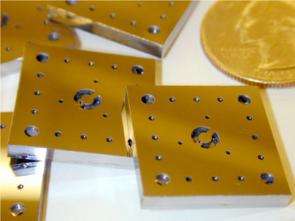
MIT researchers are putting a tiny gas-turbine engine inside a silicon chip about the size of a quarter. The resulting device could run 10 times longer than a battery of the same weight can, powering laptops, cell phones, radios and other electronic devices.
It could also dramatically lighten the load for people who can't connect to a power grid, including soldiers who now must carry many pounds of batteries for a three-day mission -- all at a reasonable price.
The researchers say that in the long term, mass-production could bring the per-unit cost of power from microengines close to that for power from today's large gas-turbine power plants.
Making things tiny is all the rage. The field -- called microelectromechanical systems, or MEMS -- grew out of the computer industry's stunning success in developing and using micro technologies. "Forty years ago, a computer filled up a whole building," said Professor Alan Epstein of the Department of Aeronautics and Astronautics. "Now we all have microcomputers on our desks and inside our thermostats and our watches."
While others are making miniature devices ranging from biological sensors to chemical processors, Epstein and a team of 20 faculty, staff and students are looking to make power -- personal power. "Big gas-turbine engines can power a city, but a little one could 'power' a person," said Epstein, whose colleagues are spread among MIT's Gas Turbine Laboratory, Microsystems Technology Laboratories, and Laboratory for Electromagnetic and Electronic Systems.
How can one make a tiny fuel-burning engine? An engine needs a compressor, a combustion chamber, a spinning turbine and so on. Making millimeter-scale versions of those components from welded and riveted pieces of metal isn't feasible. So, like computer-chip makers, the MIT researchers turned to etched silicon wafers.
Their microengine is made of six silicon wafers, piled up like pancakes and bonded together. Each wafer is a single crystal with its atoms perfectly aligned, so it is extremely strong. To achieve the necessary components, the wafers are individually prepared using an advanced etching process to eat away selected material. When the wafers are piled up, the surfaces and the spaces in between produce the needed features and functions.
Making microengines one at a time would be prohibitively expensive, so the researchers again followed the lead of computer-chip makers. They make 60 to 100 components on a large wafer that they then (very carefully) cut apart into single units.
The MIT team has now used this process to make all the components needed for their engine, and each part works. Inside a tiny combustion chamber, fuel and air quickly mix and burn at the melting point of steel. Turbine blades, made of low-defect, high-strength microfabricated materials, spin at 20,000 revolutions per second -- 100 times faster than those in jet engines. A mini-generator produces 10 watts of power. A little compressor raises the pressure of air in preparation for combustion. And cooling (always a challenge in hot microdevices) appears manageable by sending the compression air around the outside of the combustor.
"So all the parts workŠ. We're now trying to get them all to work on the same day on the same lab bench," Epstein said. Ultimately, of course, hot gases from the combustion chamber need to turn the turbine blades, which must then power the generator, and so on. "That turns out to be a hard thing to do," he said. Their goal is to have it done by the end of this year.
Predicting how quickly they can move ahead is itself a bit of a challenge. If the bonding process is done well, each microengine is a monolithic piece of silicon, atomically perfect and inseparable. As a result, even a tiny mistake in a single component will necessitate starting from scratch. And if one component needs changing -- say, the compressor should be a micron smaller -- the microfabrication team will have to rethink the entire design process.
For all the difficulties, Epstein said the project is "an astonishing amount of fun" -- and MIT is the ideal place for it. "Within 300 feet of my office, I could find the world's experts on each of the technologies needed to make the complete system," he said.
In addition, the project provides an excellent opportunity for teaching. "No matter what your specialty is -- combustion or bearings or microfabrication -- it's equally hard," he said. "As an educational tool, it's enormously useful because the students realize that their success is dependent upon other people's success. They can't make their part easier by making somebody else's part harder, because then as a team we don't succeed."
Source: MIT, by Nancy Stauffer


