A wolf in sheep’s clothing: plague bacteria reveal one of their virulence tricks
September 19, 2006 A wolf in sheep’s clothing: plague bacteria reveal one of their virulence tricks

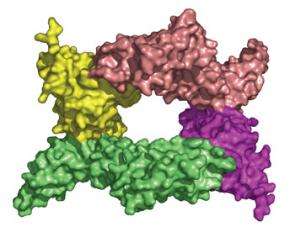
A plague's protein. A structural image of the protein-protein complex formed when YpkA (green and pink) binds to the Rac1 protein of the host cell (yellow and purple)

The bacterium that causes the plague belongs to a virulent family of bacteria called Yersinia, a group that also includes a pathogen responsible for food poisoning. These bacteria insert into their host cells proteins and other virulence factors, which kill by — among other things — disrupting the cells' normal structure. One of these proteins, called YpkA, attacks a cell’s internal skeleton.

Now, a study published by Rockefeller University researchers in the most recent issue of Cell shows exactly how YpkA does this, proving the protein’s mechanism from the atomic to the organismal level and providing a potential target for new antibiotic drugs.

C. Erec Stebbins, associate professor and head of the Laboratory of Structural Microbiology, and graduate student Gerd Prehna solved the structure for one region of the YpkA protein, a “binding domain” where it interlocks with another protein on the host cell’s membrane. By looking at the crystal structure of this protein-protein complex, Prehna discovered that the configuration looked just like one formed by some of the host’s own signaling proteins. And it’s this mimicry, he found, that leads to a signaling shutdown and deregulation of the cell’s normal structure.

After establishing this effect, Prehna set about disrupting it by mutation. Using the structure to guide him, he changed three amino acids of YpkA that contacted host proteins, and then looked at how the mutated bacteria affected human cells compared to the original wild-type Yersinia. His results confirmed the hypothesis from the structural study: While the wild-type YpkA wreaked havoc on their host cells’ cytoskeletons, the mutant left the actin-based skeleton intact.

Then, the researchers took it one step further. Stebbins and Prehna worked with collaborators at Stony Brook University, who created Yersinia bacteria with Prehna’s mutations. The Stony Brook researchers then injected mice with the wild-type and mutant strains of Yersinia. All the mice infected with the wild-type bacteria died within nine days of exposure. But the group that received the YpkA mutant had an 80 percent survival rate, showing that Prehna’s mutation drastically lowered Yersinia’s harmful effects. “Altering this binding site not only impairs the bacteria’s ability to disrupt the host cytoskeleton,” Stebbins says, “but it decreases its virulence significantly.”

“It’s rare to find something that has such a strong effect that you can hit one protein so specifically, knock out essentially half its activity, and have such a dramatic result,” he says. “Not only did we have a mechanistic explanation, but we could connect what we were seeing in animal studies all the way down to what was happening at the atomic level.”

Citation: Cell 126: 869-880 (September 8, 2006)

Source: Rockefeller University


print this article email this article download pdf blog this article bookmark this article     Stumble it Digg this share on Facebook retweet share on Reddit add to delicious
Rate this story - 4 /5 (3 votes)


September 19, 2006 all stories

Comments: 0

4 /5 (3 votes)
  • Stumble this up

  • Digg this

  • share this

  • hide
  • Related Stories

  • How plague-causing bacteria disarm host defense
    created May 24, 2007 | popularity not rated yet | comments 0
  • Sweet as can be: How E. coli gets ahead
    created Nov 12, 2009 | popularity not rated yet | comments 0
  • New explanation for nature's hardiest life form
    created Nov 12, 2009 | popularity not rated yet | comments 0
  • Vibrations key to efficiency of green fluorescent protein
    created Nov 11, 2009 | popularity not rated yet | comments 0
  • Antarctic lake home to diverse community of viruses
    created Nov 11, 2009 | popularity not rated yet | comments 0


Other News

Ancient penguin DNA raises doubts about accuracy of genetic dating techniques

Ancient penguin DNA raises doubts about accuracy of genetic dating techniques

Biology / Evolution

created Nov 10, 2009 | popularity 4.8 / 5 (22) | comments 12

Penguins that died 44,000 years ago in Antarctica have provided extraordinary frozen DNA samples that challenge the accuracy of traditional genetic aging measurements, and suggest those approaches have been ...


Rasberry crazy ant

Rapacious Rasberry ants march north

Biology / Plants & Animals

created Nov 13, 2009 | popularity 4.3 / 5 (7) | comments 10

Poor Texas. First it was killer bees, then fire ants. Now, it's the Rasberry ants.


Striped skunk

Skunk's Strategy Not Just Black and White

Biology / Plants & Animals

created Nov 10, 2009 | popularity 4.3 / 5 (4) | comments 4

Predators with experience of skunks avoid them both because of their black-and-white coloration and their distinctive body shape, according to UC Davis wildlife researcher Jennifer Hunter. The study was published ...


What is the meaning of 'one'? Evolutionary biologists argue for new meaning of 'organismality'

Biology / Evolution

created Nov 09, 2009 | popularity 4.8 / 5 (6) | comments 3

Rice University evolutionary biologists David Queller and Joan Strassmann argue in a new paper that high cooperation and low conflict between components, from the genetic level on up, give a living thing its "organismality," ...


Can biodiversity persist in the face of climate change?

Can biodiversity persist in the face of climate change?

Biology / Ecology

created Nov 06, 2009 | popularity 3 / 5 (8) | comments 2

(PhysOrg.com) -- Predictions made over the last decade about the impacts of climate change on biodiversity may be exaggerated, according to a paper published in the journal Science.