At the core
A few years ago, chemical analyses of deep sea muds that used a new X-ray technology were able to help explain why the Classic Mayan civilization collapsed more than a thousand years ago.
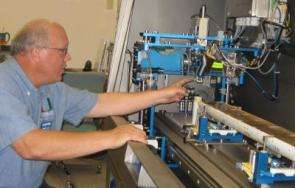
At the University of Miami Rosenstiel School of Marine and Atmospheric Science, a new tool will apply a similar technology to find answers to historic climate changes from earth and marine sediment core samples. The XRF (X-ray Fluorescence) Core Scanner is only the second to make its way to the United States, and the first of this new and improved model made by Avaatech, a company based in the Netherlands.
"From a paleoclimate researcher's perspective, this is a dream come true," said Larry C. Peterson, associate dean of students and the marine geology professor whose lab houses the scanner. "There is a tremendous amount of information about earth history preserved in the chemical composition of sediments deposited on the ocean floor, in lakes, and on land. By measuring the concentration of specific elements in these sediments, the XRF Core Scanner can help us document the history of drastic climate variations and past geological events, giving us more of an idea of the current and future state of our environment."
Made possible through National Science Foundation funding, the XRF Core Scanner will be able to chemically analyze sediment cores quickly and without any physical damage. "Previously, analyses of this type could only be done by a time-consuming process of sampling the cores, then preparing and chemically analyzing the individual samples. The Core Scanner now allows us to determine the complete chemical composition of the same cores without disturbing them, and at a speed and measurement resolution previously unimaginable. What normally would take weeks or months of laboratory time can now be done within a few hours," said Peterson. Data collected from each scan are transferred directly to computers in his lab for analysis. Once cores are loaded in the Core Scanner, the instrument can be operated from remote locations over the Internet.
Peterson and his German collaborator, Gerald Haug, were featured in the July/August 2005 issue of American Scientist for their work studying core samples taken from the Cariaco Basin off the Venezuelan coast. Using a similar XRF machine, the scientists were able to find geological records of severe droughts between 800 and 1000 AD – coincident with the collapse of Classic Mayan civilization.
"We have a collection of several thousand sediment cores from all the world's oceans stored here at the university," Peterson said. "For each sample we take or receive, we usually study half and archive the remaining portion. Those archives will comprise the greater part of our research right now. We have a number of ongoing research projects, focusing mostly on climate change in the tropics, for which this new instrument will be invaluable."
Source: University of Miami Rosenstiel School of Marine & Atmospheric Science


