Imaging technology restores 700-year-old sacred Hindu text
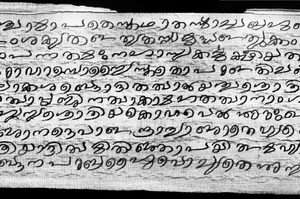
Scientists who worked on the Archimedes Palimpsest are using modern imaging technologies to digitally restore a 700-year-old palm-leaf manuscript containing the essence of Hindu philosophy.
The project led by P.R. Mukund and Roger Easton, professors at Rochester Institute of Technology, will digitally preserve the original Hindu writings known as the Sarvamoola granthas attributed to scholar Shri Madvacharya (1238-1317). The collection of 36 works contains commentaries written in Sanskrit on sacred Hindu scriptures and conveys the scholar's Dvaita philosophy of the meaning of life and the role of God.
The document is difficult to handle and to read, the result of centuries of inappropriate storage techniques, botched preservation efforts and degradation due to improper handling. Each leaf of the manuscript measures 26 inches long and two inches wide, and is bound together with braided cord threaded through two holes. Heavy wooden covers sandwich the 340 palm leaves, cracked and chipped at the edges. Time and a misguided application of oil have aged the palm leaves dark brown, obscuring the Sanskrit writings.
"It is literally crumbling to dust," says Mukund, the Gleason Professor of Electrical Engineering at RIT.
According to Mukund, 15 percent of the manuscript is missing.
"The book will never be opened again unless there is a compelling reason to do so," Mukund says. "Because every time they do, they lose some. After this, there won't be a need to open the book."
Mukund first became involved with the project when his spiritual teacher in India brought the problem to his attention and urged him to find a solution. This became a personal goal for Mukund, who studies and teaches Hindu philosophy or "our way of life" and understood the importance of preserving the document for future scholars. The accuracy of existing printed copies of the Sarvamoola granthas is unknown.
Mukund sought the expertise of RIT colleague Easton, who imaged the Dead Sea Scrolls and is currently working on the Archimedes Palimpsest. Easton, a professor at RIT's Chester F. Carlson Center for Imaging Science, brought in Keith Knox, an imaging senior scientist at Boeing LTS, as a consultant. Mukund added Ajay Pasupuleti, a doctoral candidate in microsystems at RIT, and the team was formed.
The scientists traveled to India in December 2005 to assess the document stored at a monastery-like mathas in Udupi, India. Sponsored by a grant from RIT, the team returned to the monastery in June and spent six days imaging the document using a scientific digital camera and an infrared filter to enhance the contrast between the ink and the palm leaf. Images of each palm leaf, back and front, were captured in eight to 10 sections, processed and digitally stitched together. The scientists ran the 7,900 total images through various image-processing algorithms using Adobe Photoshop and Knox's own custom software.
"This is a very significant application of the same types of tools that we have used on the Archimedes Palimpsest," Easton says. "Not incidentally, this also has been one of the most enjoyable projects in my career, since the results will be of great interest to a large number of people in India."
The processed images of the Sarvamoola granthas will be stored in a variety of media formats, including electronically, in published books and on silicon wafers for long-term preservation. Etching the sacred writings on silicon wafers was the idea of Mukund's student Pasupuleti. The process, called aluminum metallization, transfers an image to a wafer by creating a negative of the image and depositing metal on the silicon surface.
According to Pasupuleti, each wafer can hold the image of three leaves. More than 100 wafers will be needed to store the entire manuscript. As an archival material, silicon wafers are both fire- and waterproof, and readable with the use of a magnifying glass.
Mukund and Pasupuleti will return to India at the end of November to give printed and electronic versions of the Sarvamoola granthas to the monastery in Udupi in a public ceremony in Bangalore, the largest city in the Karnataka region.
"We feel we were blessed to have this opportunity to do this," Mukund says. "It was a fantastic and profoundly spiritual experience. And we all came away cleansed."
Based on the success of this project, Mukund is seeking funding to image other Dvaita manuscripts in the Udupi region written since the time of Shri Madvacharya. He estimates the existence of approximately 800 palm leaf manuscripts, some of which are in private collections.
Source: Rochester Institute of Technology


