Bird Moms Manipulate Birth Order to Protect Sons

According to a new study by scientists at the University of Arizona, female house finches are able to change their hormonal makeup to ensure male birds hatch later, grow faster and spend less time in the nest than their sisters.
Protecting her kids from peril is the job of every good mom.
When marauding mites turn up in a house finch's nest, she shelters her sons from the blood-suckers by laying male eggs later than those containing their sturdier sisters, according to new research.
Making sure the vulnerable baby boys are exposed to mites for a shorter period allows both the sons and the daughters to survive long enough to leave the nest.
"Sons are more sensitive to the mites than daughters," said Alexander V. Badyaev of The University of Arizona in Tucson. "Mothers minimize sons' exposure to mites by laying male eggs later than female eggs. As a result, the males are in the nest fewer days."
Even so, the male chicks that grow up during mite season end up just as big as ones from the mite-free time of the year.
It's all mom's doing, Badyaev said.
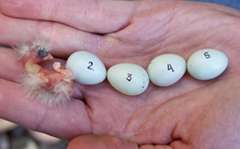
Once breeding female finches are exposed to mites, their bodies make hormonal changes that affect the order of egg laying and accelerates the development of their sons while they're still in the egg.
"We've found a mechanism by which duration of growth can be adjusted to a changing risk of mortality," said Badyaev, a UA assistant professor of ecology and evolutionary biology. He added that this is the first documentation that maternal manipulation of both ovulation and growth influences the duration of development in birds.
Badyaev and his colleagues' article, "Sex-Biased Maternal Effects Reduce Ectoparasite Induced Mortality in a Passerine Bird," is scheduled to be published in the early online edition of the Proceedings of the National Academy of Sciences the week of Sept. 18.
His co-authors are UA graduate students Terri L. Hamstra and Kevin P. Oh and UA research specialist Dana A. Acevedo Seaman. The David and Lucile Packard Foundation, the National Science Foundation and the Silliman Memorial Research Awards funded the research.
One of Badyaev's interests is figuring out how the various developmental periods of birds evolve and how birds can modify those developmental periods to maximize the survival of their young.
There's a trade-off between keeping the kids at home longer so they grow big and strong and getting them out of the nest quickly because nests are targets for predators and parasites, he said.
Since 2002, Badyaev, Oh and their colleagues have been intensively documenting the lives of a population of house finches (Carpodacus mexicanus) on the UA campus.
Throughout the year, the researchers capture birds several times a week to band and measure them and to take DNA and hormone samples. During the breeding season, the researchers locate the nests, keep track of activity in the nest, follow nestling growth and development, and take DNA samples from the chicks.
The researchers have also been counting the numbers of mites on the birds and documented a seasonal pattern. When breeding starts in February, the mites are absent. As winter turns to spring, mites start showing up on the adult females, in their nests and on their nestlings. The exact timing depends on the year. Mites can kill nestlings.
"When it is safer inside the nest than outside, then there's no need for young to leave the nest until growth is complete, but when mortality risk of staying in the nest is great, chicks need to complete their growth fast and get out as soon as they can," Badyaev said. "What should a mother do in the face of shifting mortality risk?"
"To leave the nests sooner and still survive outside of nests, the kids need to grow faster," Badyaev said. "But the mechanisms which regulate nestling growth in relation to changing mortality were not known."
So the researchers looked to see how finch moms changed their child-rearing strategy so as to always do best by their kids.
The birds lay one egg per day. To successfully raise baby finches in the presence of mites, the mothers altered the order in which male and female eggs were laid.
When mites were absent, the chances of any particular egg being male or female were even. But once mites came into the picture, the mothers laid female eggs first and male eggs last.
Males that grew during mite season did more of their development in the egg before hatching. Their mothers accelerated their sons' growth, both in the egg and after they hatched.
"Mothers essentially hid their sons in the eggs," Badyaev said.
It's remarkable that the fledglings have such similar morphology with or without mites, he said. "Mothers did that by modifying the order of laying of male and female eggs and the pattern of their growth."
Source: University of Arizona


