Stem cells: forgotten by evolution?
Max Planck scientists show that adult stem cells are possibly just the remnants of evolution
For a fairly long time, adult stem cells have been a point of scientific interest. Besides the question of how to use them therapeutically, researchers have been investigating what exactly their physiological function could be. Not least because undifferentiated cells with features typical of stem cells are being increasingly found in organs like the liver, brain, and muscles, scientists are beginning to assume that these cells play a role in repairing organs.
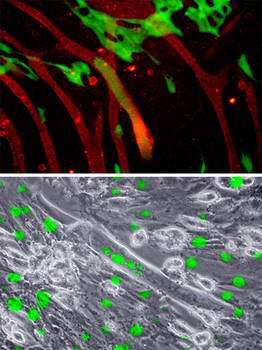
Image: Image: Middle of the upper image: the product of the fusion of a multipotent, adult stem cell, marked by the expression of a green fluorescent protein, with a muscle cell (dyed red). Next to it are unfused stem and heart muscle cells. Bottom image: a combination of phase-contrast and fluorescence microscopy shows the expression of the green stem cell markers in the nucleus of a hybrid heart muscle cell. Next to it are a number of unfused cells. Image: Max Planck Institute for Heart and Lung Research
Researchers from the Max Planck Institute for Heart and Lung Research in Bad Nauheim, Germany have now demonstrated, in a study published in the journal Molecular and Cellular Biology, that at least some adult stem cells could be the mere remnants of former embryonal differentiation processes, or, in other words, "footprints" of evolution.
The scientists belonging to Thomas Braun’s working group used as a basis for their research two cell lines of mesenchymal stem cells which had been isolated from the bone marrow of mice. What was particularly special about the process they used was that they did not add growth factors to the culture medium; the goal was to prevent the cells from differentiating prematurely. By doing so, the scientists discovered that the two cell lines were different in the expression of typical stem cell markers. The researchers thus suspect that mesenchymal stem cells are a heterogeneous group of various, different cells, that have similar characteristics.
As was hoped, the scientists, using certain substances, were able to bring the stem cell line to express proteins characteristic of muscle cells. Interestingly, when a particular path, known as the wnt-signal path, was stimulated, the cells began to develop the features of heart muscle cells. In contrast, when they were beforehand stimulated with a protein known as CDO, the cells showed certain characteristics of skeleton muscle cells.
In both experiments, a row of muscle-specific genes was activated in the cells. This provided evidence for the beginnings of a differentiation process. But this process was only apparently halfway complete. So, for example, after the activation of the wnt-signaling cascade, there was no typical striped pattern; this suggests incomplete development of the contractile apparatus. In addition, the expression of marker genes for cardiomyocytes, like the alpha-myosin-heavy-chain protein, could only be shown after the scientists performed what is known as epigenetic reprogramming (epigenetic reprogramming is a synonym for heritable modifications of the DNA others than alterations of the base sequence like DNA-methylation and changes of the chromatin).
In the differentiation toward skeleton musculature, the scientists indeed saw characteristic features of the skeletal muscle cells. It never came, however, to the point that true, multi-nucleate cells were created. The researchers were, on the other hand, able to consistently observe fusion between mesenchymal stem cells and skeletal muscle cells (see image).
The Max Planck researchers have two possible explanations for their results. On one hand, the stem cells could be missing some factor which is absolutely necessary for the complete differentiation into specialised cells and tissue. On the other hand, it could be the case that at least some of the known adult stem cell types are "only" the rudiments of earlier embryonal differentiation processes, or even dispersed leftovers from previous evolutionary stages. Indeed, these cells are still showing plasticity which is a characteristic of stem cells, but no direct physiological function can be deduced from it.
Original work:
F. B.Bedada, A.Technau, H. Ebelt, M.Schulze, T. Brau
Activation of Myogenic Differentiation Pathways in Adult Bone Marrow-Derived Stem Cells
Molecular and Cellular Biology, November 2005, pp. 9509-9519
Source: Max Planck Society


