Greenland ice sheet still losing mass
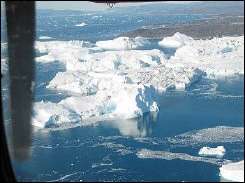
Data gathered by a pair of NASA satellites orbiting Earth show Greenland continued to lose ice mass at a significant rate through April 2006, and that the rate of loss is accelerating, according to a new University of Colorado at Boulder study.
The study indicates that from April 2004 to April 2006, Greenland was shedding ice at about two and one-half times the rate of the previous two-year period, according to CU-Boulder researchers Isabella Velicogna and John Wahr. The researchers used measurements taken with the Gravity Recovery and Climate Experiment, or GRACE, to calculate that Greenland lost roughly 164 cubic miles of ice from April 2004 to April 2006 -- more than the volume of water in Lake Erie.
The new study, published in the Sept. 21 issue of Nature, follows on the heels of a study published in Science in August by a University of Texas at Austin team using GRACE that showed Greenland lost 57 cubic miles of ice annually from 2002 to 2005. The new CU-Boulder study indicates the speed-up in ice mass loss charted by the researchers has been occurring primarily in southern Greenland, said Velicogna.
"The acceleration rate really took off in 2004," said Velicogna, a researcher at the CU-Boulder-based Cooperative Institute for Research in Environmental Sciences. "We think the changes we are seeing are probably a pretty good indicator of the changing climatic conditions in Greenland, particularly in the southern region."
Studies by several research groups indicate temperatures in southern Greenland have risen by about 4.4 degrees F in the past two decades, she said.
The CU-Boulder findings also are consistent with studies charting a dramatic acceleration of the Kangerdlugssaq and Helheim glaciers in southeast Greenland using satellite radar observations, said Wahr. A 2006 study by researchers at the University of Wales, for example, showed the two glaciers have doubled their speed and are dumping twice as much ice into the sea as they did five years ago.
"Our results correlate well with independent observations of glacier acceleration in the south of Greenland," said Wahr, also a professor of physics at CU-Boulder. "It's a fairly straightforward story -- the ice loss in Greenland increased dramatically in 2004, particularly in the south, and it is continuing."
CIRES Director Konrad Steffen, who has maintained more than 20 climate stations in Greenland for nearly two decades, said temperatures have warmed by more than 4 degrees F along the western slope of its ice sheet since 1990. "The increased surface melt of snow and ice provides additional meltwater to lubricate the bottom of the ice sheet and increases the ice flow velocity toward the coast," said Steffen, a CU-Boulder geography professor who was not involved in the Nature study.
Launched in 2002 by NASA and Germany, the two GRACE satellites whip around Earth 16 times a day at an altitude of 310 miles, sensing subtle variations in Earth's mass and gravitational pull. Separated by 137 miles, the satellites measure changes in Earth's gravity field caused by regional changes in the planet's mass, including ice sheets, oceans and water stored in the soil and in underground aquifers.
A change in gravity due to a pass by GRACE over a portion of Greenland imperceptibly tugs the lead satellite away from the trailing satellite, said Velicogna. A sensitive ranging system allows researchers to measure the distance of the two satellites down to as small as 1 micron -- about 1/50 the width of a human hair -- and to then calculate the ice mass in particular regions of Greenland.
In March 2006, Velicogna and Wahr used GRACE to determine that the Antarctic ice sheet -- which holds 70 percent of Earth's freshwater -- lost up to 36 cubic miles of ice annually from April 2002 to August 2005. Greenland, the largest island in the world, harbors about 10 percent of the world's freshwater in its ice sheet, which is up to two miles thick in places. If the Greenland ice sheet melted completely, the world's oceans would rise more than 20 feet, according to scientists.
Significant ice loss in Greenland has the potential to have severe effects on the climate of the Northern Hemisphere, said Velicogna, who also is affiliated with the Jet Propulsion Laboratory in Pasadena, Calif., which manages GRACE for NASA. Scientists believe that large amounts of freshwater purged from Greenland's eastern coast could help to weaken the counterclockwise flow of the North Atlantic Current, lowering water and wind temperatures and potentially triggering abrupt cooling events in northern Europe.
Source: University of Colorado at Boulder


