NASA Rover Opportunity Takes First Peek Into Victoria Crater
September 20, 2006
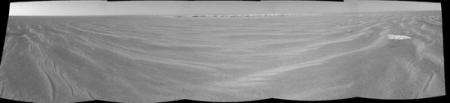
Opportunity's view of the rim of 'Victoria Crater.'

Enlarge

Opportunity´s view of the rim of ´Victoria Crater.´ (NASA)

On Monday, NASA's Mars rover Opportunity got to within about 160 feet of the rim of the half-mile-wide Victoria Crater, the rover's destination since late 2004.

The new position gave Opportunity a glimpse of the crater's opposite wall. That view from the navigation camera on the rover is available online at http://www.nasa.go … 0060919.html .

"Opportunity has been heading toward Victoria for more than 20 months, with no guarantee it would ever get there, so we are elated to see this view," said Justin Maki of NASA's Jet Propulsion Laboratory, Pasadena, Calif., an imaging scientist on the rover team. "However, we still have another two or three short drives before Opportunity is really right at the rim, looking down into the crater."

Once Opportunity reaches the rim, the rover’s panoramic camera will begin the task of creating a high-definition color mosaic. That mosaic of images will provide scientists not only with a beautiful view of the crater, but will also provide geologic details of the crater walls.

The width of Victoria crater is the equivalent of eight football fields placed end to end. That makes it about five times wider than "Endurance Crater," which Opportunity spent six months examining in 2004, and about 40 times wider than "Eagle Crater," where Opportunity first landed.

The great lure of Victoria is the expectation that a thick stack of geological layers will be exposed in the crater walls, potentially several times the thickness that was previously studied at Endurance and, therefore, potentially preserving several times the historical record. Opportunity and its twin, Spirit, are robotic geologists with instruments for examining rocks to learn about the ancient environmental conditions that existed at the times the rocks were formed. Opportunity has already found exposed rock layers that were formed in flowing surface water and other layers formed as windblown sand. Analyzing the layers at Victoria could extend the story further back in time.

Source: NASA

4.3 /5 (9 votes)  

Rank 4.3 /5 (9 votes)
Tags

Related Stories
Relevant PhysicsForums posts
  • Never ending outer space.....
    created7 hours ago
  • Neutron Star fragments?
    created9 hours ago
  • stationary or not?
    created13 hours ago
  • Scale of the Universe
    createdFeb 10, 2012
  • Titan's lack of impact craters
    createdFeb 09, 2012
  • Real pictures of black hole eating a star?
    createdFeb 08, 2012
  • More from Physics Forums - General Astronomy

More news stories

Latin America mining boom clashes with conservation

Latin America is experiencing a mining boom as prices rise fuelled by a hike in global demand, but the region is also being hit by a wave of violent protests, strikes and rallies by environmentalists.

Space & Earth / Environment

created 5 minutes ago | popularity not rated yet | comments 0

Europe stakes billion-dollar bet on new rocket

A pencil-slim rocket is scheduled to lift into space from South America on Monday, carrying a billion-dollar bet that Europe can grab a juicy slice of the market to place satellites in low orbit.

Space & Earth / Space Exploration

created 19 hours ago | popularity 3.5 / 5 (2) | comments 0

Political leaders play key role in how worried Americans are by climate change: study

More than extreme weather events and the work of scientists, it is national political leaders who influence how much Americans worry about the threat of climate change, new research finds.

Space & Earth / Environment

created Feb 06, 2012 | popularity 5 / 5 (6) | comments 72

NASA budget will axe Mars deal with Europe: scientists

US President Barack Obama's budget proposal to be submitted next week for 2013 will cut NASA's budget by 20 percent and eliminate a major partnership with Europe on Mars exploration, scientists said Thursday.

Space & Earth / Space Exploration

created Feb 10, 2012 | popularity 5 / 5 (3) | comments 48

Humans may have helped the decline of African rainforests 3000 years ago

(PhysOrg.com) -- Large areas of rainforests in Central Africa mysteriously disappeared over three thousand years ago, to be replaced by savannas. The prevailing theory has been that the cause was a change ...

Space & Earth / Environment

created Feb 10, 2012 | popularity 4.1 / 5 (14) | comments 20 | with audio podcast report


Love a click away in Indonesia's Twitter Republic

He was a geeky kid from Yogyakarta, she a glamorous city girl in Jakarta. In a country with one of the world's most vibrant social networking scenes they fell in love on Twitter.

Walney offshore wind farm is world's biggest (for now)

(PhysOrg.com) -- The Walney wind farm on the Irish Sea--characterized by high tides, waves and windy weather--officially opened this week. The farm is treated in the press as a very big deal as the Walney ...

GPS court ruling leaves US phone tracking unclear

A US Supreme Court decision requiring a warrant to place a GPS device on the car of a criminal suspect leaves unresolved the bigger issue of police tracking using mobile phones, legal experts say.

Europeans protest controversial Internet pact

Tens of thousands of people marched in protests in more than a dozen European cities Saturday against a controversial anti-online piracy pact that critics say could curtail Internet freedom.

Study finds that anti-diabetic medication can prevent the long-term effects of maternal obesity

In a study to be presented today at the Society for Maternal-Fetal Medicine's annual meeting, The Pregnancy Meeting, in Dallas, Texas, researchers will report findings that show that short therapy with the anti-diabetic medication ...

Netflix settlement trims 14 pct off 4Q earnings

(AP) -- Netflix pressed the rewind button on its fourth-quarter earnings after settling allegations that the video subscription service violated a consumer-privacy law.