Iowa State corn/soy plastics to be made into hog feeders
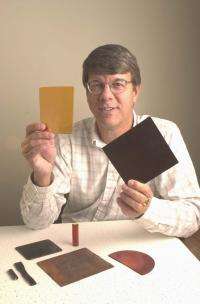
Larock, a University Professor of chemistry at Iowa State University, found the thin, square piece he was looking for and smacked it against his hand. This one is made from soybean oil reinforced with glass fibers, he said. And it's the kind of tough bioplastic he and his industrial collaborators will use to develop, test and manufacture new hog feeders.
Richard Larock displays some of the plastics he has made from corn, soybean and other bio-based oils. Larock said his research project is about as Iowa as you can get. The state, after all, is the country's leading producer of corn, soybeans and pork.
The project is partially supported by a grant of $96,000 from the Grow Iowa Values Fund, a state economic development program. Larock is working with AgVantage Inc., a Rockford, Ill., company with manufacturing facilities in Iowa, and R3 Composites, a Muscatine manufacturer.
Larock has invented and patented a process for producing various bioplastics from inexpensive natural oils, which make up 40 percent to 80 percent of the plastics. Larock said the plastics have excellent thermal and mechanical properties and are very good at dampening noises and vibrations. They're also very good at returning to their original shapes when they're heated.
And so Larock is optimistic about the future of bioplastics in commercial applications: "This project should create new technology and jobs, expand opportunities for bio-based industries and agricultural suppliers, decrease our dependence on oil, strengthen the agricultural economy of Iowa, utilize ISU patented technology, provide new markets for farmers and marry new agricultural product development with sophisticated manufacturing skills and the knowledge to commercialize these projects," he wrote in a summary of the hog feeder project.
Ron Hagemann, a principal with AgVantage, said designs for a bioplastic hog feeder have been drawn up. The designs include radio frequency identification technology that can monitor and record the feeding habits of individual hogs. Molds for the high-tech feeders should be completed later this year and prototypes should be ready for testing in a hog building next spring. If all goes well, he said a product should be ready for commercialization by the end of next year.
Hagemann said the feeders' biggest advantage in the marketplace will be material costs. Corn and soybean oils are significantly cheaper than petrochemicals. And that's particularly true when oil prices are high.
Hagemann said he expects this project to be a very good test of Larock's plastics.
Hogs, after all, aren't known for being gentle with their feeders.
"I've told Richard that if we can do this, it's all downhill from here," Hagemann said.
But Larock isn't stopping with the feeder project. He's looking at adding other low-cost agricultural ingredients to his bioplastics. He's now studying whether distillers dried grains, a co-product of ethanol production that's sold as animal feed, can add strength to his bioplastics.
Source: Iowa State University


