A Printer that Delivers 1,000 Pages a Minute?
September 21, 2006
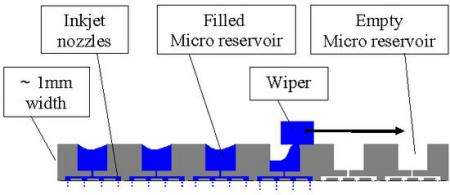
A schematic of the printer head design (side view), showing the ink micro-reservoirs, nozzles, and wiper.
Two researchers from The College of Judea and Samaria in Israel have designed an ink-jet printer head that could lead to printers capable of chugging out 1,000 pages per minute – or even more.
The innovative printer head created by engineers Moshe Einat and Nissim Einat works in a similar way as a liquid crystal display (LCD). But while an LCD emits tiny pixels of light, collectively forming the picture on your laptop or television, their print head emits pixels of ink. Their basic design is small, but it can be reproduced and the copies combined into one large printer head.
“Unlike traditional printer heads that are small and have to move back and forth across the page, our print head can be enlarged into one that is the size of a sheet of paper or larger. One can think of it as an 'ink-emitting screen',” Moshe Einat told PhysOrg.com. “This means it could print one page almost instantly, and hundreds of pages in just seconds.”
Current ink-jet printer heads work by channeling ink from a main reservoir to a series of nozzles, which are negatively pressurized to eject equal-sized ink drops. But when the number of nozzles increases, the pipe manifold connecting the reservoir to the nozzles becomes complicated and stable ink-flow conditions are harder to maintain. For example, shock waves in the ink can create “cross-talk” problems between nozzles. Another issue is the drop-ejection rate, which must be limited in order to mainstain system stability and print quality. This, in turn, stunts the print speed. The motion of standard print heads presents additional problems.
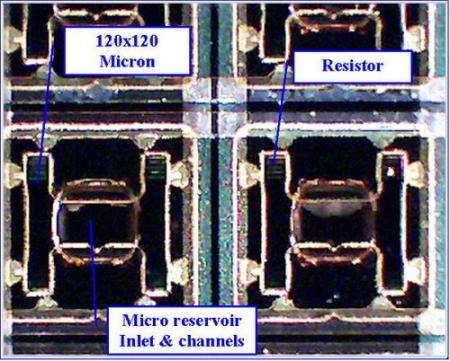
Two full (and two partial) segments of the actual printer head matrix.
“Our design avoids these physical limitations,” said Einat.
The design's building block is a micro-reservoir of ink that feeds four nozzles. The reservoir is square, one millimeter (mm) on each side, and is 0.5 mm deep. The ink enters the nozzles via capillary action (the way water naturally creeps up a plant stem, for instance). To refill, an ink-coated “wiper” slides over the top of the reservoir, depositing a layer of ink. The small amount of ink in each reservoir and the natural capillary force between the ink and the reservoir walls make pressure regulation fairly simple.
Einat and Einat combined many of these basic stand-alone segments into a 12x12 cm2 printer head matrix with a total of 57,600 nozzles. They subjected it to several tests to confirm proper ink flow within the system.
This design, which the researchers dub JeTrix, has many potential applications. Says Einat, “The future applications of JeTrix will be traditional, such as extremely high-speed printers for industry, offices, and homes. But we also anticipate brand-new, pioneering applications. One example is in-store book printing – where the book is printed instantly for the customer. This could enable small bookshops or even airport kiosks to carry a huge variety of books. There's also personalization – newspapers or journals printed with a customer's name, favorite topics, and suitable advertisements.”
He continues, “The JeTrix project is still in an early stage. The concept was proofed in a laboratory prototype, but we expect that a commercial product will be ready after two years of development, which will include additional funding and product engineering.”
For more information about this research, see the published paper in the August 15, 2006, online edition of Applied Physics Letters.
Citation: M. Einat and N. Einat, “Two-dimension full array high-speed ink-jet print head,” Applied Physics Letters 89, 073505 (2006)
By Laura Mgrdichian, Copyright 2006 PhysOrg.com
-
Particle-free silver ink prints small, high-performance electronics
Jan 13, 2012 |
5 / 5 (10) |
2
-
Korean researchers use graphene to create transparent loudspeakers
Jul 12, 2011 |
4.2 / 5 (5) |
2
-
Inkjet, laser, Memjet? Fast color printers on tap
Jan 08, 2011 |
4.1 / 5 (12) |
10
-
Improved e-jet printing provides higher resolution and more versatility
Sep 06, 2007 |
4.3 / 5 (12) |
0
-
HP Pushes Ink Jet Printing to 70 Pages per Minute
Apr 12, 2007 |
4.4 / 5 (17) |
0
-
Engineers build first sub-10-nm carbon nanotube transistor
Feb 01, 2012 |
4.9 / 5 (29) |
30
-
Something old, something new: Evolution and the structural divergence of duplicate genes
Jan 31, 2012 |
4.6 / 5 (7) |
1
-
The hidden nanoworld of ice crystals: Revealing the dynamic behavior of quasi-liquid layers
Jan 30, 2012 |
5 / 5 (3) |
1
-
Stock market network reveals investor clustering
Jan 27, 2012 |
4 / 5 (22) |
8
-
Of microchemistry and molecules: Electronic microfluidic device synthesizes biocompatible probes
Jan 26, 2012 |
5 / 5 (1) |
0
-
How is zeno paradox of motion solved
1 hour ago
-
Good books for studying physics on own
2 hours ago
-
Kinetic energy and crumple zones
4 hours ago
-
Finding the E field with a changing p???
7 hours ago
-
All matter being liquid in 10^65 years if proton decay doesn't occur.
8 hours ago
-
The acceleration of an Elephant and a Paper Clip
8 hours ago
- More from Physics Forums - General Physics
More news stories
Physicists 'record' magnetic breakthrough
An international team of scientists has demonstrated a revolutionary new way of magnetic recording which will allow information to be processed hundreds of times faster than by current hard drive technology.
16 hours ago |
4.4 / 5 (29) |
12
|
Diamond light, brighter than the sun
Its the size of five football pitches and generates light 10 billion times brighter than the sun. As the Diamond Light Source celebrates its tenth anniversary this year, Penny Bailey visits one of the ...
19 hours ago |
4.3 / 5 (6) |
14
|
With single laser pulses on single molecules
(PhysOrg.com) -- Physicists at MPQ (Max Planck Institute) succeed in resolving the internal dynamics of individual molecules using UV femtosecond laser pulses.
19 hours ago |
5 / 5 (1) |
1
|
Searching for a solid that flows like a liquid
(PhysOrg.com) -- A series of neutron scattering experiments at Oak Ridge National Laboratory and other research centers is exploring the key question about a long-sought quantum state of matter called supersolidity: ...
Feb 03, 2012 |
4.3 / 5 (7) |
17
|
Physicists push for underground testing facility
Pran Nath, the Matthews Distinguished Professor of Physics at Northeastern University, is among a group of leading theoretical physicists who have asked the Department of Energy to develop a large underground ...
Feb 02, 2012 |
4.6 / 5 (5) |
12
Scared of a younger rival? Not for some male songbirds
When mature male white-crowned sparrows duel to win a mate or a nesting territory, a young bird just doesn't get much respect.
Tiny primate 'talks' in ultrasound
One of the world's smallest primates, the Philippine tarsier, communicates in a range of ultrasound inaudible to predator and prey alike, according to a study published on Wednesday.
Playing school sports affects youths' smoking
Young people's choices about using drugs and alcohol are influenced by peersnot only close friends, but also sports teammates. A new study of middle schoolers and their social networks has found that teammates' smoking ...
New study: Adolescents suffering from depression more likely to be bullied
A new study provides evidence that adolescents who suffer from depression are more likely to develop difficulty in peer relationships including being bullied at school.
Preventing bacteria from falling in with the wrong crowd could help stop gum disease
Stripping some mouth bacteria of their access key to gangs of other pathogenic oral bacteria could help prevent gum disease and tooth loss. The study, published in the journal Microbiology suggests that t ...
New study sheds light on genetics of rice metabolism
A large-scale study analyzing metabolic compounds in rice grains conducted by researchers at the RIKEN Plant Science Center (PSC) and their collaborators has identified 131 rice metabolites and clarified the ...

Nov 23, 2008
Rank: not rated yet