'Imported' pollution tied to poor air quality in Texas in 2004
September 21, 2006 Smoke from Alaska and Canada

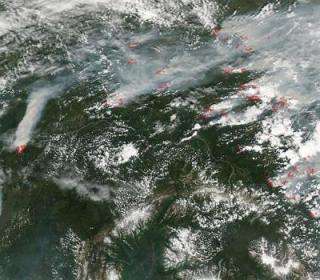
This image from the Moderate Resolution Imaging Spectroradiometer (MODIS) on NASA's Aqua satellite shows forest fires and thick smoke over Alaska and Canada on July 13, 2004. Areas where MODIS detected active fires are outlined in red. Credit: NASA/GSFC

Scientists using NASA satellites and other data including computer models and ground sensors have demonstrated that pollutants traveling even thousands of miles can impact air quality.

The study concludes that ozone pollution levels increased significantly in the air above Houston on July 19 and 20, 2004. Researchers attribute this increase in part as a result of smoke transported into the area over the course of a week from forest fires raging in Alaska and Canada. The study is one of only a few that has quantitatively examined the impact of remotely generated pollutants on air quality in the lower atmosphere.

As part of a NASA-led field research project in the summer of 2004, researchers sampled a variety of trace gases and aerosols -- tiny particles suspended in the air -- across North America. During the time of the study, forest fires in western Canada and eastern Alaska were consuming more acres than at any time during the last 50 years. Meteorological conditions carried smoke from these intense fires eastward and southward to the U.S. Gulf Coast.

"The combination of our balloon-borne ozone data and observations by NASA satellites, aircraft, and a network of ground stations provided unprecedented insight into the origins of locally poor air quality in Houston on those two days," said study lead author Gary Morris of Valparaiso University, Valparaiso, Ind.

The researchers relied on imagery from NASA's Moderate Resolution Imaging Spectroradiometer on the Terra satellite, aerosol data from the Total Ozone Mapping Spectrometer satellite, and carbon monoxide data from the Atmospheric Infrared Sounder on the Aqua spacecraft to track the an air mass from the region of forest fires in western Canada and eastern Alaska on July 12-13, 2004. The air mass traveled across Canada, through the mid-western United States, and all the way to Houston, arriving there on July 19.

"We found that with the arrival of the pollutants associated with these forest fires, ozone levels increased between 50-100 percent in the first 5 kilometers over Houston," said Morris. Meteorological conditions, the smoke from the distant forest fires, and the typical urban pollution generated in the Houston area provided a potent mix for increasing local ozone concentrations.

The scientists believe that such pollution episodes will continue. Understanding the transport and transformation of gases and aerosols over long distances is needed for improved understanding and air quality forecasting.

"This event highlights the critical role imported sources can have on local air quality," said Morris. Balloon-borne data and ground observations combined with data from NASA's suite of satellites and computer models will continue to advance our understanding of the impact of pollutants on air quality. Such information will help enable environmental managers to improve air quality forecasts and propose more effective air quality solutions.

Source: NASA / Goddard Space Flight Center


print this article email this article download pdf blog this article bookmark this article     Stumble it Digg this share on Facebook retweet share on Reddit add to delicious
Rate this story - 3.7 /5 (6 votes)


September 21, 2006 all stories

Comments: 0

3.7 /5 (6 votes)
  • Stumble this up

  • Digg this

  • share this

  • hide
  • Related Stories

  • NASA Researchers Explore Lightning's NOx-ious Impact on Pollution, Climate
    created Oct 23, 2009 | popularity not rated yet | comments 0
  • New stove dramatically improves lung health in Mexican women
    created Sep 23, 2009 | popularity not rated yet | comments 0
  • Invention busts dust
    created Sep 22, 2009 | popularity not rated yet | comments 0
  • Pollution from California Wildfires Spreads Across the United States (w/ Video)
    created Sep 04, 2009 | popularity not rated yet | comments 0
  • Wildfires set to increase 50 percent by 2050
    created Jul 28, 2009 | popularity not rated yet | comments 0


  • hide
  • Relevant PhysicsForums posts

  • The IPCC and the term "most"
    created Nov 23, 2009
  • Is global warming a fact?
    created Nov 23, 2009
  • Random variability of wind patterns
    created Nov 23, 2009
  • Record precipitation in the UK
    created Nov 22, 2009
  • More from Physics Forums - Earth

Other News

Past regional cold and warm periods linked to natural climate drivers

Space & Earth / Earth Sciences

created 12 hours ago | popularity 3.6 / 5 (9) | comments 13

Intervals of regional warmth and cold in the past are linked to the El Niņo phenomenon and the so-called "North Atlantic Oscillation" in the Northern hemisphere's jet stream, according to a team of climate scientists. These ...


Russia: no space for space tourists (AP)

Russia: no space for space tourists

Space & Earth / Space Exploration

created 20 hours ago | popularity 2.7 / 5 (3) | comments 2

(AP) -- A top Russian space official says there is no space for tourists wishing to fly to the International Space Station.


Astronauts surprised by holiday turkey dinners (AP)

Astronauts surprised by holiday turkey dinners

Space & Earth / Space Exploration

created 16 hours ago | popularity 5 / 5 (1) | comments 0

(AP) -- Space shuttle Atlantis' astronauts thought they were going to give thanks with pantry leftovers Thursday as their mission drew to a close, but found turkey dinners awaiting them.


Gullies and Flow Features on Crater Wall

Gullies and Flow Features on Crater Wall

Space & Earth / Space Exploration

created 16 hours ago | popularity 5 / 5 (1) | comments 0

(PhysOrg.com) -- This image from the High Resolution Imaging Science Experiment (HiRISE) camera on NASA's Mars Reconnaissance Orbiter shows a sample of the variety and complexity of processes that may occur ...


Thanksgiving last full day in space for shuttle (AP)

Thanksgiving last full day in space for shuttle

Space & Earth / Space Exploration

created 20 hours ago | popularity not rated yet | comments 0

(AP) -- Space shuttle Atlantis' astronauts will spend Thanksgiving checking their ship for the ride home.