New device tests uncertainty principle with new precision
September 22nd, 2006 New device tests uncertainty principle with new precision

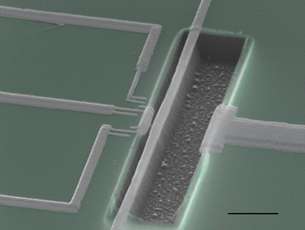
A scanning electron microscope image of an aluminum and silicon nitride resonator coupled to a superconducting single electron transistor (SSET). Researchers watched the resonator move through a phenomenon known as quantum back-action.

In the submicroscopic world -- the domain of elementary particles and individual atoms -- things behave in the strange, counter-intuitive fashion governed by the principles of quantum mechanics. Nothing (or so it seems) like our macroscopic world -- or even the microscopic world of cells or bacteria or dust particles -- where Newton's much more reasonable laws keep things sensibly ordered.

The problem comes in finding the dividing line between the two worlds -- or even in establishing that such a line exists. To that end, Keith Schwab, associate professor of physics who moved to Cornell this year from the National Security Agency, and colleagues have created a device that approaches this quantum mechanical limit at the largest length-scale to date.

And surprisingly, the research also has shown how researchers can lower the temperature of an object -- just by watching it.

The results, which could have applications in quantum computing, cooling engineering and more, appear in the Sept. 14 issue of the journal Nature.

The device is actually a tiny (8.7 microns, or millionths of a meter, long; 200 nanometers, or billionths of a meter, wide) sliver of aluminum on silicon nitride, pinned down at both ends and allowed to vibrate in the middle. Nearby, Schwab positioned a superconducting single electron transistor (SSET) to detect minuscule changes in the sliver's position.

According to the Heisenberg Uncertainty Principle, the precision of simultaneous measurements of position and velocity of a particle is limited by a quantifiable amount. Schwab and his colleagues were able to get closer than ever to that theoretical limit with their measurements, demonstrating as well a phenomenon called back action, by which the act of observing something actually gives it a nudge of momentum.

"We made measurements of position that are so intense -- so strongly coupled -- that by looking at it we can make it move," said Schwab. "Quantum mechanics requires that you cannot make a measurement of something and not perturb it. We're doing measurements that are very close to the uncertainty principle; and we can couple so strongly that by measuring the position we can see the thing move."

The device, while undeniably small, is -- at about ten thousand billion atoms -- vastly bigger than the typical quantum world of elementary particles.

Still, while that result was unprecedented, it had been predicted by theory. But the second observation was a surprise: By applying certain voltages to the transistor, the researchers saw the system's temperature decrease.

"By looking at it you cannot only make it move; you can pull energy out of it," said Schwab. "And the numbers suggest, if we were to keep going on with this work, we would be able to cool this thing very cold. Much colder than we could if we just had this big refrigerator."

The mechanism behind the cooling is analogous to a process called optical or Doppler cooling, which allows atomic physicists to cool atomic vapor with a red laser. This is the first time the phenomenon has been observed in a condensed matter context.

Schwab hasn't decided if he'll pursue the cooling project. More interesting, he says, is the task of figuring out the bigger problem of quantum mechanics: whether it holds true in the macroscopic world; and if not, where the system breaks down.

For that he's focusing on another principle of quantum mechanics -- the superposition principle -- which holds that a particle can simultaneously be in two places.

"We're trying to make a mechanical device be in two places at one time. What's really neat is it looks like we should be able to do it," he said. "The hope, the dream, the fantasy is that we get that superposition and start making bigger devices and find the breakdown."

Source: Cornell University


print this article email this article download pdf blog this article bookmark this article     Digg this Stumble it share on Facebook share on Reddit add to delicious save to Yahoo! bookmarks
4.6/5 after 61 votes


September 22nd, 2006 all stories
Physics / General Physics

Comments: 0
Rank: 4.6/5 after 61 votes

  • Stumble this up

  • Digg this

  • Share it:
  • share on Facebook
  • share on MySpace
  • share on Slashdot
  • rss-newsfeed
  • share on Google
  • share on Reddit
  • add to delicious
  • save to Yahoo! bookmarks
  • share on Windows Live
  • Add to Mixx!
Rating: 4.6/5 after 61 votes

  • Related Stories

  • New method to detect quantum mechanical effects in ordinary objects
    created Jun 22, 2009 | popularity not rated yet | comments 0
  • Physicists move closer to the quantum limit
    created Apr 12, 2004 | popularity not rated yet | comments 0
  • Scientists develop novel ion trap for sensing force and light
    created Jul 01, 2009 | popularity not rated yet | comments 0
  • Nanotubes weigh the atom
    created Jun 29, 2009 | popularity not rated yet | comments 0
  • Scientists create first electronic quantum processor
    created Jun 28, 2009 | popularity not rated yet | comments 0

Tags


  • Physicists Demonstrate Quantum Memory with Matter Qubits
    Physicists Demonstrate Quantum Memory with Matter Qubits
    Physics / General Physics
    created Jul 03, 2009 | popularity 4.4 / 5 (17) | comments 1
  • 'Holey' Nanosheets for Wastewater Dye Removal
    Nanotechnology / Nanomaterials
    created Jul 01, 2009 | popularity 5 / 5 (5) | comments 1
  • Jellyfish Robot Swims Like its Biological Counterpart
    Jellyfish Robot Swims Like its Biological Counterpart
    Electronics / Robotics
    created Jun 26, 2009 | popularity 4.4 / 5 (8) | comments 1
  • Could Maxwell's Demon Exist in Nanoscale Systems?
    Could Maxwell's Demon Exist in Nanoscale Systems?
    Physics / General Physics
    created Jun 24, 2009 | popularity 4.4 / 5 (18) | comments 29
  • Living Safely with Robots, Beyond Asimov's Laws
    Living Safely with Robots, Beyond Asimov's Laws
    Electronics / Robotics
    created Jun 22, 2009 | popularity 4.6 / 5 (53) | comments 40
  • Other News

    UQ researchers break the law -- of physics

    Physics / General Physics

    created 5 hours ago | popularity 4.7 / 5 (9) | comments 0

    (PhysOrg.com) -- Two UQ Science researchers have proved two famous physical laws that have been widely used for the past 25 years do not always work.


    Scientists create first electronic quantum processor

    Scientists create first electronic quantum processor

    Physics / General Physics

    created Jun 28, 2009 | popularity 4.8 / 5 (54) | comments 42

    A team led by Yale University researchers has created the first rudimentary solid-state quantum processor, taking another step toward the ultimate dream of building a quantum computer.


    Science journals

    How to Spot an Influential Paper Based on its Citations

    Physics / General Physics

    created Jul 04, 2009 | popularity 3.9 / 5 (10) | comments 6

    (PhysOrg.com) -- At first it may seem that the number of citations received by a published scientific paper is directly related to that paper's quality of content. The higher the quality, the more people read ...


    Fermilab's CDF observes Omega-sub-b baryon

    Fermilab's CDF observes Omega-sub-b baryon

    Physics / General Physics

    created Jun 29, 2009 | popularity 4.7 / 5 (18) | comments 7

    (PhysOrg.com) -- At a recent physics seminar at the Department of Energy’s Fermi National Accelerator Laboratory, Fermilab physicist Pat Lukens of the CDF experiment announced the observation of a new particle, ...


    New insights, and a new angle, on high-temperature superconductivity

    New insights, and a new angle, on high-temperature superconductivity

    Physics / Superconductivity

    created Jun 29, 2009 | popularity 4.9 / 5 (14) | comments 7

    (PhysOrg.com) -- A Princeton-led research team has revealed surprising information about how electron behavior influences the conduction of electricity in a class of high-temperature superconductors. An increased ...