From zero to a billion electron volts in 3.3 centimeters
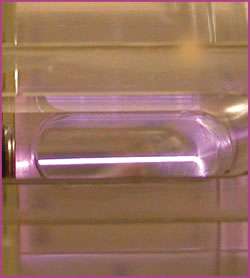
In a precedent-shattering demonstration of the potential of laser-wakefield acceleration, scientists at the Department of Energy's Lawrence Berkeley National Laboratory, working with colleagues at the University of Oxford, have accelerated electron beams to energies exceeding a billion electron volts (1 GeV) in a distance of just 3.3 centimeters. The researchers report their results in the October issue of Nature Physics.
By comparison, SLAC, the Stanford Linear Accelerator Center, boosts electrons to 50 GeV over a distance of two miles (3.2 kilometers) with radiofrequency cavities whose accelerating electric fields are limited to about 20 million volts per meter.
The electric field of a plasma wave driven by a laser pulse can reach 100 billion volts per meter, however, which has made it possible for the Berkeley Lab group and their Oxford collaborators to achieve a 50th of SLAC's beam energy in just one-100,000th of SLAC's length.
This is only the first step, says Wim Leemans of Berkeley Lab's Accelerator and Fusion Research Division (AFRD). "Billion-electron-volt beams from laser-wakefield accelerators open the way to very compact high-energy experiments and superbright free-electron lasers."
Channeling a path to billion-volt beams
In the fall of 2004 the Leemans group, dubbed LOASIS (Laser Optics and Accelerator Systems Integrated Studies), was one of three groups to report reaching peak energies of 70 to 200 MeV (million electron volts) with laser wakefields, accelerating bunches of tightly focused electrons with nearly uniform energies.
While the other groups employed large laser spot sizes and 30 TW laser pulses (TW stands for terawatts, or 1012 watts), the LOASIS "igniter-heater" approach was quite different. LOASIS drove a plasma channel through a plume of hydrogen gas with one laser pulse, heated and shaped the channel with a second pulse, and created the accelerating wave with a third pulse at a relatively modest 9 TW.
In all such techniques plasma is formed by heating the hydrogen gas enough to disintegrate its atoms into their constituent protons and electrons. A laser pulse traveling through this plasma creates a wake in which bunches of free electrons are trapped and ride along, much like surfers riding the wake of a big ship.
After propagating for a distance known as the "dephasing length" the electrons outrun the wake. This limits how far they can be accelerated and thus limits their energy. To increase the dephasing length requires lowering the plasma density, but at the same time the collimation of the laser beam must be maintained over the longer distance.
One way to do this is to increase the spot size of the laser beam, since this reduces diffraction. "The trouble with this approach is that if you double the size of the spot, you have to quadruple the laser power just to maintain the same intensity over the area of the spot," Leemans says. Increasing spot size enough to achieve 1 GeV beams would require petawatt lasers (1015 watts). "The more powerful the laser, the more expensive and cumbersome," he says. "Plus it takes the laser a lot longer to charge up, which limits its pulse repetition rate."
Big spot sizes are problematic in themselves. "There's the risk of increased electron emittance, meaning the beam spreads out and becomes hard to focus," says Leemans. "Free-electron lasers are one of the most promising applications for laser-wakefield accelerators, but they depend on all the electrons in the beam being uniformly in phase. Low emittance beams are essential for free-electron lasers."
The alternate way to increase the acceleration length is to provide a guide channel for the drive-laser pulse that creates the plasma wakefield. In the 2004 experiments, the LOASIS group did this by drilling a wire-thin channel of plasma through a plume of hydrogen gas with an igniter pulse; when heated by a separate laser pulse, the plasma expanded inside the channel so that its density was near vacuum in the center but much higher near the walls. Like an optical fiber, the channel served to guide and shape the pulse from the drive laser for distances up to two millimeters. But this technique too has its limitations.
"Because of inefficient heating, laser-formed channels only work in dense plasmas," Leemans says. "To extend the dephasing length much beyond two millimeters you need lower-density plasmas. So many researchers in the field thought the only way to reach higher beam energies was to use larger spot sizes and much more powerful lasers."
Leemans says the manifest advantages of channel guiding higher-intensity pulses from lower-power lasers, yielding coherent, tightly focused beams with little energy spread were strong incentives for the Berkeley Lab group to continue with the channel approach.
Sapphires and capacitors
At Oxford University Leemans met Simon Hooker, whose group had been studying plasma channel guides and their application to driving x-ray lasers and plasma accelerators for several years. Hooker showed Leemans a capillary channel guide carved into sapphire.
"How many laser shots can it take?" Leemans asked, and when Hooker replied, "As many as you like," a collaboration was born.
In the recent experiments Hooker and his group provided one of the Oxford waveguides and the expertise in using them for guiding high-intensity laser pulses, and Leemans and his group provided powerful lasers, engineering capabilities, and unique know-how in driving laser-wakefield accelerators in waveguides. "The time was ripe to bring the experience of these two groups together," Hooker notes.
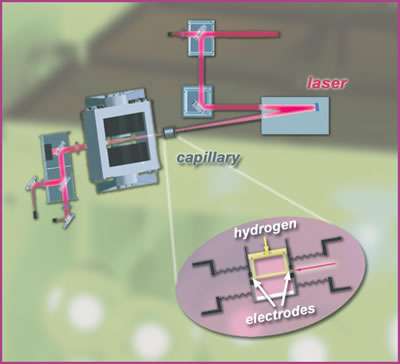
In these experiments, the guide capillary consists of two half-channels cut into the face of matching sapphire blocks; when the blocks are joined face to face, the halves of the channel form a thin tube. Other tubes come in at right angles fore and aft, through which hydrogen gas flows. Electrodes are placed near each end of the capillary.
To turn the hydrogen gas within the capillary into a plasma, a capacitor discharges current through the capillary from electrode to electrode. Almost instantly the electric discharge heats the newly formed plasma, creating an optical-fiber-like channel inside the capillary, with low plasma density in the hot center and high density against the channel's cool sapphire walls.
As Hooker explains, "Each cross section of the channel acts like a positive lens, continually focusing the beam toward the center of the channel."
Not least of this system's advantages over heating a channel with a separate laser is cost, says Leemans: "A 1 joule capacitor is much cheaper than a 1 joule laser."
After a brief, carefully timed delay, the drive pulse from a 40 TW laser generates an intense and powerful wake in the plasma, trapping bunches of free electrons and accelerating them to over 1 GeV within the capillary's 3.3 centimeter length.
Once the beam passes through the capillary, the researchers used a deflecting magnet and a meter-wide phosphor screen to measure the beam's energy, energy spread, and divergence. With an acceleration path more than 15 times as long as the igniter-heater set-up reported in 2004 -- the longest distance over which such intense laser pulses have ever been channeled -- and with four times its peak laser power, the tightly focused electron bunches reached 1 GeV; electron energies within each bunch varied at most 2.5 percent and probably less. Thus for the first time a laser-driven accelerator reached the beam energies typically found in conventional synchrotrons and free-electron lasers.
Impressive as this is, "It's the tip of the iceberg," says Leemans. "We are already working on injection" -- inserting an already energetic beam into an accelerating cavity -- "and staging," the handoff of an energetic beam from one capillary to the next and subsequently to others, until very high energy beams are achieved. "Brookhaven physicist Bill Weng has remarked that achieving staging in a laser wakefield accelerator would validate 25 years of DOE investment in this field."
Leemans's group and their collaborators look forward to the challenge with confidence. "In DOE's Office of Science, the High Energy Physics office has asked us to look into what it would take to go to 10GeV. We believe we can do that with an accelerator less than a meter long -- although we'll probably need 30 meters' worth of laser path."
While it's been said that laser wakefield acceleration promises high-energy accelerators on a tabletop, the real thing may not be quite that small. But laser wakefield acceleration does indeed promise electron accelerators potentially far more powerful than any existing machine -- neatly tucked inside a small building.
Source: Lawrence Berkeley National Laboratory


