Synthetic DNA Makes Better Hydrogels for Drug Delivery
September 26, 2006
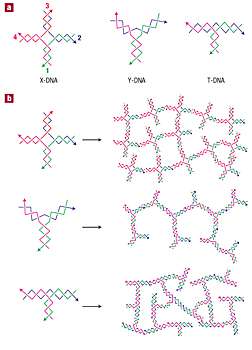
DNA chains that attach to one another along part of their length can self-assemble into branching structures including crosses, T's and Y's. In the presence of enzymes that connect the open ends to one another, these shapes combine into larger structures with many small openings, creating a sponge-like material called a hydrogel. Credit: Molecular Bioengineering Lab/Cornell University
Using synthetic DNA formed into crosses, Y's and T's, Cornell researchers have created biocompatible, biodegradable, inexpensive hydrogels that can be easily formed into any desired shape for biomedical applications.
Hydrogels are liquid or semisolid materials composed of long-chain molecules cross-linked to one another to create many small empty spaces that can absorb water or other liquids like a sponge. If the spaces are filled with a drug, the hydrogel can dispense the drug gradually as the structure biodegrades. Widespread research also is under way on using hydrogels as scaffolds for tissue engineering and tissue repair, where the spaces in the gel might be filled with stem cells, tissue-growth factors or a combination of both.
Hydrogels for these purposes are usually made from organic or inorganic polymers (molecules that form long chains), such as alginate from seaweed. Some have been made from proteins but none entirely from ordinary DNA. So far, all these processes have used organic solvents or acids or involve high temperatures, making conditions too harsh for a drug or living cells, so the materials to be encapsulated must be loaded in afterward.
The new process, developed in the laboratory of Dan Luo, Cornell assistant professor of biological and environmental engineering, uses no high temperatures or harsh chemicals, so the material to be encapsulated in the gel can be introduced before the gel is formed. Because the gel is made of only synthetic DNA, no immune response should be triggered, the researchers said, so the material encapsulated can include proteins and even live mammalian cells.
The research was published Sept. 24 in the online version of Nature Materials and will appear in a forthcoming print issue of the journal.
A DNA molecule is a long chain in a sequence that is unique to each chain. Conveniently, two chains with complementary sequences can lock onto one another like two halves of a zipper. By making synthetic DNA chains whose sequences are complementary over only part of their length, Luo and colleagues have created tree-shaped structures.
To create hydrogels, they made branched DNA that formed itself into crosses, Y's and T's with "sticky" ends that could link to each other with the help of enzymes known as ligases. The cross-shaped branched DNA forms a gel by linking together into sheets of tiny squares that tangle in three dimensions; Y shapes form hexagonal structures like a chain link fence that combine into a fibrous three-dimensional form, while T shapes create random, disorganized patterns that look like an assembly of scales.
The researchers found that they could easily alter certain properties of the resulting gelatinous materials, including rigidity and absorbency, by adjusting the types of branched DNA used and the concentration of DNA in the mix. To demonstrate the ability of some of the materials to hold their shape, the researchers created them in a variety of different molds, including some that spelled out "CORNELL" at centimeter and nanoscales.
To test the use of the DNA hydrogels for delivering drugs, the researchers encapsulated porcine insulin and the anticancer drug Camptothecin and observed that the drugs were released in a controlled manner over time. When they encapsulated live cells in a gel, they found that the cells were still alive three days later. It is possible, the researchers said, that live cells encapsulated in a DNA hydrogel could be recovered, still alive, by breaking down the DNA structure with enzymes.
Co-authors with Luo are Cornell graduate students Soong Ho Um, Jong Bum Lee and Sang Yeon Kwon, postdoctoral researcher Nokyoung Park, and Christopher Umbach, Cornell assistant professor of materials science and engineering.
Source: Cornell University
-
Physicists build highly efficient 'no-waste' laser
3 hours ago |
5 / 5 (10) |
1
-
Discovery of extremely long-lived proteins may provide insight into cell aging
Feb 03, 2012 |
4.9 / 5 (13) |
0
-
Study proves plausibility of new pathway to life's chemical building blocks
Jan 31, 2012 |
5 / 5 (6) |
6
-
Disappearing gold a boon for nanolattices
Jan 30, 2012 |
5 / 5 (4) |
0
-
Nanotube growth theory experimentally confirmed
Jan 30, 2012 |
4.9 / 5 (10) |
1
-
Engineers build first sub-10-nm carbon nanotube transistor
Feb 01, 2012 |
4.9 / 5 (31) |
30
-
Something old, something new: Evolution and the structural divergence of duplicate genes
Jan 31, 2012 |
4.6 / 5 (7) |
1
-
The hidden nanoworld of ice crystals: Revealing the dynamic behavior of quasi-liquid layers
Jan 30, 2012 |
5 / 5 (3) |
1
-
Stock market network reveals investor clustering
Jan 27, 2012 |
3.9 / 5 (23) |
8
-
Of microchemistry and molecules: Electronic microfluidic device synthesizes biocompatible probes
Jan 26, 2012 |
5 / 5 (1) |
0
-
Kinetic energy of gas
2 hours ago
-
Understanding induced emfs
4 hours ago
-
What is the precise definition of a year?
5 hours ago
-
Universe as a cellular automaton
6 hours ago
-
Question about Newton's laws
7 hours ago
-
Gravity Question (I think) with mass and speed
9 hours ago
- More from Physics Forums - General Physics
More news stories
Explained: Sigma
It's a question that arises with virtually every major new finding in science or medicine: What makes a result reliable enough to be taken seriously? The answer has to do with statistical significance -- but ...
Feb 09, 2012 |
5 / 5 (19) |
66
Quantum physicist explains $100K offer for proof scaled-up quantum computing is impossible
(PhysOrg.com) -- MIT researcher Scott Aaronson has certainly riled the physics community with his offer this past Friday, of $100,000 to anyone who can prove that scaled-up quantum computing is impossible. ...
Diamond light, brighter than the sun
Its the size of five football pitches and generates light 10 billion times brighter than the sun. As the Diamond Light Source celebrates its tenth anniversary this year, Penny Bailey visits one of the ...
Feb 07, 2012 |
4.3 / 5 (7) |
15
|
Physicists 'record' magnetic breakthrough
An international team of scientists has demonstrated a revolutionary new way of magnetic recording which will allow information to be processed hundreds of times faster than by current hard drive technology.
Feb 07, 2012 |
4.5 / 5 (41) |
14
|
Hints of the Higgs - papers are submitted
Back in December 2011, the ATLAS and CMS experiments at CERN presented some exciting results that provided tantalising hints of the Higgs boson.
Feb 08, 2012 |
4.1 / 5 (7) |
10
Walney offshore wind farm is world's biggest (for now)
(PhysOrg.com) -- The Walney wind farm on the Irish Sea--characterized by high tides, waves and windy weather--officially opened this week. The farm is treated in the press as a very big deal as the Walney ...
GPS court ruling leaves US phone tracking unclear
A US Supreme Court decision requiring a warrant to place a GPS device on the car of a criminal suspect leaves unresolved the bigger issue of police tracking using mobile phones, legal experts say.
Europeans protest controversial Internet pact
Tens of thousands of people marched in protests in more than a dozen European cities Saturday against a controversial anti-online piracy pact that critics say could curtail Internet freedom.
Europe stakes billion-dollar bet on new rocket
A pencil-slim rocket is scheduled to lift into space from South America on Monday, carrying a billion-dollar bet that Europe can grab a juicy slice of the market to place satellites in low orbit.
Study finds that anti-diabetic medication can prevent the long-term effects of maternal obesity
In a study to be presented today at the Society for Maternal-Fetal Medicine's annual meeting, The Pregnancy Meeting, in Dallas, Texas, researchers will report findings that show that short therapy with the anti-diabetic medication ...
Netflix settlement trims 14 pct off 4Q earnings
(AP) -- Netflix pressed the rewind button on its fourth-quarter earnings after settling allegations that the video subscription service violated a consumer-privacy law.