Team to build next-generation magnet
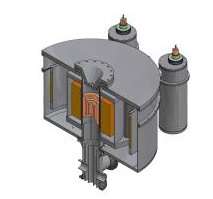
The National Science Foundation has awarded the National High Magnetic Field Laboratory an $11.7-million grant for construction of an innovative magnet that will have the potential to revolutionize a technique used to learn more about little-understood molecules.
The magnet -- which will generate extremely high magnetic fields using just one-third the power of traditional "all-resistive" magnets -- will enable unique experiments to be conducted at the Florida State University facility. It will be used primarily for nuclear magnetic resonance (NMR) to study proteins, nucleic acids, catalysts, conductors and semiconductors.
Gregory S. Boebinger, director of the magnet lab, praised the facility's engineering team, which has designed and built an estimated $40 million worth of one-of-a-kind magnets since the lab's creation. Established by the National Science Foundation in 1990, the magnet lab is operated jointly by FSU, the University of Florida and Los Alamos National Laboratory in New Mexico.
"The magnet engineers are absolutely critical to the lab's success," Boebinger said. "The lab's customers are its users, and the users can't explore new frontiers in science without cutting-edge tools such as the Series Connected Hybrid."
Mark D. Bird, interim director of the lab's Magnet Science & Technology division and a co-principal investigator on the grant, said the lab has such great success with big magnet projects because its engineers and technicians are the best in the world at what they do.
"The award for the construction phase validates the Series Connected Hybrid concept and the strength of our team," Bird said. "And it sets the stage for the next generation of high-field-powered systems."
A key advantage of the new magnet, which is a hybrid of resistive and superconducting magnets, is that it will allow experiments to be performed at lower cost and for longer time frames than would be the case using existing all-resistive magnets. Resistive magnets require both electricity and cooled water while being used; superconducting magnets require little or no electrical power to run once they are brought up to full field.
Eventually, multiple numbers of such hybrid systems will increase the number of experiments that can be carried out at the lab each year.
The Series Connected Hybrid will provide a unique combination of high field strength (36 tesla) and highly stable and homogeneous field, a critical factor in collecting the best data with the NMR technique. In addition, by replacing part of a resistive magnet with a superconducting magnet, the operational costs are reduced significantly, allowing an experiment to be run longer, which lengthens researchers' data-acquisition times.
A large part of the grant will be used to develop the sophisticated instrumentation and probes required for NMR science.
"Our team is working to ensure that the most exciting science is supported by the best instrumentation," said project co-principal investigator Timothy A. Cross, who directs the lab's NMR program.
Although the new magnet will reduce power consumption, cost savings are likely to be moderated by an expected increase in users, given the high demand for magnet time. To learn more about the new magnet, please visit www.magnet.fsu.edu .
Source: Florida State University


