Ancient sea creature rediscovered after 25 years
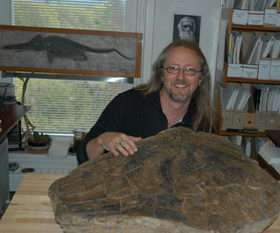
University of Alberta scientists have named a new species of ancient marine reptile, fondly called the Ping Pong Ichthyosaur after the spot the prehistoric creature called home for the last 25 years.
Embryos found within the body of a pregnant fossil also mark the most recent record of a live birth and the physically smallest known ichthyosaur embryos.
"It was pretty amazing to realize this valuable discovery had sat under a ping-pong table for 25 years," said Dr. Michael Caldwell, paleontologist at the U of A. "But I suppose that after 100 millions of years in the dirt, it's all relative."
A few decades ago, graduate students and a technician from the Faculty of Science collected several ichthyosaur specimens - the marine animals resembled dolphins and fish - from the Loon River Formation at Hay River, NWT. Somehow the bones ended up in several boxes underneath a ping-pong table in the science undergraduate lab. When Caldwell arrived in 2000, he started renovations, found the boxes and immediately started inquiring about the fossils. Allan Lindoe, the technician of the original dig, was still in the faculty and explained the history.
Working with Erin Maxwell, an undergraduate student at the U of A at the time, Caldwell soon learned the bones were from the Lower Cretaceous period, or about 100 million years old. This finding was significant since it bridged a huge gap - the previous set of pregnant ichthyosaur specimens was dated 80 millions earlier. The Loon Lake collection was also the most northern record of ichthyosaur remains from Canada.
"What was really interesting was that, at this point in history, the ichthyosaur goes extinct," said Caldwell. "So anything from this time is going to be really important. When we opened it up, we found material in three-dimensions and very finely preserved. Then, it turned out that one was pregnant with two embryos. It was amazing."
"What it shows is that the Canadian version of extinction of the ichthyosaur has more diversity that anyone thought. Even in their declining years there were a lot more species that we thought."
Over the course of ichthyosaur evolution, the limbs were modified as paddles while the pelvis and hind limbs were reduced in size. These changes over time make it improbable that these aquatic animals could have crawled out onto land to lay eggs. The finding of these pregnant ichthyosaur fossils makes it "very clear they gave live birth and didn't lay eggs," said Caldwell.
Ichthyosaurs, like most reptiles, continuously replaced their teeth throughout their lives. So while pregnant, most female ichthyosaurs were also completely toothless, giving up the calcium for their own teeth and bones to their developing embryo. "Considering an ichthyosaur could be carrying 12 embryos at one time, that is a lot of calcium needed," said Caldwell.
The Loon River Formation material is distinctive enough to warrant the erection of a new genus and species of ichthyosaur. Caldwell and Maxwell, who is now completing her PhD in palaeontology at McGill University, named it Maiaspondylus lindoei, after the technician who helped discover it.
The research is published in the current issue of the journal Palaeontology.
Source: University of Alberta


