Scientists work on mathematical model that adds up to better flood prevention
September 26, 2006
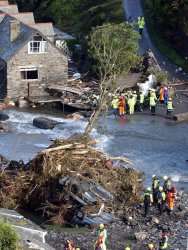
Scene of flooding at Boscastle, Cornwall in 2004. Credit: EMPICS/PA
Oxford researchers have won funding to improve the usefulness of weather predictions on the probability and extent of extreme rainfall. This will help hydrologists, civil engineers, policy-makers and government to take appropriate measures to protect buildings and people from the devastating effects of extreme floods such that in Boscastle, Cornwall, in 2004.
The new £300,000 research project at Oxford University is funded by the Natural Environment Research Council.
Dr Patrick McSharry, from Oxford University’s Department of Engineering Science, said: 'What we are doing is bringing together, for the first time, three different areas of science: mathematics, supercomputer weather prediction, and historical data.
‘We are using advanced mathematical techniques, which were originally developed for a different application. This helps us to improve the predictions we can make based on data that has already been collected. To do this we are using the vast computing power provided by new weather models. For example, there is a limit to the accuracy of data collection and tiny measurement errors can lead to increasing forecast uncertainty as you look further into the future.
'So if we can improve the mathematics to handle the uncertainty in the data and models, we can improve the accuracy of the predictions for people such as engineers and policy-makers.'
The new mathematical prediction techniques to be used in the study will be developed in collaboration with researchers at the Said Business School, who were originally looking to improve models for forecasting electricity demand.
The techniques will be used in conjunction with the output from a state-of-the-art supercomputer weather model at the European Centre for Medium-Range Weather Forecasts.
The data, on which the work will be based, will come from the largest record of historical data of UK rainfall patterns, which date back as far as 1860 when weather records were produced by amateur enthusiasts. It will be the first time that researchers will have gained access to this vast amount of data in electronic format. It will be made available by a specialist hydrologist at Hydro-GIS Ltd.
Dr Harvey Rodda, of Hydro-GIS said: ‘Accurate rainfall predictions are needed as part of the information used to design measures to protect houses built in areas which are most vulnerable to flooding. The connection between rain and flooding is complicated. It is not enough just to predict rainfall depth, but the prediction must also say how likely rain is at any time, which means calculating the probability of rainfall. Another element is the pattern of rainfall: for example, for the severe floods in Boscastle in 2004 and those on the Thames in 2003, the causes and pattern of rainfall were different, so scientists need to know what pattern of rainfall caused the flooding.’
The research will also produce an automatic system for discovering the most likely pattern in the predicted rainfalls. The new prediction system and data will be freely available over the internet for use by hydrologists, civil engineers, government policy-makers and researchers.
For more information about the Systems Analysis, Modelling and Prediction Group at Oxford University’s Department of Engineering, see http://www.eng.ox.ac.uk/samp/
Source: Oxford University
-
Spaceborne precipitation radar ships from Japan to U.S.
Feb 09, 2012 |
not rated yet |
0
-
Deconstructing a mystery: What caused Snowmaggedon?
23 hours ago |
3.8 / 5 (4) |
1
-
New insights: How soil production processes respond to erosion
Feb 08, 2012 |
5 / 5 (1) |
0
-
Climate-change effects on malaria risk
Feb 03, 2012 |
not rated yet |
0
-
Climate and the statistics of extremes
Jan 18, 2012 |
3.9 / 5 (7) |
20
-
Engineers build first sub-10-nm carbon nanotube transistor
Feb 01, 2012 |
4.9 / 5 (31) |
30
-
Something old, something new: Evolution and the structural divergence of duplicate genes
Jan 31, 2012 |
4.6 / 5 (7) |
1
-
The hidden nanoworld of ice crystals: Revealing the dynamic behavior of quasi-liquid layers
Jan 30, 2012 |
5 / 5 (3) |
1
-
Stock market network reveals investor clustering
Jan 27, 2012 |
3.9 / 5 (23) |
8
-
Of microchemistry and molecules: Electronic microfluidic device synthesizes biocompatible probes
Jan 26, 2012 |
5 / 5 (1) |
0
-
I found this. What is it?
2 hours ago
-
Derivative wrt a constant?
7 hours ago
-
Using Excel to figure out how much money I could make if I traded my dividends?
9 hours ago
-
Linear Equations (General and Standard forms: From Wikipedia)
11 hours ago
-
Elastic Collisions (Oblique Impact)
16 hours ago
-
how to scale this expression
Feb 10, 2012
- More from Physics Forums - General Math
More news stories
A frank discussion of the power law and linking correlation to causation
(PhysOrg.com) -- Michael Stumpf a mathematics professor at Imperial College in London, and Mason Porter a lecturer at Oxford have teamed together to write and publish a perspective piece in Science regarding the in ...
US workers are 'giving away the store,' costing firms billions
Nearly 70 percent of the nation's service employees give away free goods and services from hamburgers to cable TV costing companies billions of dollars a year, according to a groundbreaking study.
Other Sciences / Economics & Business
Feb 09, 2012 |
3.5 / 5 (4) |
10
Employers feel no love for unscrupulous practice of 'service sweethearting'
A new study led by two Florida State University marketing professors finds that some frontline service employees who are rewarded for hikes in customer loyalty and satisfaction also may engage in "service ...
Other Sciences / Economics & Business
Feb 10, 2012 |
3.3 / 5 (3) |
8
New insights into how to correct false knowledge
The abundance of false information available on the Internet, in movies and on TV has created a big challenge for educators.
Other Sciences / Social Sciences
Feb 07, 2012 |
4.9 / 5 (7) |
9
|
Neanderthal demise due to many influences, including cultural changes: study
As an ice age crept upon them thousands of years ago, Neanderthals and modern human ancestors expanded their territory ranges across Asia and Europe to adapt to the changing environment.
Other Sciences / Archaeology & Fossils
Feb 07, 2012 |
4.4 / 5 (5) |
8
|
Walney offshore wind farm is world's biggest (for now)
(PhysOrg.com) -- The Walney wind farm on the Irish Sea--characterized by high tides, waves and windy weather--officially opened this week. The farm is treated in the press as a very big deal as the Walney ...
GPS court ruling leaves US phone tracking unclear
A US Supreme Court decision requiring a warrant to place a GPS device on the car of a criminal suspect leaves unresolved the bigger issue of police tracking using mobile phones, legal experts say.
Europeans protest controversial Internet pact
Tens of thousands of people marched in protests in more than a dozen European cities Saturday against a controversial anti-online piracy pact that critics say could curtail Internet freedom.
Europe stakes billion-dollar bet on new rocket
A pencil-slim rocket is scheduled to lift into space from South America on Monday, carrying a billion-dollar bet that Europe can grab a juicy slice of the market to place satellites in low orbit.
Study finds that anti-diabetic medication can prevent the long-term effects of maternal obesity
In a study to be presented today at the Society for Maternal-Fetal Medicine's annual meeting, The Pregnancy Meeting, in Dallas, Texas, researchers will report findings that show that short therapy with the anti-diabetic medication ...
Netflix settlement trims 14 pct off 4Q earnings
(AP) -- Netflix pressed the rewind button on its fourth-quarter earnings after settling allegations that the video subscription service violated a consumer-privacy law.