Astronomers discover two new planets, both among the hottest ever
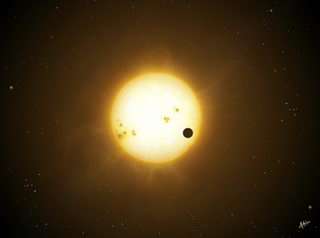
Astronomers have discovered two new planets outside our solar system, both extremely close to their stars and thus among the hottest ever found.
A University of Florida astronomer is among more than three dozen astronomers who found the new large planets, announced today at the Transiting Extrasolar Planets Workshop at the Max Planck Institute for Astronomy in Heidelberg, Germany.
Stephen Kane, a UF postdoctoral associate, said he and his colleagues pinpointed the planets by detecting the slight dimming of starlight that occurs when the planets pass in front of their stars. Of about 200 planets discovered so far, the new planets are only the 13th and 14th to be found using this technique, called the transit method. But that's likely to change quickly as the United Kingdom-based effort to discover planets with the transit method gathers steam, Kane said.
"We can expect these two planets to be the first in a wave of a whole lot of these new types of planets," he said.
Known as "Hot Jupiters" because of their Jupiter-like size and temperature, the new planets are so close to their stars that they complete their orbit in a mere two and two-and-one-half days, respectively. That compares to 88 days for Mercury, the planet with the fastest orbit nearest the sun in our solar system. The very close orbit also means that the new planets are hotter than Mercury, which has a surface temperature of 752 degrees Fahrenheit. The planets are estimated to have a temperature of at least 3,272 degrees.
There is also evidence that the solar radiation from the stars is so intense that it is whipping away their atmospheres. "Hot Jupiters are assumed to have a significantly reduced lifetime due to their proximity to the star," Kane said.
Most planets outside our solar system have been found using the radial velocity method, which measures the gravitational wobble in the star induced by the orbiting planet. The transit method would seem at first to be impractical because it requires a lucky break: The orbital plane of the planets under observation must be aligned toward Earth so astronomers can see the starlight dim as the planets pass.
The astronomers who discovered the two new planets dealt with this complication through, in Kane's words, "brute force." The astronomers surveyed millions of stars using twin telescopes snapping photos of the southern and northern skies from La Palma in Spain's Canary Islands and Sutherland, South Africa. Each telescope is equipped with eight wide-angle cameras, each of which has a field of view of eight degrees, which comprises a relatively large chunk of the sky. By comparison, the full moon comprises about half a degree.
The work was done through UK's leading planet detection program, a consortium of eight universities called SuperWASP, or Wide Angle Search for Planets.
Kane's role in the research was to help pick out from the vast numbers of photographed stars the most likely candidates for further investigation. The job was a difficult one because planets passing in front of stars only slightly diminish the starlight, dimming it by only about 1 percent for just a few hours. Kane also led the research on the prototype for SuperWASP, and has worked on both SuperWASP telescopes, among other efforts.
"We have computer programs which are able to search all of these light curves from the stars and see if there's something in them which looks like the star has become fainter for a short period, but it's a complicated task," Kane said.
After SuperWASP identified the tiny dips in starlight caused when the planets passed in front of their stars, a French-built instrument detected a slight wobble in each star's motion as the planets passed around them, confirming the existence of the planets.
The planets are located in the constellations Andromeda and Delphinius, respectively. The Andromeda planet is more than 1,000 light years away, while the Delphinius planet is 500 light years away.
Both of the new planets are far too hot to support life. But Kane said their discovery adds to growing knowledge about how planets form, which should help astronomers understand and zero in on Earth-like planets.
"Once we understand planet formation, we'll understand a lot more about how terrestrial planets form as well," he said.
Source: University of Florida


