Researchers helping to take the natural gas out of ethanol production
It takes a lot of natural gas to run an ethanol plant. A plant needs steam to liquefy corn starch and heat to distill alcohol and more heat to dry the leftover distillers grains.
Burning natural gas to produce all that heat is the second largest expense at most ethanol plants – trailing only the cost of the corn used for ethanol production. One estimate says Iowa's annual production of more than one billion gallons of ethanol accounts for about 16 percent of the state's demand for natural gas.
That has Iowa State University researchers working with an Ames company to develop a renewable and cost effective alternative to the natural gas burned by most ethanol plants.
The technology involves partial combustion of biomass – that could include corn stalks, distillers grains, waste wood or other biorenewables – to produce a mixture of hydrogen, carbon monoxide, methane and other flammable gases. The resulting mixture is known as producer gas and it can replace natural gas in an ethanol plant's heaters. The producer gas can also be upgraded to what's known as syngas, a mixture that can be converted into high-value transportation fuels, alcohols, hydrogen, ammonia and other chemicals.
Producer gas is made by injecting biomass into a fluidized bed gasifier, a thermal system that pumps air up through a bed of hot sand, creating bubbles and a sand-air pseudo fluid. A reaction between the biomass and the hot sand-air mixture produces flammable gases. The process also generates its own heat to sustain the reaction. It's a system that's reliable, produces few emissions and can be efficiently integrated into a plant's existing natural gas boilers and dryers.
Iowa State researchers Robert C. Brown, the Bergles Professor in Thermal Science and Iowa Farm Bureau Director of the Office of Biorenewables Programs; Ted Heindel, a professor of mechanical engineering; and Francine Battaglia, an associate professor of mechanical engineering, are working with Frontline BioEnergy, an Ames company that produces biomass gasification systems, to study and design a gasifier large enough to produce energy for an ethanol plant. The project is partially supported by a $132,274 grant from the Grow Iowa Values Fund, a state economic development program.
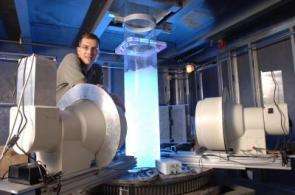
Heindel will work with Nathan Franka, a master's student in mechanical engineering, to observe and measure a fluidized bed in action. They'll use Iowa State's $640,145 X-ray flow visualization facility to see through a test bed that's six inches in diameter. They'll be looking to see what happens inside the fluidized bed when biomass is injected. Heindel will take X-ray radiography, X-ray computed tomography and X-ray stereography images of the flows to measure local conditions.
Battaglia will work with Mirka Deza, a doctoral student in mechanical engineering, to simulate the results of Heindel's tests using computational fluid dynamics. The idea is to run simulations and compare the results with data from the fluidized bed experiments. If the results don't match, the researchers will have to figure out why and the computational models may require modifications. Iowa State's "Lightning," a new high-performance computer capable of 1.8 trillion calculations per second, will provide the computational power for the simulations.
Battaglia said the validated computer models can help Frontline BioEnergy make appropriate design changes. Using the computer models to assist with the design work is much cheaper and faster than building prototypes and running experiments, she said. That's because designers can change parameters and quickly analyze how each change affects performance. Besides, she said, researchers can't look inside a real gasifier to see what's happening.
John Reardon, the research and development manager for Frontline BioEnergy, said the Iowa State research will provide the company with insights about the mixing that happens inside a fluidized bed gasifier. That will help the company design improved commercial-scale gasifiers capable of processing 300 tons or more of biomass per day. A diagnostic tool developed as part of the research project will also help the company avoid problems in the fluidized bed and maximize the reliability of those gasifiers.
All that can be a boon to an industry that produces an alternative to fossil fuel.
"Using biomass to fuel an ethanol plant can reduce ethanol costs," Reardon said. "It also hedges against volatility in the natural gas market and also doubles the renewable energy ratio of the ethanol product."
Source: Iowa State University


