Mars Kicks Up the Dust as It Makes Closest Approach to Earth
November 3, 2005 Mars Kicks Up the Dust as It Makes Closest Approach to Earth

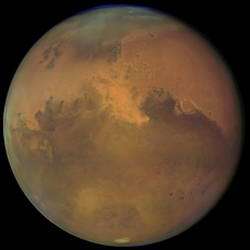
NASA's Hubble Space Telescope snapped this picture of Mars on October 28, within a day of its closest approach to Earth on the night of October 29. Hubble astronomers were also excited to have captured a regional dust storm on Mars that has been growing and evolving over the past few weeks.

The dust storm, which is nearly in the middle of the planet in this Hubble view is about 930 miles (1500 km) long measured diagonally, which is about the size of the states of Texas, Oklahoma, and New Mexico combined. No wonder amateur astronomers with even modest-sized telescopes have been able to keep an eye on this storm. The smallest resolvable features in the image (small craters and wind streaks) are the size of a large city, about 12 miles (20 km) across. The occurrence of the dust storm is in close proximity to the NASA Mars Exploration Rover Opportunity's landing site in Sinus Meridiani. Dust in the atmosphere could block some of the sunlight needed to keep the rover operating at full power.

On October 29/30, Mars and Earth reached the point in their orbits where the two planets were the closest they have been since August of 2003. The red planet, named after the Roman god of war, won't be this close again to Earth until 2018. At the 2005 closest approach Mars was at a distance of 43 million miles (69 million km), comparatively a stone's throw across the solar system. Mars goes through a 26-month cycle where its distance from Earth changes. At times when the distance is smallest between the two planets, Mars appears brighter in the sky and larger through telescopes for Earth viewers.

This image of 2005 Mars closest approach was taken with Hubble's Advanced Camera for Surveys. Different filters show blue, green, and red (250, 502 and 658 nanometer wavelengths). North is at the top of the image. Mars is now in its warmest months, closest to the Sun in its orbit, resulting in a smaller than normal south polar ice cap which has largely sublimated with the approaching summer.

The large regional dust storm appears as the brighter, redder cloudy region in the middle of the planet's disk. This storm has been churning in the planet's equatorial regions for several weeks now, and it is likely responsible for the reddish, dusty haze and other dust clouds seen across this hemisphere of the planet in views from Hubble, ground-based telescopes, and the NASA and ESA spacecraft studying Mars from orbit. Bluish water-ice clouds can also be seen along the limbs and in the north (winter) polar region at the top of the image.

Source: Space Telescope Science Institute (STScI)
Image credit: NASA, ESA, The Hubble Heritage Team (STScI/AURA), J. Bell (Cornell University), and M. Wolff (Space Science Institute)


print this article email this article download pdf blog this article bookmark this article     Stumble it Digg this share on Facebook retweet share on Reddit add to delicious
Rate this story - 4 /5 (2 votes)


November 3, 2005 all stories

Comments: 0

4 /5 (2 votes)
  • Stumble this up

  • Digg this

  • share this

  • hide
  • Related Stories

  • Scientists monitor developing Mars dust storm
    created Apr 20, 2009 | popularity not rated yet | comments 0
  • Lunar Reconnaissance Orbiter to Help Astronauts Survive in Infinity
    created Apr 17, 2009 | popularity not rated yet | comments 0
  • Mars Spacecraft Teams on Alert for Dust-Storm Season
    created Apr 16, 2009 | popularity not rated yet | comments 0
  • Join STEREO and Explore Gravitational 'Parking Lots' That May Hold Secret of Moon's Origin
    created Apr 09, 2009 | popularity not rated yet | comments 0
  • A curious pair of galaxies
    created Mar 16, 2009 | popularity not rated yet | comments 0


Other News

Mars

Life on Mars theory boosted by new methane study

Space & Earth / Space Exploration

created 12 hours ago | popularity 4.8 / 5 (16) | comments 4

Scientists have ruled out the possibility that methane is delivered to Mars by meteorites, raising fresh hopes that the gas might be generated by life on the red planet, in research published tomorrow in Earth an ...


Hubble's deepest view of universe unveils never-before-seen galaxies

Hubble's Deepest View of Universe Unveils Never-Before-Seen Galaxies (w/ Video)

Space & Earth / Astronomy

created 15 hours ago | popularity 4.7 / 5 (28) | comments 16

(PhysOrg.com) -- In 2004, Hubble created the Hubble Ultra Deep Field (HUDF), the deepest visible-light image of the Universe, and now, with its brand-new camera, Hubble is seeing even farther. This image was ...


Absence of evidence for a meteorite impact event 13,000 years ago

Absence of evidence for a meteorite impact event 13,000 years ago

Space & Earth / Earth Sciences

created 15 hours ago | popularity 4.4 / 5 (8) | comments 10

An international team of scientists led by researchers at the University of Hawaii at Manoa have found no evidence supporting an extraterrestrial impact event at the onset of the Younger Dryas ~13000 years ...


Gravestones Talking through Time

Gravestones Talking through Time

Space & Earth / Earth Sciences

created 6 hours ago | popularity 4.5 / 5 (2) | comments 0

(PhysOrg.com) -- A visit to your local graveyard can provide not only a history lesson, but a science lesson as well. Historians know that gravestones can reflect the lives of people whose memories are lost ...


Aussie galaxy survey to lead to 'new physics'

Aussie galaxy survey to lead to 'new physics'

Space & Earth / Astronomy

created 10 hours ago | popularity 4.5 / 5 (11) | comments 4

(PhysOrg.com) -- Australian astronomers have released the first set of data from the first project to look at the effects of "dark energy" halfway back in the Universe's lifetime.