2,000 Theropod teeth
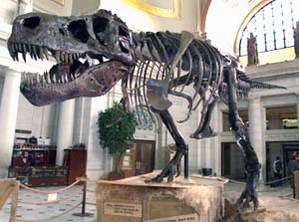
A paleontologist at Washington University in St. Louis has concocted a mathematical scheme for identifying dinosaurs based upon measurements of their copious Mesozoic dental droppings. His method could help paleobiologists identify and reconstruct the lives of the creatures that roamed terra firma many millions of years ago.
Image: Josh Smith compares tooth measurements of unidentified dinosaur species with those of known Tyrannosaurus specimens to create a preliminary — though rigorous — method of dinosaur classification.
What do you get when you cross Carcharodontosaurus with Majungatholus? Good luck telling the two apart. Owing to paltry numbers of whole specimens that fail to illuminate a range of intraspecies morphological variation, dinosaur classification can be a task as gargantuan as some of its famed species. But Josh Smith, Ph.D., assistant professor of earth and planetary sciences at Washington University in St. Louis, has concocted a mathematical scheme for identifying dinosaurs based upon measurements of their copious Mesozoic dental droppings. His method could help paleobiologists identify and reconstruct the lives of the creatures that roamed our terra firma many millions of years ago.
Smith, who claims he's "not very good at math," and his coauthors, David R. Vann and Peter Dodson of the University of Pennsylvania, devised a quantitative methodology by which an isolated tooth of a predatory dinosaur — a theropod — can be correlated with a given genus. They used a variety of measurements — some of which had been defined by previous workers — that describe the basic size and general shape of the teeth as well as devised functions that help quantitatively describe the shapes of the curved surfaces possessed by the teeth. The result was a preliminary but rigorous method of classifying theropod teeth with established genera. Smith and his colleagues published their in work in a recent issue of The Anatomical Record (Vol. 285, 2005).
"My whole point was to take an isolated tooth and figure out what dinosaur it belonged to," Smith explained. "The questions I'm interested in are different than 'what did this thing eat?' I'm interested more in teeth as tools for dinosaur identification rather than the teeth as teeth themselves."
Teeth as hardy identifiers
People like teeth. The same mineral that helps us chaw our way to Thanksgiving bliss allows paleontologists like Smith to study a time period so far removed from our own that traces of bones and enamel are among the only clues to the past. Mesozoic-aged dinosaurs, living between 225 and 65 million years ago, are referred to as polyphyodont animals because they continually shed and replaced teeth throughout their lives. Tooth replacement introduces the hardest and most resilient substance in the vertebrate body, enamel, into the local environment many times over as old teeth are lost and fall from the mouths of their owners into streams and onto the forest floor. After countless tooth replacements and millions of years of sedimentation, Smith and his colleagues have uncovered an ample data set of preserved dinosaur enamel: Smith's Rosetta stone of theropod classification.
"The problem is that theropod teeth are simple enough that everyone has ignored them for the last 200 years, " Smith said. He said that the simple shapes of theropod teeth have complicated previous rigorous attempts to use them for classification.
The mathematical tedium Smith claims to have spared while devising the methods was not lost on tooth examination: Smith collected measurements and curvature data from about 2,000 teeth, scrutinizing dinosaur chops as a dentist would a root canal. Thousands of measurements ultimately boiled down into a data set of just under 300 usable teeth. The dataset is comprised of measurements of teeth from genera that are known with certainty; it thus forms a standard of comparison against which unknown teeth can be compared.
Smith then ran statistics on the database to correlate the shapes of unknown teeth with the most similar tooth of known origin. During a test of the methods, most of the time the model worked, correctly identifying known, and even similar-looking teeth as the correct genus.
"I've created the beginnings of a standard of comparison; a data set with teeth that we know where they came from, against which to compare isolated teeth. That's basically all I've done," Smith said.
He said that the model, although functional, isn't without its weaknesses. To properly correlate a tooth with a species, the species that the tooth belongs to must be represented in the data set; otherwise, the analysis will try to match the tooth with the species that most resembles the unknown.
Increasing the data set
"So now I'm working on making the method better and increasing the size of the data set," Smith adds.
Dinosaur identification is critical for paleontologists trying to accurately reconstruct the Mesozoic Period. Teeth can reveal dinosaur eating habits and biology if the tooth is associated with its rightful owner.
"We're taking a potential data set — that is, isolated teeth — that has the potential to be really powerful," Smith said, "Until now, the data have largely been overlooked but we're trying to make use of them. And it looks like it's working. Which is only really significant because everybody said it wouldn't."
Source: Washington University in St. Louis (By Alison Drain)


